





 Portuguese
  English
  Spanish
  7 min of reading
  0 comments


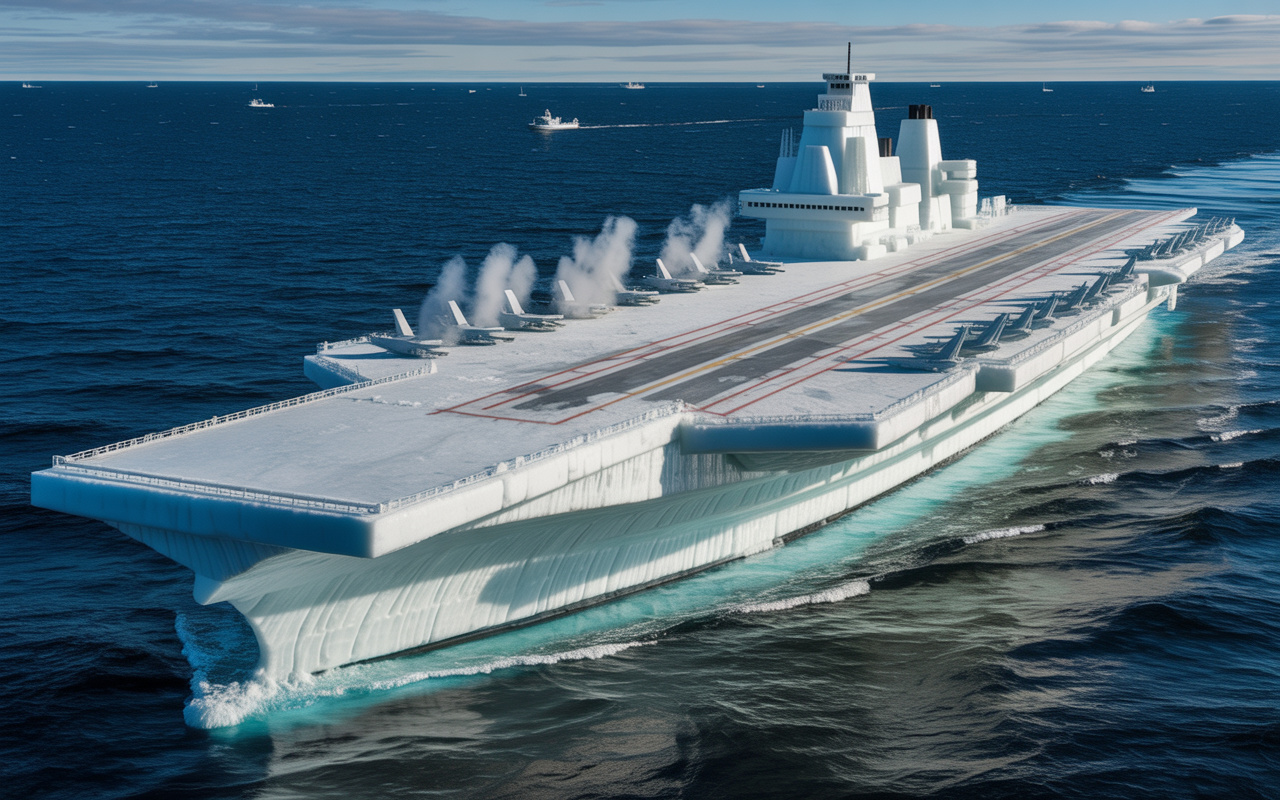
United Kingdom and Canada Tested “Reinforced Ice” in 1943 and Planned an Aircraft Carrier Up to 600m for the Atlantic; Project Habakkuk Almost Became Reality.
The central fact of this story took place on the axis of United Kingdom–Canada, between 1942–1944, at the height of World War II. The prototype that proved the concept was built on Lake Patricia, within Jasper National Park, in the province of Alberta, Canada, in 1943, with the participation of the National Research Council of Canada and British military coordination around the Combined Operations Headquarters. The material concept originated from inventor and strategist Geoffrey Pyke, and the project reached the highest political level when endorsed by Prime Minister Winston Churchill in internal wartime discussions during that period.
This is the true story of a plan that seems like science fiction: to build a gigantic aircraft carrier using ice, sawdust, and refrigeration, as if it were an artificial iceberg capable of carrying planes across the Atlantic.
Project Habakkuk and the “Hole” in Aerial Protection in the Atlantic
To understand why anyone would even consider an ice ship, we need to go back to the problem that pressured the Allies in 1942.
-
Friends have been building a small “town” for 30 years to grow old together, with compact houses, a common area, nature surrounding it, and a collective life project designed for friendship, coexistence, and simplicity.

-
This small town in Germany created its own currency 24 years ago, today it circulates millions per year, is accepted in over 300 stores, and the German government allowed all of this to happen under one condition.

-
Curitiba is shrinking and is expected to lose 97,000 residents by 2050, while inland cities in Paraná such as Sarandi, Araucária, and Toledo are experiencing accelerated growth that is changing the entire state’s map.

-
Tourists were poisoned on Everest in a million-dollar fraud scheme involving helicopters that diverted over $19 million and shocked international authorities.


The North Atlantic was the main logistical route between North America and Europe, and convoys were frequently attacked by German submarines. There was an “gap” in aerial coverage over areas too far for land-based planes while also being outside the constant range of available aircraft carriers and escorts.

The traditional response was simple on paper and difficult in practice: produce more aircraft carriers and escort ships, in addition to expanding the range of maritime patrol aircraft.
However, naval production requires time, steel, shipyards, and an industrial chain contested by all war programs. It was in this urgent window that “impossible” ideas began to be treated as viable alternatives.
Project Habakkuk was born right there: if there’s a shortage of steel, a shortage of ships, and a shortage of tonnage, then build a floating base with a material abundant in the Northern Hemisphere and durable enough to survive in ice and at sea: ice itself. But not just any ice.
Pykrete: the “Ice with Fibers” that Doesn’t Behave Like Ice
The technical heart of Project Habakkuk is the material known as pykrete, associated with the name of Geoffrey Pyke. The logic was to create a simple composite: ice mixed with wood fibers (like sawdust). This completely changes the behavior of the block, as the fibers act as internal reinforcement, reducing cracks and distributing stresses.
In practice, pykrete ceased to be “a fragile ice that cracks and shatters” and began to behave like a structural material, much more resistant to impacts.
The idea was not to make the ship indestructible in an absolute sense, but to create a structure that wouldn’t easily sink, that could absorb local damage and be repaired without collapsing like a perforated metal hull.
The point that turned this concept into something serious was the combination of two characteristics: resistance and slow melting. A block of pykrete tends to melt more slowly than pure ice because the fibers alter thermal conduction and create an internal matrix that holds the shape for longer. It’s as if the ice gained “armor” inside.
The Prototype on Lake Patricia in 1943 and Why It Was Decisive
The most important part of this story is that it was not just theoretical. In 1943, a prototype was built on Lake Patricia, in Alberta, within Jasper National Park, with technical support from the National Research Council of Canada.
This prototype had modest dimensions compared to the final plan, but it was large enough to demonstrate the critical points: flotation, stability, material integrity, and maintenance through refrigeration.

The choice of Canada was not random. Besides offering climate and infrastructure suited to the experiment, it was a way to test the behavior of pykrete under controlled conditions, away from the operational risks of the Atlantic.
The prototype incorporated a refrigeration system to keep the body frozen, which already anticipates the great contradiction of Habakkuk: building an “ice” ship actually required a ship with active thermal engineering, energy, piping, and constant maintenance.
Even so, the experiment achieved its goal. The prototype lasted for months and demonstrated that the notion of a large floating structure of pykrete was technically possible. The question shifted from “Can it be done?” to “Is it worth doing?”.
Aircraft Carriers Up to 600 Meters: When Size Becomes Strategy
The studies of Project Habakkuk even proposed a gigantic ship, with an estimated length of up to 600 meters, something that would place the project in its own category, above any conventional aircraft carrier of the time.
The projected width, in the range of dozens of meters, would allow for an extensive runway and greater aircraft capacity, in addition to internal space for refrigeration machines, accommodations, workshops, and storage.
In this case, size was not showmanship. It was part of the survival logic. A pykrete “ice carrier,” being bulky with thick walls, could tolerate localized damage without immediate loss of buoyancy. Instead of relying solely on metallic watertight compartments, the mass of the body itself would function as a physical barrier against explosions, collisions, and surface penetrations.
This is where the project begins to sound almost mythical, but the reasoning was straightforward: if the Atlantic had stretches without aerial coverage, then you position a platform large enough to operate aircraft and durable enough not to need frequent returns to port. The Habakkuk was intended to be, in practice, a “mobile war island.”
Internal Refrigeration and the Challenge of Keeping an Iceberg Afloat
The greatest enemy of an ice ship is not the torpedo. It is the physics of heat. Even in the North Atlantic, the ship would need to keep parts of the hull at a stable temperature, avoid deformations, control cracks, and maintain the geometry necessary for a landing strip.
The designed solution was an internal distributed refrigeration system, with pipes and insulated sections capable of continuously removing heat from the pykrete body. This required energy generation, maintenance, redundancy, and thermal control engineering.
In practice, Habakkuk would not be “a block of ice floating.” It would be a thermal machine the size of a lying skyscraper, trying to overcome nature constantly to maintain the structural material within the correct physical regime. And the larger the ship, the greater the thermal inertia, which helps but also increases the complexity of the system and operational costs.
This was one of the points that weighed against the project: it would save steel in the hull, but would require steel, copper, machines, piping, and an entire industrial system to enable refrigeration and life on board.
Why Project Habakkuk Lost Momentum Between 1943 and 1944
Even having moved past the “idea” stage, Habakkuk faced an unbeatable adversary: the rapid evolution of the war itself. Between 1943 and 1944, the Allies began to close the “aerial gap” in the Atlantic with real improvements that did not require an ice ship.
Naval and aeronautical production gained momentum. Patrol aircraft with greater range and better detection capability, along with new tactics, radars, and escorts, reduced the vulnerability of the convoys. Meanwhile, the availability of escort carriers and the reorganization of the industrial effort took away the strategic urgency that sustained Habakkuk.
This led to the final point: cost and time. For Project Habakkuk to have real military value, it would need to be ready before conventional solutions resolved the problem. However, the scale of the project was so large that it pushed the schedule and budget into a risk zone. When the war offered “good enough” alternatives faster, Habakkuk became an experimental luxury.
In 1944, the program was abandoned. Not because it was impossible, but because it was no longer necessary.
What Habakkuk Reveals About War, Engineering, and Human Limits
Project Habakkuk is one of those cases where history seems exaggerated until you look at the three pillars: location, source, and date. The prototype existed in 1943, on Lake Patricia, in Alberta, with institutional participation from the National Research Council of Canada, within an effort where the United Kingdom sought solutions for the Atlantic.

The concept of the material is linked to the name of Geoffrey Pyke, and the project reached the British political summit with discussions and endorsement from Winston Churchill in 1942, when the war demanded out-of-the-box ideas.
What makes this fascinating is not just the idea of “ice + sawdust.” It’s the reasoning behind it: when logistics become the center of war, everything else reorganizes. Habakkuk is a response to a brutally simple question: how to keep aircraft close to the enemy long enough to protect vital routes?
It also exposes the other side of engineering: there is no magic solution. Replacing steel with ice does not eliminate costs; it just changes where the costs appear. Habakkuk would save metal hulls but would charge in refrigeration, energy, maintenance, and operational complexity.
Why This Story Still Seems “Impossible” Today
The image of an ice aircraft carrier is so counterintuitive that it has become a folk legend and is sometimes treated as a myth. However, Habakkuk is a documented case of a real project, with a real test, at the right coordinates and the right time. It existed as a program because the world was literally betting the survival of nations on the math of logistics.
In the end, it became a rare symbol: a project that was technically viable, politically considered, and strategically abandoned because the world changed too quickly.
And that, in itself, is one of the most impressive military curiosities ever recorded: a moment when World War II almost launched an armed artificial iceberg into the sea, with a landing strip, internal refrigeration, and ambitions to dominate the Atlantic.










-

-

2 pessoas reagiram a isso.