





 Portuguese
  English
  Spanish
  4 min of reading
  1 comment


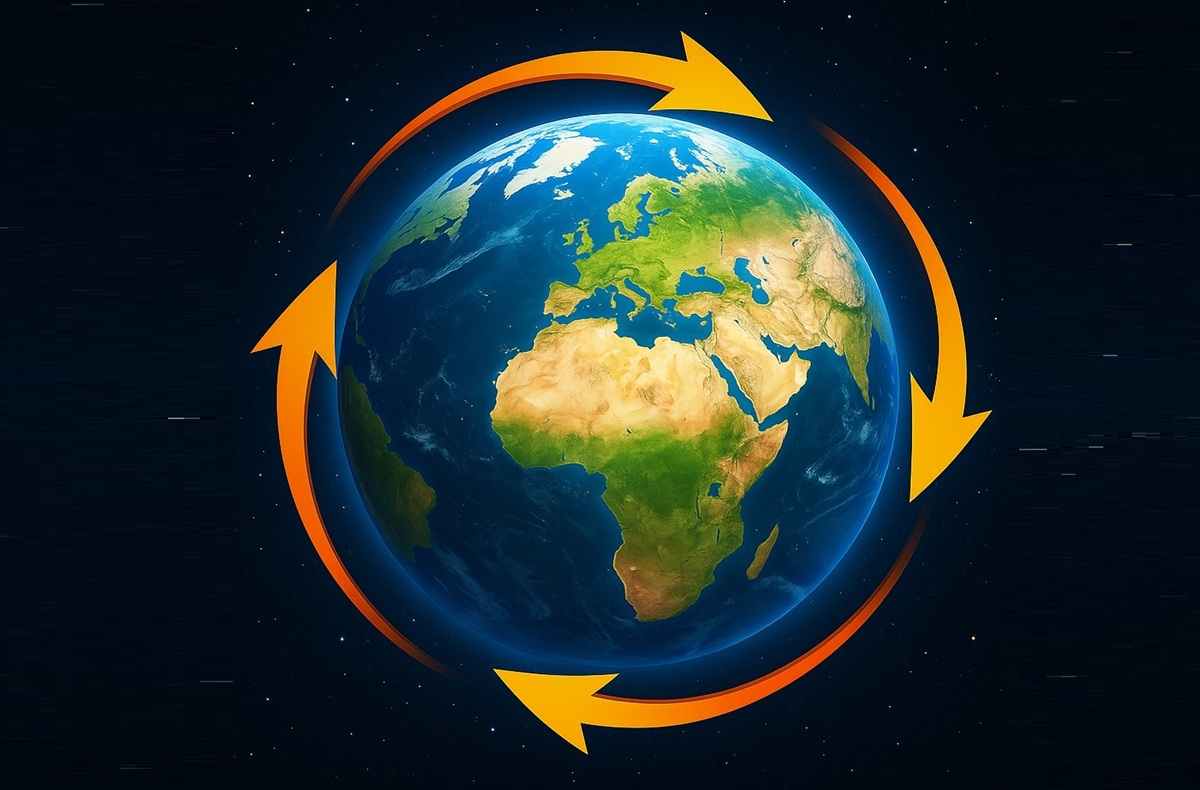


Scientists Predict Shorter Days In July And August, But Still Don’t Fully Understand Why The Earth Is Spinning Faster.
The Earth will spin faster in the coming months. The prediction from astronomers and specialized centers indicates that, in July and August, the planet’s rotation is expected to accelerate again, going against what was considered a natural trend: that the rotation would gradually slow down over time.
This information surprised even experienced specialists, who admitted they do not have conclusive explanations for this phenomenon.
Changes Registered Over Time
The Earth’s rotation has undergone many changes. Today, the planet completes just over 365 spins on its axis during the time it takes to make one orbit around the Sun — which defines a year. However, hundreds of millions of years ago, this number was quite different.
-
Motorola launched the Signature with a gold seal from DxOMark, tying with the iPhone 17 Pro in camera performance, Snapdragon 8 Gen 5 that surpassed 3 million in benchmarks, and a zoom that impresses even at night.

-
Satellites reveal beneath the Sahara a giant river buried for thousands of kilometers: study shows that the largest hot desert on the planet was once traversed by a river system comparable to the largest on Earth.

-
Scientists have captured something never seen in space: newly born stars are creating gigantic rings of light a thousand times larger than the distance between the Earth and the Sun, and this changes everything we knew about stellar birth.

-
Geologists find traces of a continent that disappeared 155 million years ago after separating from Australia and reveal that it did not sink, but broke into fragments scattered across Southeast Asia.

Scientists analyzed ancient corals and found that, between 444 and 419 million years ago, the Earth made 420 complete rotations around its axis in one year.
In other words, days were shorter, and the year had more days.
This was possible because corals grow daily and deposit thin layers of calcium. These layers vary according to the season of the year.
By counting the deposits, researchers were able to estimate the number of days in an ancient year.
The change in rotation occurred mainly due to the influence of the Moon. Over time, the Moon has been moving away from the Earth. This distance causes an effect that slows the planet’s spin, at an estimated rate of 1.8 milliseconds per century.
High Precision Measurements
In recent decades, scientists have been precisely tracking the planet’s rotation using atomic clocks. This monitoring has made it easier to detect small, but significant, variations in the duration of days.
Under normal circumstances, when the Earth spins more slowly, an additional second — known as a leap second — can be added to adjust sensitive systems like GPS. However, since 2020, what has been observed is the opposite: the rotation has been accelerating.
In 2020, the 28 shortest days since 1960 were recorded. And this pattern has continued. Each year, a new record for the “shortest day” has been set. The most recent, in 2024, was 1.66 milliseconds shorter than the normal 86,400 seconds.
Forecasts For July And August
The current forecast indicates that July and August 2025 should bring new shortened days. The website Timeanddate.com, based on data from the International Earth Rotation and Reference Systems Service (IERS) and the United States Naval Observatory, reported the following records:
- July 9: day 1.30 milliseconds shorter;
- July 22: 1.38 milliseconds shorter;
- August 5: 1.5 milliseconds shorter than the standard.
If this is confirmed, they will be the shortest days of the year.
The Moon And Its Position
Although the Moon is pointed out as the main cause of the Earth’s slowdown over time, it can also cause acceleration at certain moments. When it is closer to the Earth’s equatorial line, its resistance to the Earth’s movement increases. When it moves away from this region, this influence decreases.
In the days predicted for July and August, the Moon will be farther from the equator. This may explain part of the predicted acceleration. However, this explanation only covers part of the phenomenon.
A Still Mysterious Phenomenon
Since 1972, 27 leap seconds have been added to compensate for the Earth’s slowdown. But, since 2016, no additional second has been necessary. In June of this year, the IERS confirmed that there will be no leap second.
This change in pattern was not expected. Physicist Judah Levine from the National Institute of Standards and Technology (NIST) stated in 2021 that scientists expected the Earth to continue spinning more slowly. For him, the absence of this adjustment need surprised the scientific community.
The specialist in Earth’s rotation Leonid Zotov from Moscow State University reinforced this view. He stated that the cause of the acceleration has not yet been explained and that the available atmospheric and oceanic models are not sufficient to justify the current phenomenon.
Impact Of Earthquakes On Rotation
Besides the Moon, there are other factors that interfere with the planet’s spin. One example is earthquakes. In 2011, a magnitude 9.0 earthquake struck Japan. The impact was so strong that the Earth’s axis shifted by about 17 centimeters, and Japanese territory moved approximately 2.4 meters.
This earthquake slightly altered the Earth’s rotation, shortening days by about 1.8 microseconds. This occurs because mass movement in the Earth’s crust can change how the planet spins.
Dr. Richard Gross from NASA’s Jet Propulsion Laboratory compared the effect to that of a figure skater.
When she pulls her arms close to her body, she spins faster. In the case of the Earth, earthquakes cause a similar movement by redistributing mass closer to the axis.
He explained that by analyzing mass models before and after the earthquake, it is possible to calculate how the rotation was affected. In 2004, an earthquake in Indonesia also accelerated the rotation, decreasing the day by 2.68 microseconds.
The IERS will continue to monitor the duration of days with precision. Based on these records, it will be possible to know if the days in July and August 2025 will indeed be the shortest in recent years.
If the forecasts are confirmed, scientists may have more clues to understand why the Earth is spinning faster. Until then, the planet’s rotation will continue to be observed with attention and some mystery.
With information from iflscience.







onde está a surpresa, se rodar mais rápido os dias ficam mais curtos.
Na Bíblia diz, no final dos tempos encurtamento os dias para que meu povo não sofra.