





 Portuguese
  English
  Spanish
  3 min of reading
  0 comments


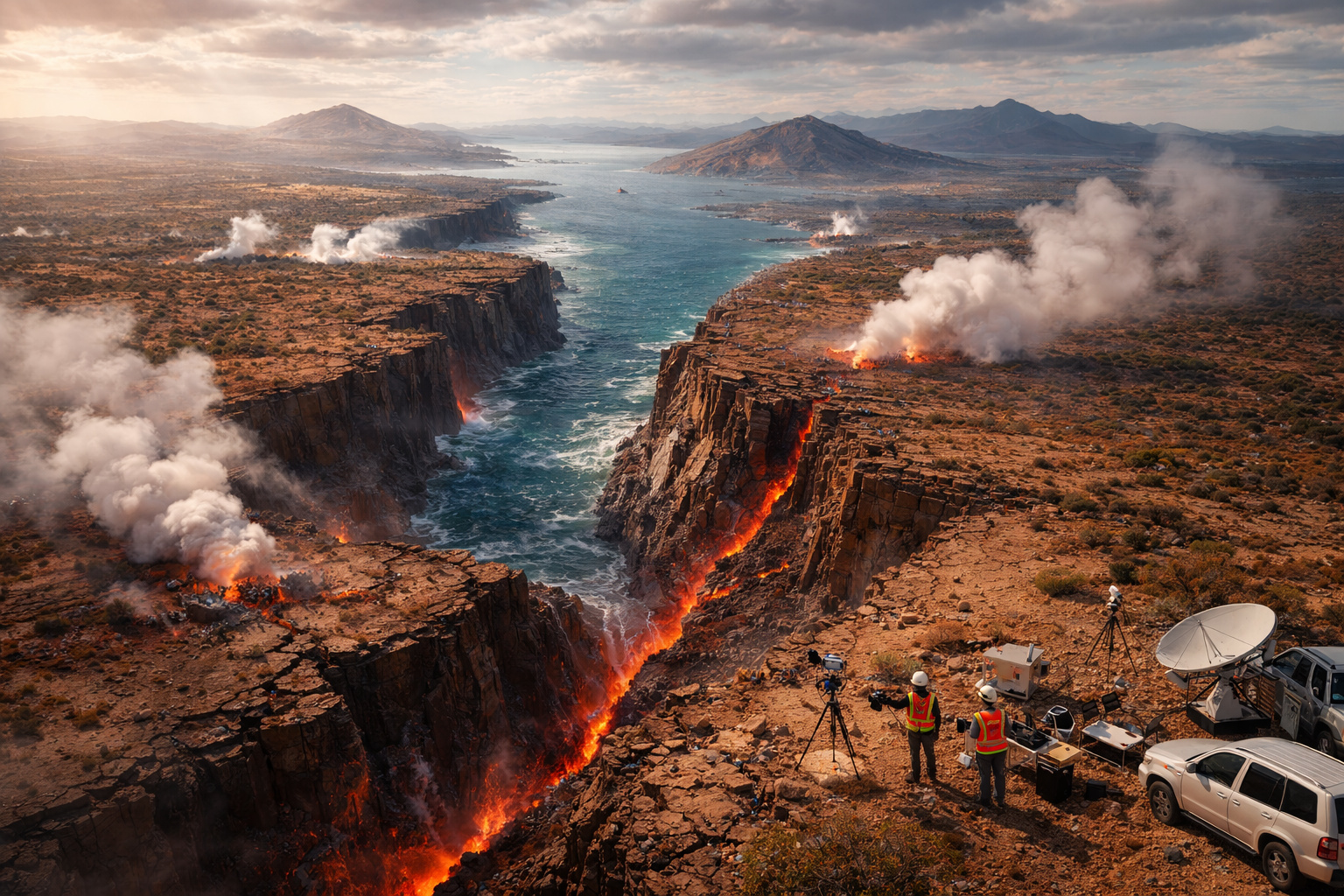
Tectonic Changes Underway in East Africa Indicate That a New Ocean May Arise Over Millions of Years, Transforming the Geographic Configuration of the African Continent
A large-scale geological process is underway in East Africa and has already been documented by the international scientific community.
According to a study published in the journal Geophysical Research Letters, a global reference in geoscientific research, the phenomenon is directly linked to the evolution of the East African Rift, one of the largest active tectonic structures on the planet.
The rift system extends from Jordan to Mozambique, as described by the Encyclopædia Britannica, crossing strategic regions of the continent.
-
Motorola launched the Signature with a gold seal from DxOMark, tying with the iPhone 17 Pro in camera performance, Snapdragon 8 Gen 5 that surpassed 3 million in benchmarks, and a zoom that impresses even at night.

-
Satellites reveal beneath the Sahara a giant river buried for thousands of kilometers: study shows that the largest hot desert on the planet was once traversed by a river system comparable to the largest on Earth.

-
Scientists have captured something never seen in space: newly born stars are creating gigantic rings of light a thousand times larger than the distance between the Earth and the Sun, and this changes everything we knew about stellar birth.

-
Geologists find traces of a continent that disappeared 155 million years ago after separating from Australia and reveal that it did not sink, but broke into fragments scattered across Southeast Asia.

This extensive rift results from the gradual separation of the ancient African plate into two large blocks: the Somali Plate and the Nubian Plate, which simultaneously interact with the Arabian Plate.
Technical Investigation Confirms Plate Movement
For decades, scientists considered that the East African Rift could represent the point of future continental division.
However, concrete evidence gained prominence in 2005, when a large fissure opened in the Afar Desert, Ethiopia, within a few days. The event was regarded as an important landmark to reinforce the tectonic theory in the region.
Later, in 2018, satellite images allowed for deeper analysis of the fissure’s dynamics, providing more precise data on plate displacement.

According to marine geologist Ken Macdonald, in an interview with NBC News, GPS measurements reveal that the plates move a few millimeters per year.
According to the researcher, the greater the number of accumulated measurements, the better the understanding of what is occurring within the Earth’s crust.
Formation of Oceanic Ridges and Possible New Ocean
The analyses showed that, in the Afar region, the tectonic plates are moving apart at distinct speeds.
This combined separation forms the so-called oceanic ridge system, a typical environment where new oceans begin to develop.
As Macdonald explained, the Gulf of Aden and the Red Sea may, in geological future, flood the Afar region and the Rift Valley.
If this occurs, part of East Africa could transform into a new ocean, and a portion of the territory could become a small separated continent.
It is worth mentioning that both the Red Sea and the Gulf of Aden were also formed by similar rifting processes.
In addition, scientists observe that the formation of oceanic crust can already be identified, as its composition and density differ from those of continental crust.
Seismic Activity Reinforces Tectonic Dynamics
The eastern arm of the Rift Valley remains geologically active.
According to Dr. Edwin Dindi from the Department of Geology at the University of Nairobi, in a statement to Kenyan Broadcasting Corporation, the region experiences various frequent tremors.
This seismic activity confirms that the tectonic process continues to evolve.
Geological Timeline and Gradual Transformation
Despite the accumulated evidence, the complete formation of a new ocean will not occur in the short term. According to Dr. Dindi himself, millions of years will be needed for the transformation to solidify.
Thus, although the phenomenon is already underway, it follows the natural rhythm of deep geological processes.
The East African Rift represents one of the clearest examples of how the Earth’s internal dynamics continue to reshape continents and oceans over time.
In light of these slow yet continuous transformations, what will the planet’s map look like when these tectonic forces complete their natural cycle?








-

-

-

-

-

-

61 pessoas reagiram a isso.