





 Portuguese
  English
  Spanish
  6 min of reading
  0 comments


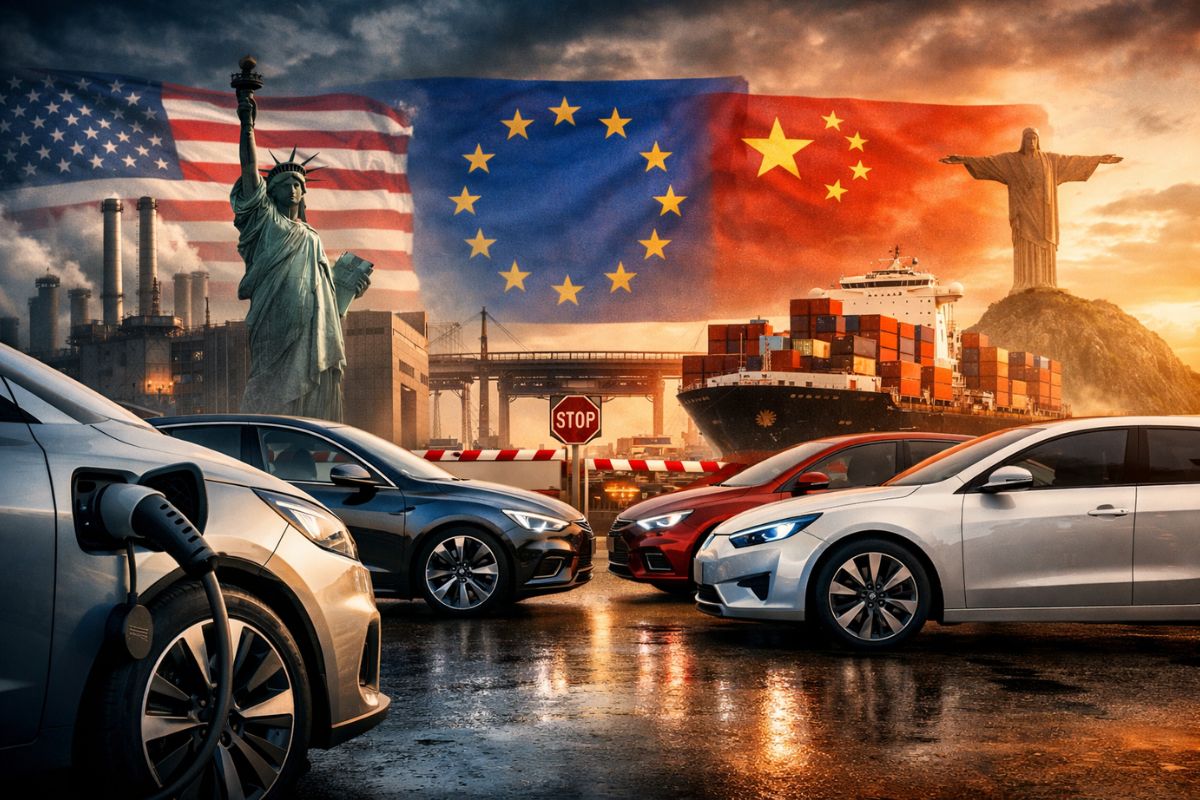
With Electric Cars at the Center of the New Industrial Geopolitics, the Advantage Shifted from Environmental Discourse to Production Logic: Those Who Dominate Batteries, Scale, and Local Supply Chains Capture Investment, Jobs, and Exports; Those Who Delay Strategic Decisions Risk Becoming Just a Consumer Market for Ready-Made Imported Vehicles.
The electric car has ceased to represent mere innovation in the automakers’ yard and has become the centerpiece of an industrial competition involving the state, mineral supply chains, energy, and manufacturing capacity. This shift gained momentum as large-scale Chinese production reduced battery costs over the past decade, pushing technology into the mass market.
With the United States and Europe raising trade barriers, a significant portion of investments began to seek new production bases in emerging economies. According to the insideevs portal, in this repositioning, Brazil came onto the radar for combining a predominantly clean energy matrix, a consolidated automotive base, and access to strategic minerals, but still faces regulatory delays and mixed signals from industrial policy.
The Transition to Electric Cars Moved from an Environmental Agenda to the Competition for the Value Chain

For years, the debate on electric mobility was treated as a sustainability issue, focusing on emissions and climate goals. This axis remains important but no longer solely explains the current race. What has changed is the economic weight of the transformation, because those who control the most valuable stages of the electric car also control income, technology, and international negotiating power.
-
The government requests the Federal Revenue Service for a new system to automate the income tax declaration, reducing errors, time, and bureaucracy for millions of Brazilians.

-
Pix in installments, international Pix, and contactless payment without internet: the Central Bank revealed the new features coming to the tool that is already used by almost every adult in Brazil.

-
Mercado Livre has just started selling medications with delivery in up to three hours to your door, and this move could completely change the way Brazilians buy medicines on a daily basis.

-
In Dubai, rising tensions from the war in the Middle East are causing super-rich individuals to leave the Gulf and direct their fortunes to a new financial refuge in Asia.


The industrial reading became clearer with the consolidation of battery electric vehicles as the dominant platform of the new automotive phase. When a country attracts local assembly, component suppliers, software development, and battery integration, it captures a comprehensive package of productive activity. When it does not, it becomes a high-value importer and exporter of demand.
This is where the discussion becomes strategic. The question is no longer whether electrification is advancing because it is. The question is who will produce what, where, and with what technological margin, and how much of this wealth will remain in the national territory in the form of skilled jobs, revenue, and innovation capacity.
China Changed the Scale Benchmark and Pushed the Electric Car to the Center of the Market
The major disruption came from Chinese industrial scale. Instead of treating the electric car as a high-priced niche, China organized production volume, supply chain inputs, and manufacturing learning at an accelerated pace. The result was a significant drop in battery costs and an increase in supply for different consumer segments.
This movement was not restricted to the domestic market. Chinese manufacturers began to compete for space in other countries with a combined strategy of price, embedded technology, and speed of launch.
When scale reduces cost and shortens the development cycle, competition ceases to be gradual and becomes immediate pressure on traditional automakers.
In practice, China not only sells more vehicles. It influences product standards, redefines consumer expectations, and forces reevaluations in the industrial policies of other blocs. This explains why the discussion on electric cars has moved to the center of decision-making for governments, companies, and global supply chains.
US and Europe Closed Doors to Protect Local Industry but Opened New Routes for Emerging Markets
Faced with the rapid advance of Chinese electric vehicles, the United States and Europe adopted higher tariffs and industrial protection mechanisms. The logic is clear: preserve internal productive capacity, reduce external vulnerability, and buy time to reorganize local competitiveness. Trade barriers, in this context, are economic instruments, not technical details.
However, every barrier generates displacement. Part of the global investment that would face higher costs to enter these markets seeks alternatives in countries with industrial potential, significant consumer markets, and favorable energy conditions.
Thus, emerging economies have come to be seen as platforms for productive expansion and not merely sales destinations.
This reconfiguration changes the map of automakers’ decisions. Where the choice was once merely to open markets, now the choice involves building ecosystems.
Where it used to be enough to import, there is now increasing pressure for local production, supplier integration, and long-term commitments to technology. It is in this rearrangement that Brazil gained centrality.
Brazil Came Onto the Radar of Electric Cars but Needs to Turn Potential Advantage into Real Advantage
Brazil brings together attributes that weigh in the new industrial geography. The predominantly clean energy matrix improves the environmental competitiveness of production, the presence of strategic minerals increases relevance in the supply chain, and the already installed automotive base reduces the entry cost for new operations. This is not starting from scratch; it is a platform with concrete assets.
Furthermore, the country carries historical experience in technological transitions in the automotive sector, such as ethanol and flex-fuel vehicles.
This history proves the capacity for institutional and business adaptation when there is coordination between regulation, investment, and demand. In a global competition for electric cars, industrial memory matters, as long as it is accompanied by execution.
The problem is that potential advantage does not automatically convert into results. Regulatory delays, direction noise, and mixed signals from industrial policy can slow projects and raise the risk of defensive decisions.
When this happens, the country risks receiving end products but failing to capture the most valuable stages of engineering, development, and export.
The Strategic Dilemma Became Explicit: Produce Technology and Jobs or Just Increase Consumption of Imports
The growing presence of Chinese manufacturers in Brazil is a sign of structural change, not merely a short-term commercial dispute.
It can pave the way for new factories, knowledge transfer, supplier formation, and regional scale gains. But it can also be limited to market occupation if there is no clear design for local content and innovation.
In other words, the center of Brazilian decision-making is not in the abstract debate about the future. It lies in the concrete architecture of industrial policy, with regulatory predictability, feasible goals, and incentives aligned with local production of greater value.
Without a coherent strategy, the country participates in electrification as a customer; with a coherent strategy, it participates as an industrial protagonist.
This is the decisive point of the decade. The electric car is already reorganizing chains, investments, and production hierarchies.
If Brazil uses this window to combine industry, technology, and international integration, it can create a virtuous cycle of employment and export. If it hesitates, it may consolidate technological dependency at the very moment when the world is redefining the automotive industry.
The competition for electric cars is not just about mobility; it is about economic positioning in the next global cycle. Brazil is already on the radar of factories, but being on the radar is not a guaranteed destination.
What defines the outcome is the speed of decision-making and the quality of the industrial strategy adopted now.
If you had to choose the country’s immediate priority, what would it be: demand progressive local production, accelerate incentives for battery technology in the national territory, or reduce barriers to lower import costs and quickly expand adoption? And why would this choice make a real difference in your region in the coming years?









-

-

-

5 pessoas reagiram a isso.