





 Portuguese
  English
  Spanish
  6 min of reading
  1 comment


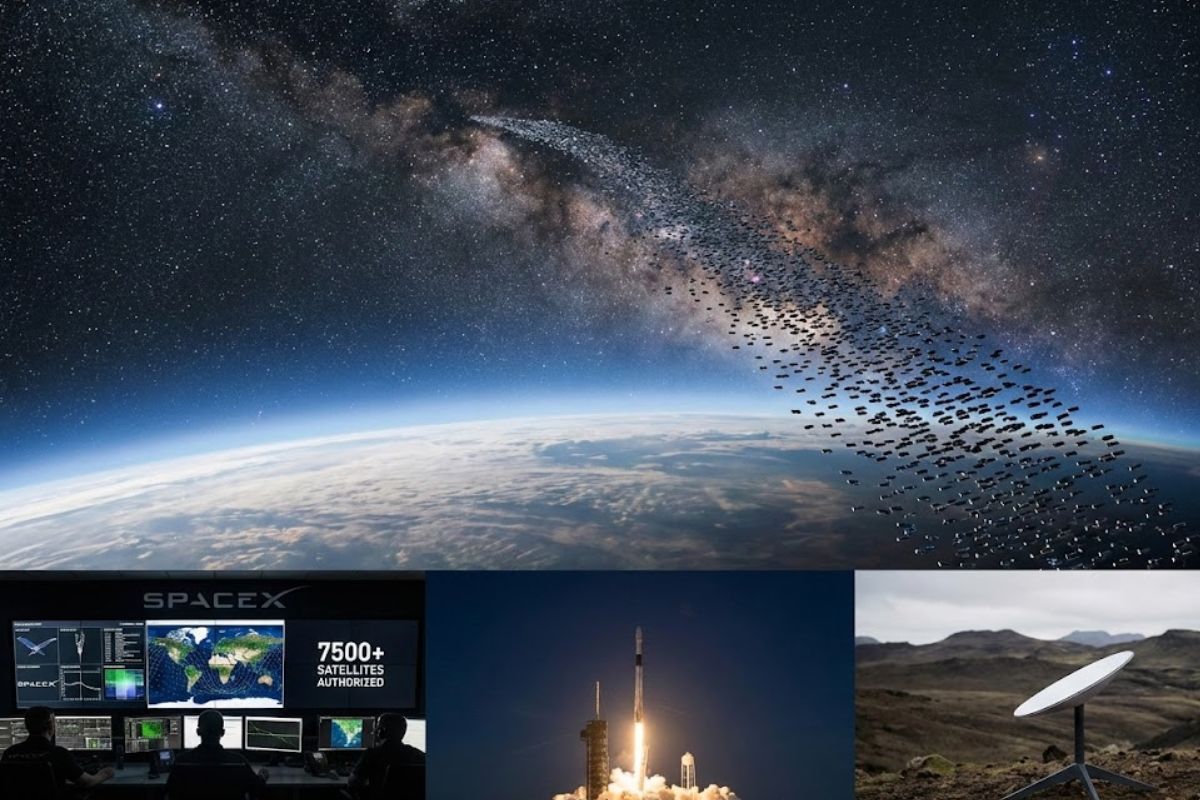

The FCC Authorized Elon Musk’s SpaceX to Launch an Additional 7,500 Units of Starlink Gen2 into Space, Raising the Limit to About 15,000 Satellites in Orbit. The License Removes Old Restrictions, Imposes Deadlines Until 2028 and 2031, and Expands the Debate on Collisions, Debris, and Nighttime Astronomical Observation.
At the center of the new race for global connectivity, Starlink has received regulatory approval to accelerate the expansion of its network: the Federal Communications Commission of the United States authorized SpaceX to launch an additional 7,500 satellites from the Starlink Gen2 project, bringing the total to about 15,000 that can be maintained in orbit. The decision doubles the planned operational presence and repositions the competition for space internet.
The authorization was seen as a strategic victory, but it came with warnings that grow in line with the fleet. The larger the megaconstellation, the greater the risk of orbital congestion, with potential impacts on orbital safety, debris generation, and night sky observation by astronomers, in addition to requiring increasingly complex management of space traffic.
What the FCC Authorized and How Starlink Will Operate on a New Scale
The FCC authorized SpaceX to launch an additional 7,500 satellites from Starlink Gen2, raising the total limit to approximately 15,000 units that Elon Musk’s company can maintain in orbit.
-
A British startup creates tires that generate electricity in electric vehicles when passing over potholes, speed bumps, and cracks.

-
Scientists have created robots made with living cells that have their own nervous system, swim on their own, explore the environment, and self-organize without any genetic engineering, and now they want to do the same with human cells.

-
Students create a solar-powered ambulance that operates without a plug, without fuel, and still keeps medical equipment running in remote areas.

-
French “ghost” submarine lost in World War II reappears after more than 80 years on the seabed near the coast of Spain.


The authorization is significant because it changes Starlink’s operational scale and supports the plan to expand the global satellite internet offering.
Initially, SpaceX had requested authorization to launch 30,000 second-generation satellites. The regulatory body, however, limited the permitted number by half.
Even so, the approval was seen as a victory because it ensures critical mass to maintain leadership in the sector and expand coverage and capacity in markets where Starlink seeks to grow.
Why Starlink Gen2 Is Central to the Space Internet Competition
The authorization reinforces Starlink’s strategic character as connectivity infrastructure.
The stated goal is to expand the global satellite internet offering, which directly depends on satellite density in orbit, simultaneous servicing capacity, and network stability to sustain the user experience.
With approval for an additional 7,500 satellites, Starlink raises the operational ceiling and strengthens its competitive position in a global competition where scale is often an advantage.
The more active satellites, the greater the service capacity and the greater the pressure to manage interference and orbital traffic.
What Changed with the Revocation of Requirements and Its Effect on Network Capacity
The new decision revokes previous requirements imposed by the United States government that prevented coverage overlap between satellites and restricted network capacity expansion.
In practice, this opens up space for Starlink to operate with more coverage flexibility and network design.
This change is central to the megaconstellation model because it allows for a more aggressive reorganization of capacity and coverage, sustaining a faster and more reliable network.
By removing restrictions, Starlink gains leeway to enhance performance without being hampered by rules that limited capacity expansion.
Faster Connections and the Benchmark of Up to 1 Gbps on Starlink
The decision is presented as capable of enabling faster and more reliable connections via Starlink, with speeds that can reach 1 Gbps.
This benchmark is relevant because it puts satellite internet in a position to compete with terrestrial fiber optic connections in some remote areas.
The point is not just maximum speed, but the promise to improve stability and reliability, which are critical variables for the end user.
By getting closer to the fiber experience in remote areas, Starlink increases its potential for replacement in locations where terrestrial infrastructure is limited.
The Timeline Set by the FCC and the Pressure for Constant Launches
The authorization came with a mandatory timeline. The FCC determined that 50% of the new satellites must be operational by December 1, 2028, and the remainder by December 2031. This forces SpaceX to maintain a steady launch and update pace.
The timeline also raises operational management requirements. It is not enough to launch; it is necessary to put satellites into operation, maintain performance, and ensure coordination in orbit.
The more regulatory deadlines, the greater the pressure for execution without delays, with increasingly complex space traffic control.
Orbital Congestion, Collisions, and the Risk of Space Debris
The authorization reignites concerns about space safety linked to the increasing risk of collisions and the generation of orbital debris, known as space junk.
The problem intensifies when thousands of satellites share similar orbital bands and when the need for maneuvering and coordination becomes routine.
In this scenario, Starlink faces not only a connectivity mission but a systemic challenge: to prevent fleet expansion from increasing the likelihood of incidents.
More objects in orbit mean more possible interactions, greater need for prediction, and more risk of cascading effects should impacts occur.
Scientific Impacts of Starlink and the Warning from Astronomers About the Night Sky
The scientific community, especially astronomers, has raised alarms about the impacts of the satellite constellation on night sky observation.
The described concern focuses on light pollution caused by the reflections of solar panels, which can interfere with observations and recordings.
The discussion goes beyond visual discomfort. For astronomical observation, any increase in interference can compromise measurements, tracking, and projects that depend on cleaner skies.
The expansion of Starlink is thus viewed as a technological advancement and, at the same time, as additional pressure on observational science.
The Altitude Reduction in Early 2024 and What It Reveals About Operational Complexity
In early 2024, SpaceX itself was forced to reduce the altitude of part of its fleet to mitigate the risks of impact with other objects in orbit.
This move adds complexity to the large-scale operation that the company executes and illustrates the level of adjustments necessary when operating with thousands of units.
The altitude reduction highlights that technical decisions may be necessary even after satellites are already active, reinforcing that managing a megaconstellation is a continuous process.
Starlink needs to balance expansion with operational corrections to reduce risks and maintain predictability.
Tension Between Musk and Government and the Political Environment Surrounding Starlink’s License
The measure also comes after a period of tension between Elon Musk and the United States government, especially due to the businessman’s public statements and political decisions linked to the platform X, formerly known as Twitter.
The material indicates that a recent rapprochement between the parties may have favored the granting of the license.
This context adds an additional layer to the debate. Starlink is a project with commercial, technological, and strategic dimensions, and regulatory decisions may become even more sensitive when there is political noise.
The license, in this sense, is technical but occurs within an environment of institutional relations that can influence pace and public perception.
What the Decision Signals for Megaconstellations and the Global Competition for Space Internet
By authorizing an additional 7,500 satellites, the FCC accelerates the advancement of megaconstellations and expands the global debate on how to organize orbital occupation.
Starlink reinforces leadership and delivery capacity, but also amplifies the friction point: orbital congestion, debris, collisions, and scientific impacts.
In the short term, the decision strengthens the expansion of satellite internet with promises of higher speed and greater reliability.
In the medium and long term, the same expansion pressures the need for coordination and management of space traffic on an unprecedented scale.
The competition for connectivity in space advances, but the cost of operating safely and predictably also rises.
Do you think that Starlink’s expansion with an additional 7,500 satellites should prioritize speed and coverage, or should the priority focus on reducing orbital congestion and scientific impacts before further increasing the fleet?







Eu te amo.