





 Portuguese
  English
  Spanish
  4 min of reading
  0 comments


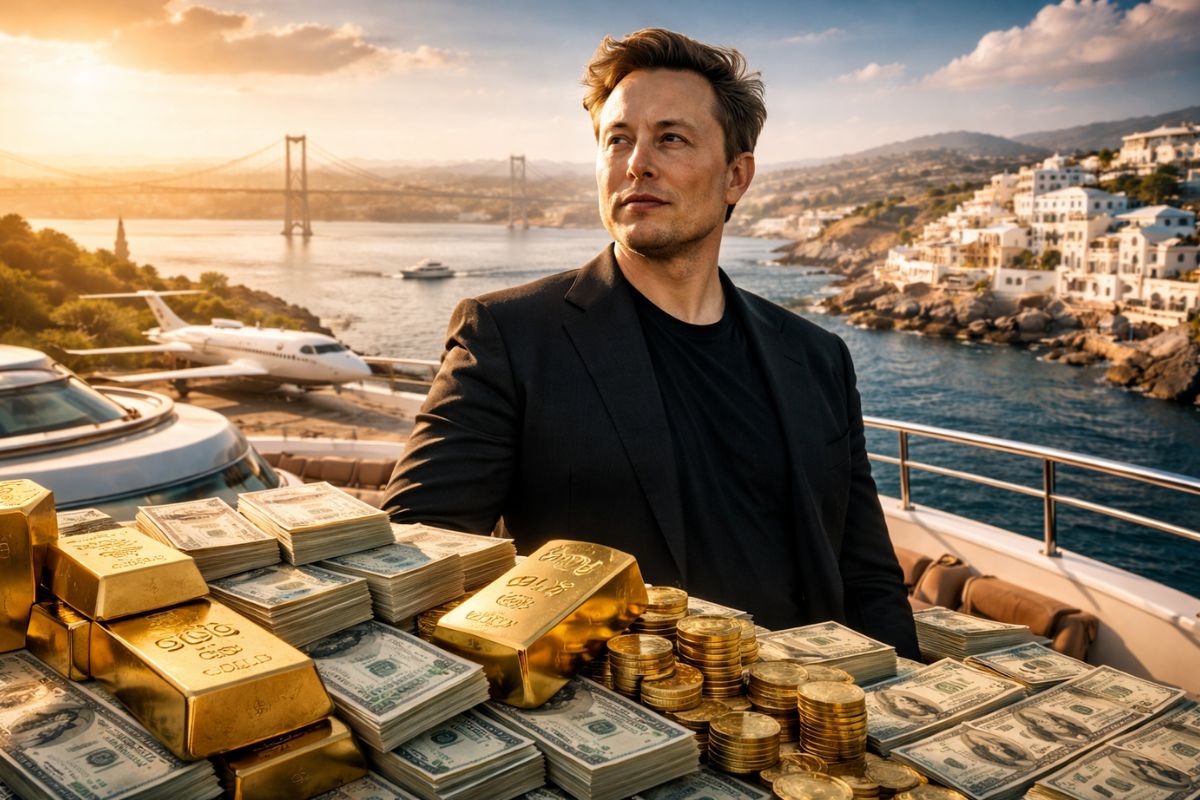
Elon Musk’s Fortune Doubled in Less Than Two Years and Is Now Used as a Direct Comparison with the GDP of European Countries. The Cited Calculation Places Portugal and Greece Together Below the Billionaire’s Wealth After a Deal Involving SpaceX and xAI That Raised the Market Value of His Group
Elon Musk’s fortune has reached a rare level by surpassing US$ 800 billion and, with that, has become a public benchmark for discussing the size of entire economies. When numbers of this magnitude circulate, the comparison with GDP ceases to be mere curiosity and begins to influence perceptions of power, scale, and influence.
The most repeated point in recent discussions targets Europe: the combined GDP of Portugal and Greece appears below the wealth attributed to the businessman. The reading is not just mathematical, it is symbolic, because it puts individual wealth and national production in the same framework.
How the GDP Comparison Gained Strength and Why Portugal and Greece Became References
The central comparison places Elon Musk’s fortune above the combined GDP of Portugal and Greece, presented as around US$ 565 billion when adding US$ 257 billion from Greece and approximately US$ 308 billion from Portugal.
-
Friends have been building a small “town” for 30 years to grow old together, with compact houses, a common area, nature surrounding it, and a collective life project designed for friendship, coexistence, and simplicity.

-
This small town in Germany created its own currency 24 years ago, today it circulates millions per year, is accepted in over 300 stores, and the German government allowed all of this to happen under one condition.

-
Curitiba is shrinking and is expected to lose 97,000 residents by 2050, while inland cities in Paraná such as Sarandi, Araucária, and Toledo are experiencing accelerated growth that is changing the entire state’s map.

-
Tourists were poisoned on Everest in a million-dollar fraud scheme involving helicopters that diverted over $19 million and shocked international authorities.


The contrast draws attention because GDP is usually the most cited number to summarize a country’s production capacity, while fortune measures concentrated wealth.
There is an inevitable collateral effect in these calculations: GDP and fortune do not mean the same thing, but they are placed side by side because they are large numbers, easy to repeat, and that cause immediate impact.
Nonetheless, the comparison with Portugal and Greece grows because it is direct, fits in one sentence, and offers a recognizable European “landmark” for those following international economics.
What Changed in Business Operations and Where SpaceX Fits into This Equation
The recent jump is attributed to a deal involving two companies associated with the billionaire: SpaceX and xAI.
The cited move was SpaceX acquiring the artificial intelligence startup xAI, which would have boosted the market value of both and reorganized the internal weight of the portfolio.
In this structure, SpaceX appears as the most valuable business, with a mentioned value of US$ 1 trillion.
The stake attributed to the businessman in the resulting company is 43%, estimated at around US$ 542 billion.
This detail matters because it explains how Elon Musk’s fortune grows through asset repricing, and not due to a single isolated event.
The Speed of the Jump and What It Reveals About Wealth Concentration
The speed is treated as an element as relevant as the final value.
Elon Musk’s fortune is said to have doubled in less than two years, with a cited milestone in December 2024, when he reached US$ 400 billion, and the subsequent mark above US$ 800 billion.
When this kind of growth occurs, the conversation about GDP returns to the table because the scales become comparable in numerical terms.
Portugal and Greece serve as a recurring example, but the structural point is the elasticity of private valuations and the impact that a deal involving SpaceX can have on personal wealth.
What seemed “slow” in the real economy becomes “fast” in valuation.
Comparisons with Other Billionaires and the Effect of Distortion in Public Debate
The contrast becomes more evident when the second richest name cited, Larry Page, with an estimated fortune of US$ 277 billion, appears.
Even though it is a gigantic value, it is treated as “just” when compared to Elon Musk’s fortune, which changes the public’s perception of what is large or small within the top of the pyramid.
This type of comparison tends to shift the discussion from productivity to wealth, and from economic structure to company valuation.
Still, Portugal and Greece continue to appear because the GDP of both countries combined helps to dimension the concentration: an individual wealth greater than the combined GDP of Portugal and Greece becomes a phrase that needs no translation.
What This Calculation Does Not Resolve and Why GDP Continues to Be Used Anyway
GDP measures annual production flow; fortune measures stock of wealth.
Putting both on the same line does not prove “economic superiority,” but produces a useful contrast for communication: it shows how business evaluations can concentrate value in few assets and people.
Still, GDP continues to be used because it is a universal number, and because Portugal and Greece have widely known statistics in the international debate.
Repetition transforms the calculation into a narrative, and the narrative into a mental shortcut.
This is why Elon Musk’s fortune makes headlines: it serves as a shortcut to talk about scale, about financial power, and about how the market prices companies like SpaceX.
Elon Musk’s fortune above US$ 800 billion gained traction not only due to the record but also due to how it was framed against the GDP of Portugal and Greece and the direct connection with a deal involving SpaceX and xAI.
When private numbers begin to compete, in the collective imagination, with national numbers, the debate changes tone and reference.
In your reading, what makes more sense to compare with GDP: individual wealth, market value of companies like SpaceX, or just the real impact on jobs and taxes? If you had to choose one indicator to measure the “size” of a country, would you use GDP, per capita income, or another metric, and why?










-

-

-

-

-

6 pessoas reagiram a isso.