





 Portuguese
  English
  Spanish
  5 min of reading
  3 comments


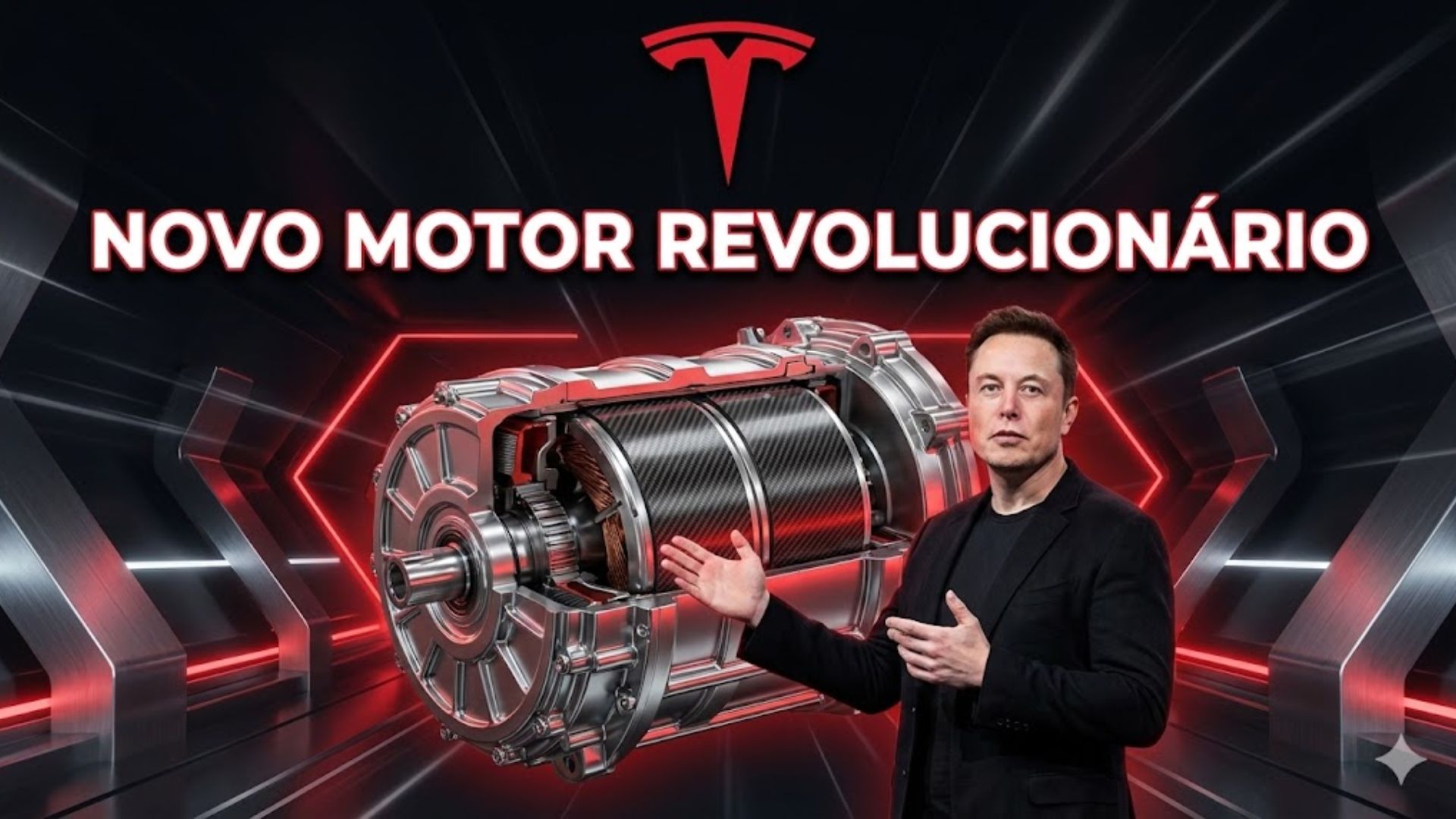


High-RPM Electric Motor Technology, Automotive AI Advances, and Tesla’s Industrial Expansion Combine to Pressure Global Rivals and Consolidate a New Level of Performance and Efficiency in Electric Vehicles.
Tesla has launched a set of electric motor and transmission capable of spinning at up to 20,000 revolutions per minute.
It takes a sedan weighing nearly two tons from 0 to 100 km/h in about 2 seconds and maintains a range of about 600 km per charge, depending on the version.
At the heart of this advance is the motor with a rotor wrapped in carbon fiber, introduced in 2021 in the Model S Plaid, and the strategy to combine proprietary hardware, automated driving software, and a global charging network that today totals over 75,000 Supercharger connectors worldwide.
-
A French brand placed a car on four huge red balloons to prove that its suspension made the vehicle “float,” and the surreal scene became one of the most iconic and unusual images in automotive history.

-
Jeep Avenger begins production in Brazil, debuting as the brand’s new entry-level SUV and inaugurating an unprecedented phase by becoming the first national Jeep manufactured outside of Goiana, as part of a R$ 3 billion plan.
-
Costing R$ 12,490, the new Shineray Urban Lite 150 “cheap one” arrives in Brazil with a CVT transmission, digital dashboard, and LED lights, making it more affordable than the Biz and targeting those who want to abandon the bus.
-
Ducati brings to Brazil the Superleggera V4 Centenario: 228 hp that become 247 with a track kit, carbon fiber and carbon-ceramic brakes, estimated price between R$ 1.5 and 2 million, deliveries only in 2027.

While marketing rhetoric talks about a “gearless” motor, what Tesla offers is a single gear set-up, without a conventional gearbox, integrated with a high-RPM, high-efficiency motor.
This combination has pressured traditional competitors such as Ford, General Motors, and Volkswagen, as well as newcomers like Rivian and Lucid, and is part of the competition with the Chinese BYD for global leadership in electric vehicles.
Carbon Fiber Motor: Architecture and Performance
The motor adopted in the Model S Plaid uses a copper rotor wrapped in a carbon fiber sleeve.
In common electric motors, metal parts expand with heat and mechanical stress at high RPM, which limits the maximum speed.
In Tesla’s design, the carbon fiber keeps the rotor compressed, reduces deformation, and allows operation in the range of 20,000 rpm, about 25% higher than previous generations.
Elon Musk described the concept as a way to achieve a stronger electromagnetic field, while the carbon sleeve prevents the copper from expanding radially under load.
According to him, this feature enables the combination of a compact, lightweight motor with high power density.
Each Model S Plaid uses three of these motors, two on the rear axle and one in the front, with a combined power of about 1,020 hp.
The transmission is single-speed, typical of high-performance electrics, which explains the sense of continuous acceleration, although there is a set of reduction gears between the motor and the wheels.
Extreme Acceleration and High Range


In official tests and specifications, the Model S Plaid accelerates from 0 to 60 mph (96 km/h) in 1.99 seconds, with independent measurements slightly above this value under specific track conditions.
The declared top speed is 320 km/h.
The range certified for the model is about 590 km, depending on wheels, tires, and usage conditions.
On highways, the numbers tend to be lower but remain above those of many previous high-performance electrics.
The efficiency gain comes from a combination of a more efficient motor, improved aerodynamics, and electronic battery management.
Tesla also introduced a new generation of drive unit, with an estimated cost of US$ 1,000 and designed to operate without rare earth elements.
Competitors under Pressure in the Global Market
While refining motors, batteries, and software on platforms designed exclusively for electrics, Tesla competes with manufacturers still adapting combustion vehicle structures.
This approach produces heavier, less efficient, and more expensive to manufacture vehicles.
Ford is one of the best-known examples: its electric division recorded US$ 5.1 billion in losses in 2024, in addition to an average loss of US$ 37,000 per vehicle in the last quarter of that year.
Rivian, focused on electric pickups and SUVs, also faces high costs, with losses exceeding US$ 39,000 per unit in certain periods.
BYD, a global leader in volume, faces additional tariffs in the European Union applied to electric models manufactured in China, a situation that the company is trying to navigate with factories in other countries and an expansion of plug-in hybrids.
Gigafactories and Large-Scale Production
Tesla’s industrial advantage also relies on its network of gigafactories located in Nevada, California, Texas, New York, Shanghai, and Berlin.
There is also a project for a plant in Mexico, whose implementation has progressed more slowly due to regulatory and macroeconomic issues.
In Shanghai and Berlin, the company uses giga-stamping machines capable of producing large structural sections in a single piece.
This model reduces the number of components, simplifies assembly, and lowers costs.
Advances in AI and the Continuous Update Cycle
The Full Self-Driving (Supervised) package uses data from billions of miles of real driving to train neural networks responsible for assisting acceleration, braking, and lane changes, always with active supervision from the driver.
In this context, the supercomputer Dojo was announced as a proprietary platform to train computer vision models with large volumes of video sent by the fleet.
The system used the proprietary D1 chip, with over a million computational cores and focused on performance optimized for AI.
Analysts estimated that Dojo could add up to US$ 500 billion to Tesla’s potential market value by accelerating robotaxi projects and AI services.
By 2025, however, the company discontinued the project, replacing it with solutions based on chips from suppliers like Nvidia and AMD, as well as new internal processors geared toward inference.
Even with the closure of Dojo, Tesla continues to provide frequent updates via the internet, sometimes at intervals of about two weeks.
Supercharger Network as Industry Standard
Tesla operates approximately 7,900 stations with over 75,000 connectors globally.
In recent years, it has begun opening part of the network to other manufacturers and has established its connector as the NACS standard in North America.
Almost all major manufacturers operating in the North American market have adopted the standard, which turns Tesla into an infrastructure provider for direct competitors as well.
With high-RPM motors, a cheaper drive unit in development, a software ecosystem based on fleet data, and the largest fast-charging network in the industry, Tesla raises the technological stakes in the global electric market.
In this scenario, the central point becomes how Ford, GM, Volkswagen, Rivian, BYD, and other companies will respond to this set of advantages in the coming years?









Fontes?
Aí aparece o Elao na apresentação girando o virabrequim.
Motor não tem autonomia, ele é de serviço contínuo, o carro é que tem autonomia