





 Portuguese
  English
  Spanish
  8 min of reading
  1 comment


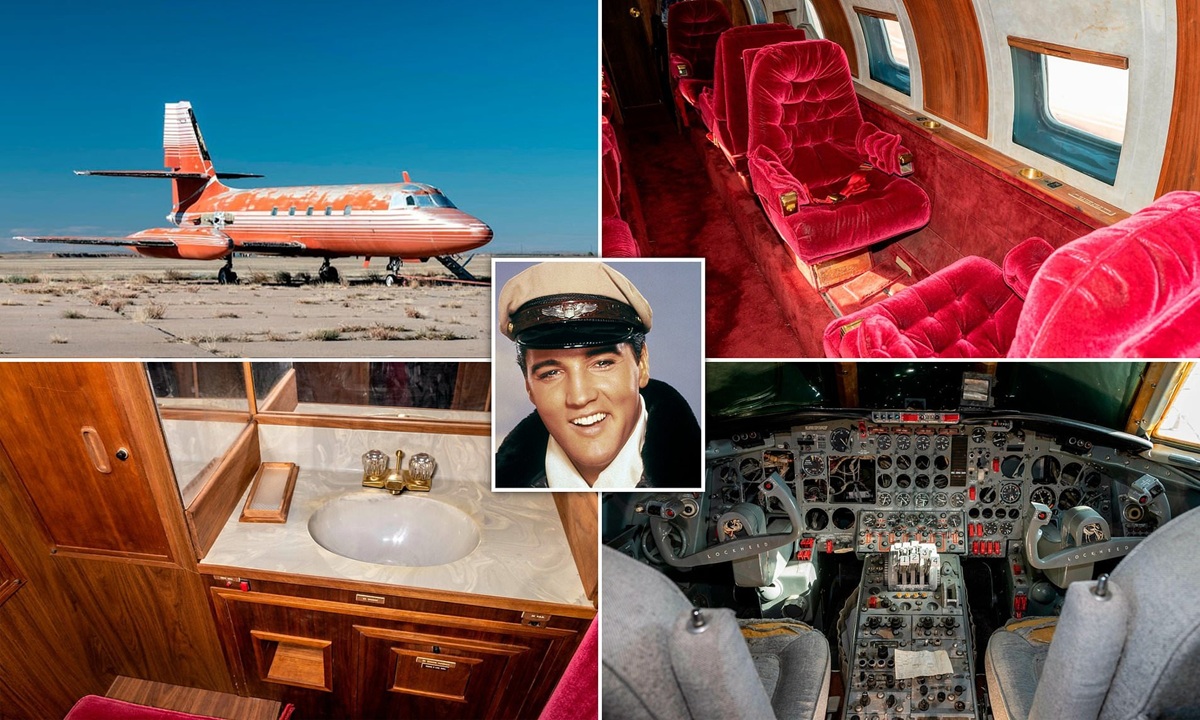

Decades After Being Abandoned in the New Mexico Desert, Elvis Presley’s Lockheed JetStar Jet is Reborn as a Themed Motorhome Created by YouTuber James Webb, Who Plans to Take It on a Tour Across the United States.
At the end of 1976, at the height of his fame and extravagance, Elvis Presley realized yet another of his eccentric dreams: he bought a 1962 Lockheed JetStar private jet to call his own.
The King of Rock spent around US$ 840 thousand in 1976 to add the aircraft to his personal fleet.
Elvis already owned other planes – including the famous Convair 880 nicknamed “Lisa Marie” – but the small JetStar, which he even nicknamed “Hound Dog II”, would be his new sky toy.
-
(Video): Italian pilot lands plane on moving train at 120 km/h and achieves unprecedented feat in aviation, even with a narrow runway and without direct visual contact.

-
It seems to have come out of a science fiction movie: A Brazilian city where it rains almost every day, recording over 4,000 mm per year, driven by climatic factors — a direct result of its strategic location in the Amazon.

-
The water crisis that could change everything this year has already begun; it’s not just about the climate, it affects technology, raises product prices, and can halt entire companies without warning.

-
A Japanese mason transforms raw granite into small cups and handcrafted utensils, collects giant stones, cuts with precision, and impresses with detailed manufacturing and finishing.

The acquisition was part of the star’s favorite hobby: he loved to collect luxurious cars and planes.
Inside, the jet was a retro luxury banquet from the ’60s. Elvis Presley’s Lockheed JetStar interior, showcasing red velvet swivel seats and wood and gold finishes, preserved like a time capsule of 1970s luxury.

As soon as he took possession, Elvis made sure to customize the interior details to his liking.
The red velvet seats, soft and eye-catching, accommodated up to nine people – all swivel and reclining, with shiny gold seatbelts.
There was also a comfortable sofa that matched the red shag carpet. The walls showcased polished wood panels, and gold-plated hardware gleamed on the window blinds and trim details.
For onboard entertainment, Elvis equipped the jet with a cassette tape player and an RCA VCR connected to a small TV – high technology for the time – in addition to a microwave and a drink dispenser in the aircraft’s galley.

Courtesy of Mecum Auctions
What He Wanted to Do With the Aircraft
Elvis intended to use the JetStar to make his travels more efficient. With it, he could easily transport his musicians, backup singers, and even friends.
The star kept several pilots on standby so he could fly at any moment to meet his passionate fans in different cities.
In the early months of 1977, the Lockheed JetStar complemented Elvis’s small air fleet – it was the third private plane in his personal hangar, alongside Lisa Marie and another JetStar he already owned.
There Wasn’t Time to Enjoy
Unfortunately, Elvis had little time to enjoy this new acquisition. Less than a year after the purchase, in August 1977, the world lost the King of Rock, and his golden planes lost their most illustrious pilot.
After the premature death of Elvis, the fate of the JetStar became uncertain.
Still in 1977, the jet was sold to a Saudi Arabian company, and a long odyssey of abandonment began.
For poorly documented reasons, the aircraft ended up parked in Roswell, in the northern U.S. state of New Mexico – a location famous for housing an extensive airplane graveyard in the desert.

Courtesy of Mecum Auctions
There, under the relentless sun and sandy winds, Elvis’s shiny jet gradually lost its luster.
The red-and-silver exterior paint faded and peeled, exposing the aluminum underneath.
The engines had been removed – two of the original turbines were sent for display at a museum in Tennessee – and many cockpit components disappeared over time, either removed for reuse or simply worn out after decades in the open air.
Surprisingly, the interior remained untouched and sealed like a time capsule. Locked away in the desert, Elvis’s jet held out for almost forty years parked at the Roswell International Air Center, becoming a curious relic waiting for its fate.
abandoned interior image
In the following decades, the abandoned Elvis plane became legend among fans and collectors.
Some adventurers dared to peek through the dusty windows to glimpse the red velvet still shining in the New Mexico sun.
From time to time, there were attempts to give the aircraft a new direction. Around 2017, auction companies began offering the jet to the market, fueling hopes that some enthusiast would rescue it.
The initial expectation was astronomical: bids were expected to range between 2 and 3.5 million dollars. But the reality was quite different.
In the May 2017 auction, the JetStar was sold for only US$ 430 thousand – a bargain, even though no one knew exactly what to do with that 42,000-kilo colossus without engines.
The 2017 buyer declared plans to showcase the plane as a themed attraction in his car shop. However, the project never materialized: the buyer never arranged for the jet’s transport and, astonishingly, never even saw it in person.
Thus, the plane remained forgotten on the Roswell tarmac, accumulating dust and questions about its future.
The Sale

Only in January 2023 did the decisive turning point of this story come. Taking advantage of what would have been Elvis Presley’s 88th birthday, the auction house Mecum Auctions put the iconic plane up for bid.
Under curious eyes, the bids started at US$ 100 thousand and slowly climbed. In the end, an anonymous bidder on the phone made the winning bid of US$ 260 thousand, ending four decades of waiting.
Little did the audience know, but behind the phone was an unusual character: James Webb, an adventurous YouTuber known for the channel “Jimmy’s World.”
Webb, a former mechanic and aviation enthusiast, decided to bet all his chips on that rock relic. “We’re still trying to decide if it was the best or worst financial decision of my life”, Webb joked later, revealing that he paid about US$ 234 thousand for the jet (net value after fees).
The New Owner of the Plane
James Webb had a plan as crazy as it was bold for the JetStar: to transform the jet into a motorhome on wheels.
Webb organized the logistics to transport the fuselage overland from Roswell to Florida, on a journey of 2,500 km.
After all, flying the jet was impossible – without engines and with the documentation deactivated, restoring it to flying condition would cost millions of dollars (it is estimated that US$ 5.7 million would be needed just to make it aeronautically viable), not to mention modern regulatory barriers, since the former JetStar turbines do not meet the current noise standards.
In light of this, Webb opted for a creative and radical solution: to attach the jet’s fuselage to a bus chassis.

His idea was to preserve the vintage interior as a traveling museum, allowing fans to experience what it was like to be on Elvis’s jet – but on solid ground. In other words, he literally planned to “give a ride” on the jet across the country.
The main fuselage of the JetStar was mounted on a 1999 Freightliner truck chassis, chosen for its strength and compatibility with the weight of the plane.
Webb and his team fused metal with metal, adapting supports and wheels. It took 18 months of intense work – and all of Webb’s savings invested – to bring the unusual hybrid vehicle to life.
During the renovation, the jet’s interior was kept exactly as Elvis left it. “We just vacuumed and cleaned the wood, that’s it. Everything is as it was 40-some years ago,” Webb explained, amazed at the preservation.
Onboard electricity was restored, and, surprisingly, all the appliances worked again after decades of inactivity: the tube TV lit up, the VCR roared, the interior lights shone, and even the Kenmore microwave beeped, ready for use.
“I was blown away,” the YouTuber admitted, referring to the “time capsule state” of the jet.
By mid-2024, the transformation was complete. Webb affectionately named the creation “Elvismobile”, Elvis’s vehicle.
Where wings and turbines once existed, there were now wheels and a diesel engine. The time had come for the old jet to hit the road – literally. In July 2024, James Webb started the Elvismobile.
The wheeled jet traveled about 2,575 km, starting from Florida and crossing several states into the American Midwest.
At every stop at gas stations and every overtaking on the highways, the surreal scene drew attention: a jet “driving” on the road, as if it had made a wrong landing on a highway.
Webb reported that the trip had tense moments, especially due to the curious harassment from drivers: “People would pull up, hit the brakes, pull out their phones to film, and start zigzagging in front of me… It was like an ambulant traffic stop.”
Despite traveling at a mere 65 mph – “much slower than flying in a real jet,” Webb joked – the vehicle performed solidly and achieved about 5 kilometers per liter of diesel, which he considers “much more economical than a real jet.”
When it finally entered the festival grounds in Oshkosh on July 20, 2024, the Elvismobile was received like a celebrity.
How It Stands in 2025
Now, in 2025, the Elvismobile continues its journey across the roads of the United States, keeping the King’s memory alive in a traveling manner. The tour schedule includes a triumphant return to Oshkosh in the summer of 2025, to once again delight aviation and rock ‘n’ roll fans.
New destinations are being evaluated – museums, car meets, themed music events – all interested in hosting the curious red fuselage that once soared through the skies with Elvis on board. James Webb admits that, after so much effort, he still doesn’t have a definitive plan for the future of the jet. “Honestly, I don’t know what comes next… Maybe continue on the road so more people can enjoy it,” he said.
For now, his mission has been fulfilled: wherever he parks, the reborn Elvis JetStar attracts crowds and provides an unmatched nostalgic experience.
In conclusion to this improbable saga, there is an emotional reflection on the creative preservation of Elvis’s legacy.
What was once just a forgotten piece of rock history – a rusting jet in the desert – has transformed into a traveling cultural attraction, thanks to the bold vision of an ingenious fan.

Instead of ending up in pieces or silently corroding under the sun, the King of Rock’s plane now glides on wheels, carrying stories and memories with it.
Fans from different generations can enter the cockpit, sit in the same upholstery where Elvis relaxed, imagine the chords of “Jailhouse Rock” playing on the tape deck, and feel, for a few moments, the grandeur of that lifestyle.
In a way, Elvis Presley remains “on the road” – or better, on the road and not in the sky – enchanting the public in a completely new way.
James Webb’s project gave the Lockheed JetStar a second life, proving that creativity and passion can keep the legacy of an icon alive. Almost half a century after Elvis’s last takeoff, his red jet is back on the road, reminding everyone that the King’s legend still has much journey – and road – ahead.






Elvis, eternamente…