





 Portuguese
  English
  Spanish
  4 min of reading
  0 comments


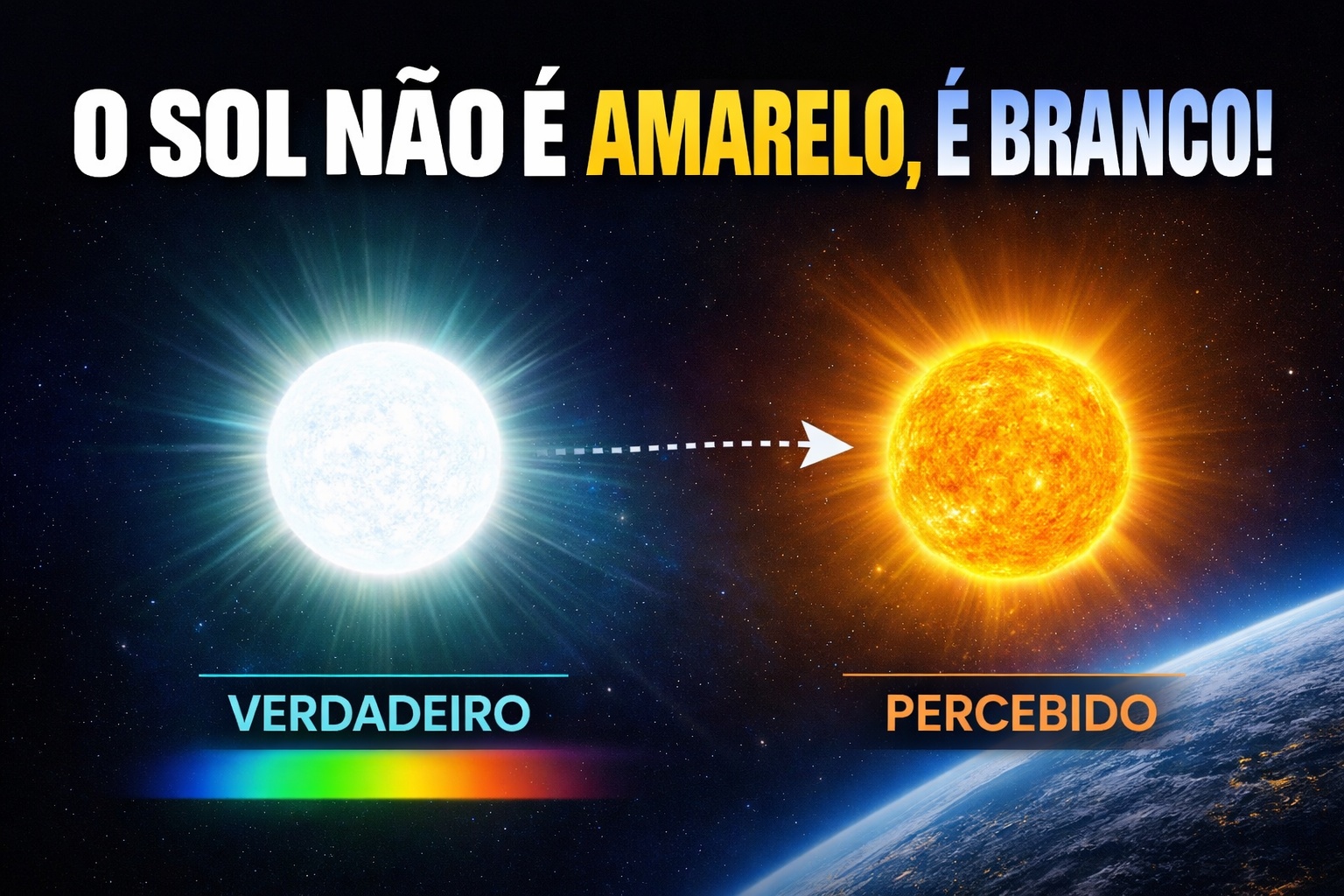
Few Know, But The Sun Is White. The Yellowish Color Seen From Earth Is Caused By The Atmosphere; Solar Spectrum Measurements Show Maximum Emission Around 500 Nm.
During elementary school, almost everyone learns to draw the Sun the same way: a yellow circle, sometimes even orange, with rays around it. This image repeats itself in textbooks, simplified scientific illustrations, and even in educational animations. The problem is that it is technically incorrect. Few know, but the Sun is not yellow. From a physical and spectral standpoint, it is white.
This statement is not an opinion or scientific provocation. It is based on direct measurements of the solar spectrum taken outside the Earth’s atmosphere, where there is no interference from air, dust, or gases. When analyzed under ideal conditions, the light emitted by the Sun contains all the colors of the visible spectrum in very similar proportions, which characterizes the white color.
What The Technical Data Of The Solar Spectrum Really Show
The Sun is classified as a type G2V star, with a surface temperature around 5,778 kelvins. A body in this thermal range emits radiation according to the black body radiation laws, which means that its light spreads across the entire visible spectrum.
-
Scientists have captured something never seen in space: newly born stars are creating gigantic rings of light a thousand times larger than the distance between the Earth and the Sun, and this changes everything we knew about stellar birth.

-
Geologists find traces of a continent that disappeared 155 million years ago after separating from Australia and reveal that it did not sink, but broke into fragments scattered across Southeast Asia.
-
Samsung launches cordless vertical vacuum cleaner with up to 400W of suction and relies on AI to automatically recognize corners, carpets, and different surfaces.

-
The lost continent beneath Europe: separated from North Africa about 240 million years ago, comparable in size to Greenland, Greater Adria was crushed over 40 million years and left geological marks from the Alps to the Balkans.




Measurements show that the peak emission of the Sun occurs around 500 nanometers, a region between green and cyan. This technical detail often confuses people, as many interpret “peak” as “dominant color.”
In practice, this does not mean that the Sun is green or yellow, but rather that this is the region where maximum intensity occurs, while all other colors continue to be present in significant amounts.
When all these colors come together to human eyes in balance, the perceptual result is white.
Why Then Do We See The Sun Yellow From Earth
The answer lies in the Earth’s atmosphere. As it travels through dozens of kilometers of air, sunlight undergoes a process known as Rayleigh scattering. This phenomenon causes shorter wavelengths, such as blue and violet, to be scattered in all directions.
It is this scattering that makes the sky blue during the day. But it also has another important side effect: by removing some of the blue from the light that goes directly to our eyes, the remaining sunlight appears to be more yellowish.
The greater the distance the light travels through the atmosphere, the more intense this effect becomes. Therefore:
- at noon, the Sun seems more white-yellow,
- at dawn and dusk, it appears orange or red,
- and outside the atmosphere, it looks pure white again.
Astronauts in orbit report exactly this: seen from space, without atmospheric interference, the Sun is intensely white, not yellow.
Space Photographs Confirm That The Sun Is White
Images captured by satellites and space probes corroborate this conclusion. When there is no artificial color correction for educational or aesthetic purposes, the solar disc appears white, with subtle variations caused only by magnetic activity and hotter or colder regions of the photosphere.
Many images released to the public show the Sun in yellow, red, or orange tones, but this usually happens for two reasons:
- use of specific filters to highlight structures,
- or false colors applied for scientific purposes.
These colors do not represent the Sun’s real appearance to the human eye under neutral conditions.
Why Do Textbooks Insist On The Yellow Sun
The answer is simple: didactic and visual tradition. Yellow has become a graphic shortcut to represent the Sun, just as blue represents water and green represents plants. However, this simplification ends up creating an incorrect idea that perpetuates itself for generations.

From a scientific point of view, it would be more correct to teach that:
- the Sun emits white light,
- the atmosphere alters the perception of this light,
- and the observed color depends on the optical path to the observer.
This seemingly minor detail helps to better understand concepts such as electromagnetic spectrum, light dispersion, and stellar physics.
What This Curiosity Reveals About How We Perceive The Universe
The fact that the Sun appears yellow but is white is a perfect example of how our perception is mediated by the environment. We do not see the universe “as it is,” but as it presents itself after passing through natural filters, such as the atmosphere, or artificial ones, like telescopes and sensors.

Few know, but this same logic applies to:
- star colors,
- galaxy brightness,
- planet hues,
- and even the Moon’s appearance in the sky.
Physical reality exists, but the way we perceive it depends on the medium between us and the observed object.
A Simple Truth That Almost Nobody Learns
In the end, the idea that the Sun is yellow is more cultural than scientific. When observed without distortions, the star that sustains all life on Earth is white, intense, and balanced throughout the visible spectrum.
Few know this because we are rarely taught to separate visual perception from physical reality. And it is precisely in these small corrections of understanding that science shows its power: revealing that even what seems obvious can be wrong.







-

-

-

-

11 pessoas reagiram a isso.