





 Portuguese
  English
  Spanish
  4 min of reading
  0 comments


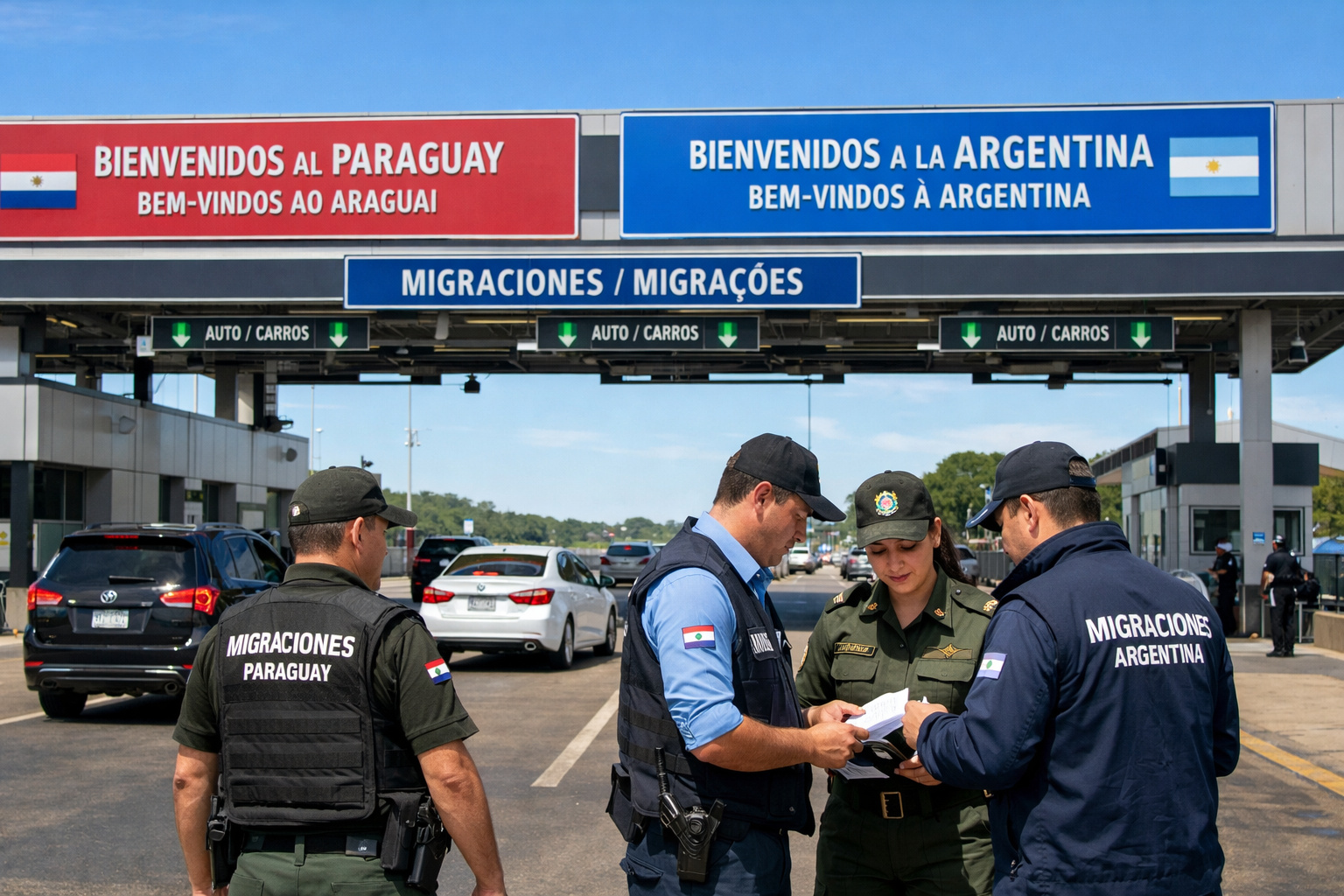
The Integration Of Migration Controls At The Main Link Between Paraguay And Argentina Promises To Reduce Lines, Strengthen Security And Transform The Routine Of Thousands Of People Who Cross The Border Daily
Since February 9, crossing the border between Paraguay and Argentina has begun to change significantly. The two countries have launched, in a pilot phase, an integrated migration system at the Puerto Falcón–Clorinda, the second busiest border crossing between the nations. The main novelty is simple in theory but profound in practice: a single migration process now applies for both countries, reducing time, bureaucracy, and historical lines.
The information was disclosed by Forbes Paraguay, which highlighted that the initiative is part of a broader process of border management modernization, focusing on operational efficiency, security, and regional integration. At the same time, the project addresses an old demand from those who depend daily on border crossings to work, study, or maintain family ties.
In this context, the implementation of the unified model marks a concrete advance in bilateral cooperation, especially at a strategic point that sees thousands of crossings every day. Authorities expect positive impacts to be felt within the first few weeks of the experimental phase.
-
The government requests the Federal Revenue Service for a new system to automate the income tax declaration, reducing errors, time, and bureaucracy for millions of Brazilians.

-
Pix in installments, international Pix, and contactless payment without internet: the Central Bank revealed the new features coming to the tool that is already used by almost every adult in Brazil.

-
Mercado Livre has just started selling medications with delivery in up to three hours to your door, and this move could completely change the way Brazilians buy medicines on a daily basis.

-
In Dubai, rising tensions from the war in the Middle East are causing super-rich individuals to leave the Gulf and direct their fortunes to a new financial refuge in Asia.


Integrated System Reduces Bureaucracy And Speeds Up Crossing Between The Two Countries
The new scheme officially began operating on Monday, February 9, following coordinated efforts between Paraguayan and Argentine migration authorities. The central goal is to eliminate the duplication of procedures, which until now forced travelers to go through separate controls, one on each side of the border.
According to the National Director of Migrations of Paraguay, Jorge Kronawetter, the initiative represents the fulfillment of a commitment that has been postponed for years. “We had an outstanding debt with Paraguay, which we have now managed to realize with the National Directorate of Migrations of Argentina and the work of their technicians,” he stated.
Furthermore, Kronawetter emphasized that the advancement was only possible due to the technical alignment between the two countries. By harmonizing procedures, systems, and operational routines, the teams managed to create a simpler flow without relinquishing state control. In this way, travelers now complete a single migration registration, valid simultaneously for entering and exiting both territories.
As a result, a significant reduction in waiting times is expected, especially during peak hours when lengthy lines have become part of the daily landscape in the Puerto Falcón–Clorinda region.
Cross-Checking Increases Security Without Hindering The Flow Of People
Despite the simplification of the process, authorities emphasize that the new system does not represent a relaxation of security criteria. On the contrary, one of the pillars of the integrated model is the cross-checking of alert databases between the two countries.
According to Kronawetter, every movement made at the border post is now automatically checked against Paraguayan and Argentine systems. “There’s a very important security component because every movement is verified in the alert databases of both countries,” he explained.
This mechanism allows for identifying risks, migratory alerts, or judicial restrictions more efficiently while avoiding rework and unnecessary delays. Thus, control becomes smarter, more technological, and coordinated, aligned with the best international practices in border management.
By integrating information and systems, Paraguay and Argentina also reduce operational gaps, strengthening the prevention of illicit activities without compromising the smooth flow of regular traffic.
Cross-Border Local Traffic, Representing 60% Of The Flow, Will Have Differentiated Treatment
Another key point of the project lies in the next phase of implementation: the differentiation of cross-border local traffic, which accounts for approximately 60% of all movement in the region. This group includes residents who cross the border daily—and, in many cases, several times a day—for work, trade, health, or family reasons.
“The next step would be to have the possibility to differentiate cross-border local traffic, which makes up about 60% of the traffic in this area,” Kronawetter stated. The idea is to create even more agile mechanisms for this specific audience without reducing control and security standards.
With this, the system can provide differentiated treatment for those living near the border, while maintaining comprehensive processes for tourists, transporters, and occasional travelers. This segmentation is expected to further relieve pressure on migration posts and make the flow more predictable.
In the broader context, the initiative reinforces Paraguay’s positioning as a country that invests in regional integration, administrative efficiency, and the use of technology, crucial factors for boosting trade, tourism, and economic development in border areas.
Do you think the single process between Paraguay and Argentina will really end the lines at the border or will the change only work outside peak hours?








-

Uma pessoa reagiu a isso.