





 Portuguese
  English
  Spanish
  3 min of reading
  1 comment


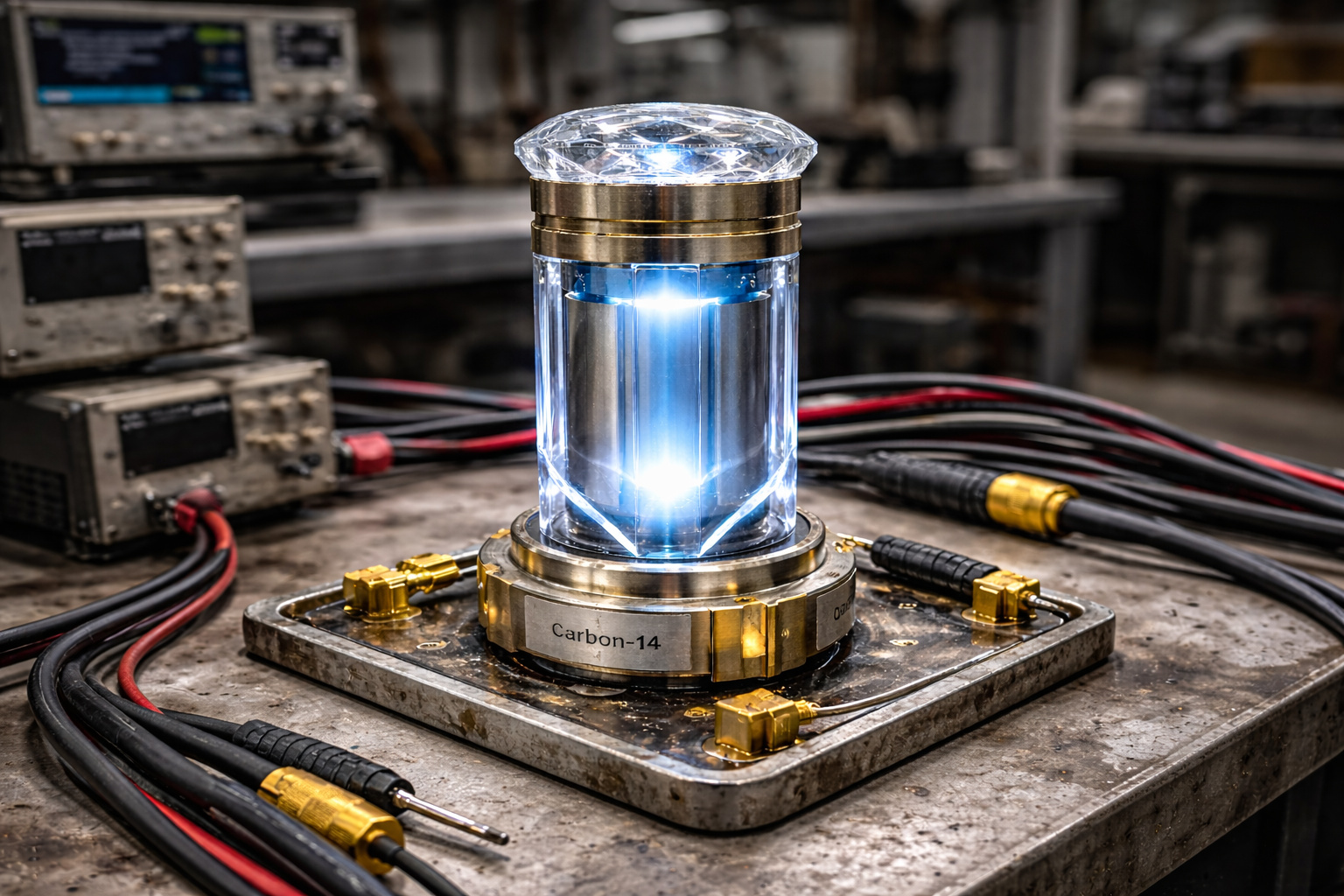


Carbon-14 Encapsulated in Synthetic Diamond Technology Promises Continuous Energy Supply for Millennia
A major technological impact scientific innovation was announced in the UK and quickly drew international attention.
Researchers from the University of Bristol, in partnership with the UK Atomic Energy Authority (UKAEA), presented in December 2024 a carbon-14-based nuclear battery with the potential to operate for up to 5,700 years, according to an official statement from the institutions.
The project uses the radioactive decay of carbon-14, an isotope widely used in archaeological dating, to generate electricity continuously and steadily over thousands of years.
-
Motorola launched the Signature with a gold seal from DxOMark, tying with the iPhone 17 Pro in camera performance, Snapdragon 8 Gen 5 that surpassed 3 million in benchmarks, and a zoom that impresses even at night.

-
Satellites reveal beneath the Sahara a giant river buried for thousands of kilometers: study shows that the largest hot desert on the planet was once traversed by a river system comparable to the largest on Earth.

-
Scientists have captured something never seen in space: newly born stars are creating gigantic rings of light a thousand times larger than the distance between the Earth and the Sun, and this changes everything we knew about stellar birth.

-
Geologists find traces of a continent that disappeared 155 million years ago after separating from Australia and reveal that it did not sink, but broke into fragments scattered across Southeast Asia.

According to the involved scientists, this is one of the most long-lasting advancements ever developed in the field of long-duration energy storage, especially targeted at specific and strategic applications.
Technical Investigation Reveals Safe Operation and Diamond Encapsulation
The battery was developed from a previously studied concept, enhanced with modern nuclear engineering techniques.
The carbon-14 is encapsulated in synthetic diamond, one of the most durable materials known, which ensures that radiation remains fully contained within the structure.

According to the University of Bristol, the diamond not only acts as a safety barrier but also helps to optimize the system’s energy efficiency.
In this way, the technology allows for continuous electricity generation without the need for recharging, maintaining operational stability for centuries or even millennia.
Strategic Applications and Current Technical Limitations
The battery was designed primarily for sectors requiring stable energy supply for long periods.
Highlighted applications include implantable medical devices, remote monitoring equipment in isolated areas, underwater stations, and space exploration missions, including probes and satellites.
In the aerospace sector, for example, the possibility of powering equipment for decades or centuries drastically reduces the need for maintenance or replacement.
However, despite the impressive durability, researchers explain that the current power output is limited.
Generation occurs at levels of microwatts, which prevents usage in high energy-consuming devices such as electric vehicles or smartphones.
Even so, scientists claim that future versions could increase energy capacity, gradually expanding the range of applications.
Autonomous Residential System Reinforces Concept of Long-Duration Energy
Alongside the nuclear advancement, an independent project started in 2016 demonstrated another approach for energy autonomy.
A residential system began operating entirely autonomously by utilizing more than 1,000 recycled notebook batteries, combined with solar energy.
The project started with a forklift battery and a few solar panels, but progressively evolved over the years.
Today, the system comprises about 650 batteries organized in 100 Ah packs, connected by copper wires.
To optimize performance and resolve irregular discharge issues, the creator began disassembling the batteries and using the cells individually in custom racks.
Currently, the setup features 24 solar panels of 440 watts each and provides continuous energy without relying on the electrical grid.
Despite initial challenges, there have been no recorded cases of overheating, fires, or swollen batteries over more than eight years of operation.
Nuclear Energy and Electronic Reuse in Global Perspective
The carbon-14 battery and the home system share a common goal: to enhance energy autonomy for long periods.
While nuclear technology focuses on extreme durability for thousands of years, the residential system emphasizes the reuse of electronic waste combined with solar energy.
According to the involved institutions, the development of these solutions follows strict technical criteria and safety standards aligned with international regulations.
The advancement strengthens the global debate on sustainable energy storage, technological innovation, and environmental responsibility.
What Could More Rapidly Transform the Energy Sector: Millennia-Lasting Nuclear Batteries or Home Systems Based on Reuse and Solar Energy?








Este trecho sobre bateria de notebook com energia solar não tem relação nenhuma com a material, que viagem.