





 Portuguese
  English
  Spanish
  6 min of reading
  7 comments


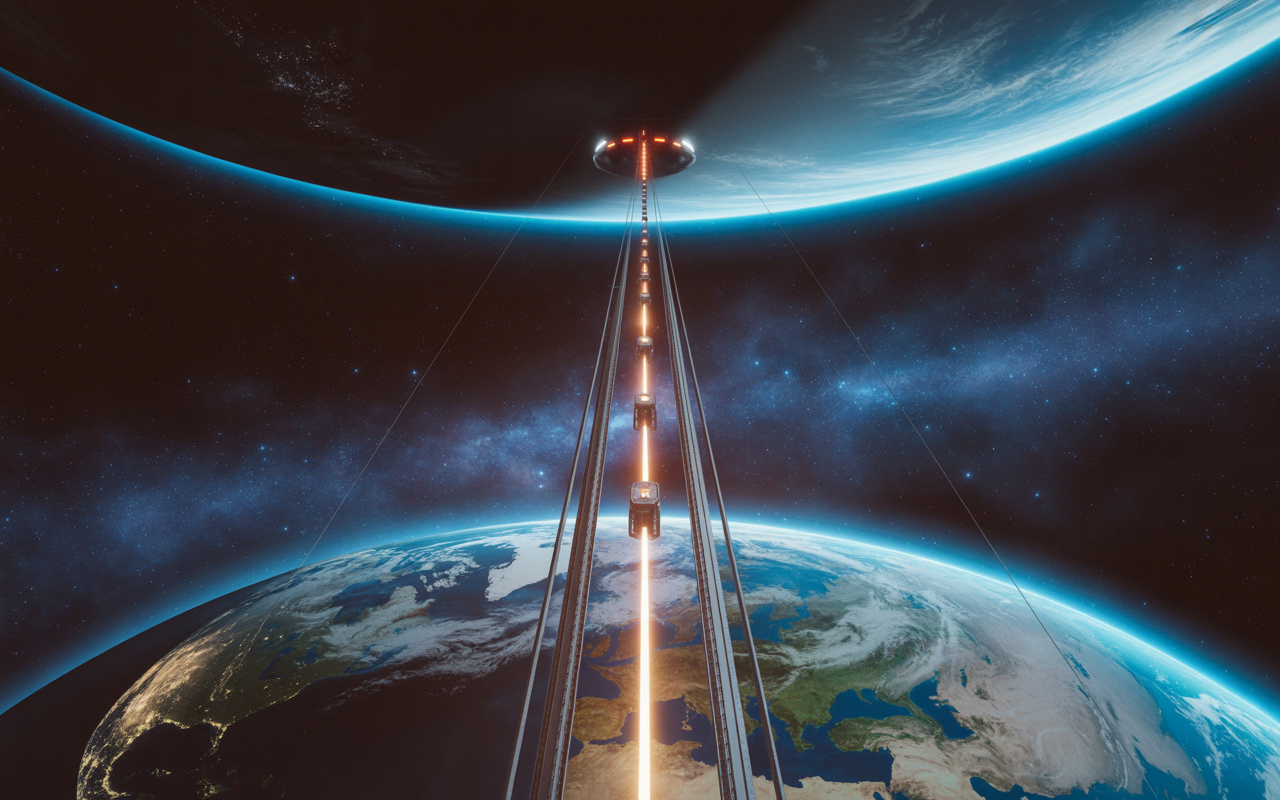


It May Seem Science Fiction, But It Is Already Serious Agenda Among Engineers and Physicists: A Space Elevator, With 96 Thousand Km of Length, Capable of Transporting Cargo to Earth Orbit Without the Use of Rockets. Understand How the Project Works, the Challenges, and What Can Change in the Space Race.
The idea of a space elevator consists of building an ultra-strong cable anchored to the Earth’s surface and connected to a counterweight in space, about 96,000 kilometers high. Along this cable, motorized vehicles—nicknamed “buckets” or “climbers” —would ascend, transporting satellites, equipment, and even humans to orbit.

If it seems impossible at first glance, know that the conception of the space elevator dates back to the Russian physicist Konstantin Tsiolkovsky, who proposed the concept in 1895. Since then, the project has gained theoretical support and, more recently, started attracting the attention of the global scientific community.
How Would the 96,000 Km Space Elevator Work?
Contrary to popular belief, the elevator would not rise into space using propulsion. Instead, it would be sustained by centrifugal forces. Here’s how it would work:
-
With a cost per shot close to zero, the DragonFire laser could change naval warfare in 2027 and provide British ships with nearly unlimited defense against drones.

-
A British startup creates tires that generate electricity in electric vehicles when passing over potholes, speed bumps, and cracks.

-
Scientists have created robots made with living cells that have their own nervous system, swim on their own, explore the environment, and self-organize without any genetic engineering, and now they want to do the same with human cells.

-
Students create a solar-powered ambulance that operates without a plug, without fuel, and still keeps medical equipment running in remote areas.

- A base on Earth, near the equator (for stability).
- A cable made of ultra-strong material (such as carbon nanotubes or graphene), extending beyond geostationary orbit (about 35,786 km) and anchored to a counterweight with sufficient mass to maintain gravitational balance.
- Automated climbers, powered by solar energy or laser beams from the surface, would ascend this cable carrying loads into space.
- The speed of the climbers would be 200 to 300 km/h. A trip to orbit would take about 5 to 7 days, at a significantly lower cost than rockets.
Why Could the Space Elevator Replace Rockets?
Currently, launching any cargo into space depends on liquid or solid fuel rockets, which consume billions of dollars each year and leave environmental footprints.
See the comparison:
| Aspect | Rockets | Space Elevator |
|---|---|---|
| Cost per kg launched | US$ 2,700 (SpaceX) | Estimated between US$ 100 and US$ 300 |
| Carbon Emission | High | Practically None |
| Safety | Explosion Risk | Lower Operational Risk |
| Reusability | Limited | Reusable and Continuous |
| Launch Frequency | Large Intervals | Constant and Controlled |
Additionally, the space elevator does not depend on launch windows or ideal weather conditions, which brings unmatched logistical advantages.
What Is the Actual Size of the Space Elevator?


For the cable to maintain balance between Earth’s gravity and centrifugal force, it needs to extend far beyond geostationary orbit. Hence, the latest calculations indicate an ideal length of 96,000 kilometers, almost a quarter of the distance to the Moon (384,400 km).
The space anchoring point would function as a counterweight and stabilizer. It could be a captured asteroid, anartificial space station, or a platform with gigantic solar panels.
The “Buckets” That Ascend to Space
The vehicles that traverse the cable are called climbers — a mix of elevator, crane, and robot. They are designed to transport loads of 10 to 20 tons in a single journey, with electrical energy obtained via:
- Integrated Solar Panels
- Laser Beams Sent from Earth
- Powered Cables (hypothesis under study)
These “buckets” could make weekly trips to orbit, turning space transport into a routine and accessible activity.
What Is Preventing the Project from Becoming a Reality?
Despite theoretical and technological advances, the space elevator has still not been built due to three major reasons:
Cable Material
To support its own weight and extreme tensions, the cable would need to be made of a material 200 times stronger than steel and extremely light. The two viable options are:
- Carbon Nanotubes
- Pure Graphene
Both are still under development for large-scale structural applications.
Collision Risk
Low Earth orbit is full of space debris. An elevator with 96 thousand km of length would cross multiple altitudes, increasing the risk of collision with satellites and space junk.
Geopolitical Viability
This is a structure that would cross the airspace of various countries and would be subject to international treaties. The ideal anchoring location would be on the Equator, where the centrifugal force is maximum—but this requires political stability, international agreements, and billions in investments.
Real Initiatives and Projects in Progress
Despite the challenges, several organizations and universities worldwide have been working on the concept of the space elevator. Some of them include:
- ISEC (International Space Elevator Consortium)
- Shizuoka University (Japan): In 2018, launched a miniature experiment to test the movement of climbers in space.
- Obayashi Corporation (Japan): Aims to build a functional prototype by 2050.
- NASA: Has been studying feasibility since the 1990s through the Institute for Advanced Concepts.
These projects not only test the concept in the lab but also seek solutions for materials, tension control, and large-scale energy.
What Would Change with the Construction of a Space Elevator?
The implementation of a space elevator with 96,000 km of length could bring about a revolution in access to space. The main transformations include:
Lowering the Cost of Satellite Launches
Startups and governments could launch satellites at up to 90% lower cost, enabling global internet, climate monitoring, and defense technologies.
Commercial Space Travel
The ability to transport tourists to orbit through more stable and safer transportation would open up the space tourism market with more comfort and less risk.
Construction of Space Bases
With frequent transportation of equipment, it would be possible to build stations in orbit, space refineries, and even lunar habitats.
Interplanetary Exploration
The reduced cost of launching probes and spacecraft from Earth orbit (rather than from Earth itself) would accelerate the race to Mars, Jupiter, and beyond.
What If the Cable Breaks?
One of the most common questions is: what if the space elevator cable breaks? The surprising answer is: it would not fall to Earth catastrophically. This is because the cable is under tension, and if it breaks, part of it would be launched into space while the other part would fall in a controlled and predictable manner.
Additionally, the cable would be manufactured with interconnected segments, allowing for repairs and partial replacements. The technologies involved include:
- Satellite Monitoring
- Maintenance Drones
- Artificial Intelligence for Vibration Control
Curiosities About the Space Elevator
- The journey to orbit would take 7 days, but with much lower energy consumption than rockets.
- The structure would require the development of a new generation of sensors, space traffic control, and international regulations.
- It is mentioned in works of science fiction such as 2001: A Space Odyssey (Arthur C. Clarke) and Red Mars (Kim Stanley Robinson).
When Could It Become a Reality?
Experts estimate that, between 2045 and 2060, it may be possible to build the first functional space elevator prototype in lunar orbit, where gravity is lower. The next step would be to bring it to Earth, with a complete and operational model.
The limiting factor is still the industrial production of carbon nanotubes and graphene on a large scale, something that may be resolved in the coming decades, given the speed of nanotechnology.
The project of a space elevator with 96,000 km of length is still, for many, a distant dream. But its technical viability advances every year, and the benefits it would bring to science, economy, and the environment are hard to ignore.
Just as commercial airplanes were discredited in the early 20th century or how the internet seemed futuristic in the 1980s, the space elevator could be humanity’s next historical turning point. And when that happens, rockets—symbols of the current space age—might become obsolete.
Be it through nanotechnology, solar energy, or artificial intelligence, the next space race may begin… by climbing a cable.







Não lembro que tenha sido citado em 2001, do Arthur C. Clark, lançado antes de terem começado a estudar essa possibilidade, mas foi citado em 3001 A Odisséia Final, um dos livros da sequência, lançado em 1997.
Seria interessante ver esse belo futuro, o elevador espacial levando e trazendo turistas espaciais. Uma pena que está previsto pra 2045 a 2060, até lá muitos de nós, potenciais turistas do espaço, já viramos pó. 😢
A idéia é boa, mas dado o seu tamanho e extensão, seria flexível demais, parecendo uma gigantescas corda tubular.
Existem vários outros riscos além das possibilidades de quebras.
Essa estrutura flexível de 96 mil km poderia dar 7 voltas e meia na terra.
Também por algum motivo, poderia se contorcer toda.
São vários os desafios de engenharia a serem vencidos.
Tudo precisa de um início para se encontrar soluções. Não duvido nada que um dia isso seja real e viável.