





 Portuguese
  English
  Spanish
  6 min of reading
  1 comment


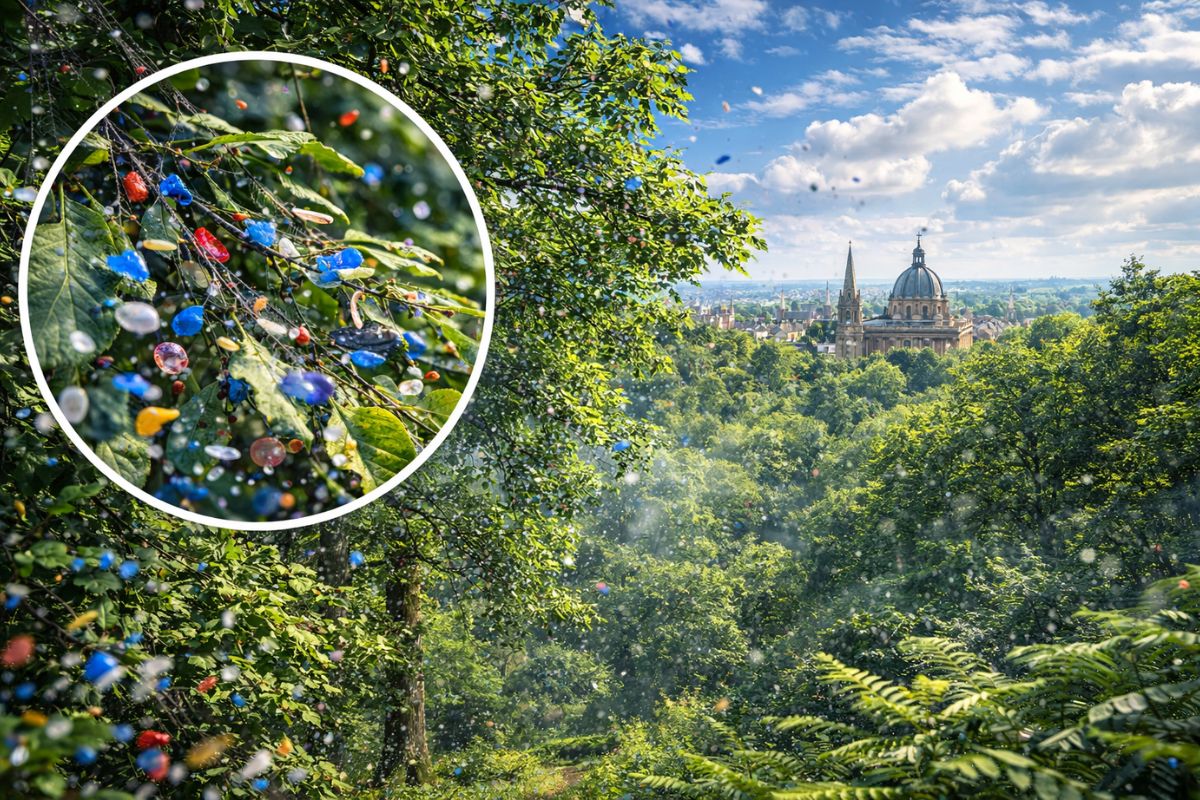


England Discovers That Trees Capture Microplastics And Concentrate More Particles In Wytham Woods Than In The City Of Oxford, Exposing A Really Global Inhalation Risk
In much of the collective imagination, the countryside is still seen as synonymous with clean air, simple living, and a safe distance from modern pollution. But a new study conducted in Oxfordshire turned this scenario upside down by showing that trees capture microplastics in large quantities and, worse, can concentrate more particles in rural forests than in urban areas.
In Wytham Woods, a forest protected for its ecological value on the outskirts of Oxford, researchers recorded between 12 and 500 microplastics per square meter per day, with peaks almost twice as high as in the city center. What was thought to be a refuge of pure air turned out to be an efficient sink for atmospheric plastic pollution, invisible to anyone walking under the trees, but measurable in every soil and deposition sample.
The Myth Of Pure Air In The Countryside Challenged By Data
During three months of monitoring, the study compared the deposition of particles in three distinct scenarios: the rural forest of Wytham Woods, the suburban area of Summertown, and the urban center of Oxford. The result was counterintuitive: the forest accumulated more microplastics per day than the city itself.
-
Motorola launched the Signature with a gold seal from DxOMark, tying with the iPhone 17 Pro in camera performance, Snapdragon 8 Gen 5 that surpassed 3 million in benchmarks, and a zoom that impresses even at night.

-
Satellites reveal beneath the Sahara a giant river buried for thousands of kilometers: study shows that the largest hot desert on the planet was once traversed by a river system comparable to the largest on Earth.

-
Scientists have captured something never seen in space: newly born stars are creating gigantic rings of light a thousand times larger than the distance between the Earth and the Sun, and this changes everything we knew about stellar birth.

-
Geologists find traces of a continent that disappeared 155 million years ago after separating from Australia and reveal that it did not sink, but broke into fragments scattered across Southeast Asia.

This is not about plastic bags flying around, disposable cups left on trails, or visible litter. The focus here is on microscopic particles, suspended in the air, that slowly settle onto the ground.
In Wytham Woods, this deposition reached up to 500 particles per square meter per day, showing that the rural environment is not isolated from the plastic pollution we mass-produce in cities and industrial hubs.
At the same time, urban centers continued to display another type of prominence: greater diversity of plastics and a chemical signature directly related to intense consumption and industrial activity. What changes is the “role” of the landscape: the city emits, the forest captures.
How Trees Capture Microplastics And Concentrate Pollution

The central mechanism identified by scientists is simple and disturbing: trees capture microplastics extremely efficiently.
Leaves, branches, trunks, and even the irregularity of the crowns function as a three-dimensional mesh that intercepts particles floating in the atmosphere.
As the air passes through the forest, the trees act as natural filters, retaining plastic fragments that then detach and fall, mixing with the leaf litter and soil.
What seemed like only a benefit, removing part of the air pollution, comes with a side effect: the concentration of microplastics in ecosystems that are not the main culprits of their emission.
Another notable fact is the size of these particles. Up to 99% of the detected microplastics were tiny, invisible to the naked eye, with dimensions under 100 micrometers.
They are light enough to remain suspended for long periods, travel great distances with air currents, and cross borders without any physical barrier.
In other words, it is not just the city that breathes plastic. When trees capture microplastics in rural areas, they expose the global nature of pollution, which reaches from the urban center to the most “untouched” forest on the map.
The “Chemical Signature” Of Plastics In The Air Of Oxford
To understand not only how much plastic reached the ground but also what type of plastic was circulating, researchers used a high-resolution FTIR spectroscope.
This technique allows for the identification of the chemical composition of particles based on the way they absorb infrared light.
The result was a kind of chemical fingerprint of the air:
- Wytham Woods, the rural forest, showed a predominance of PET (polyethylene terephthalate), closely associated with synthetic clothing and food packaging.
- In Summertown, the suburban area, the highlight was polyethylene, typical of plastic bags and common packaging.
- In the urban center of Oxford, ethylene-vinyl alcohol (EVOH), a polymer used in multi-layer packaging and industrial components, dominated.
In total, 21 different types of plastics were identified, distributed across four size ranges. Each environment, urban or rural, carries its own combination of polymers, reflecting patterns of consumption, disposal, and atmospheric circulation.
When trees capture microplastics, they also silently archive the chemical history of our economy.
Wind, Rain, And The Invisible Path Of Particles
The study also showed that the climate is not a mere backdrop: it is a protagonist in how microplastics move and settle.
During periods of high pressure and stable atmosphere, the deposition of particles decreased, indicating less material flow being transferred by the air column.
When winds intensified, especially from the northeast, the numbers soared, feeding the forest and the city with new loads of microplastics transported from afar.
Rain played an ambivalent role. Overall, it reduced the total amount of particles collected – as if it were “washing” the air, but in the samples that reached the ground, the particles tended to be larger.
Water, in this case, acts as a drag mechanism for heavier fragments, while the smaller ones continue to travel.
All of this reinforces an uncomfortable idea: microplastics not only exist, they circulate, jumping from one scenario to another according to wind patterns, atmospheric stability, and rainfall regimes. When the climate changes, so does the map of where trees capture microplastics.
Inhalation Risk: City And Countryside In The Same Problem
If the countryside receives more deposition at some times and the city concentrated greater diversity of plastics, the impact on human health converges to the same point: inhalation of microplastics is not an exclusively urban problem.
The particles detected in Oxfordshire are small enough to pass through the upper airways and reach deeper regions of the respiratory system. Science is still investigating in detail what happens next, but there are already clear concerns:
Interaction with lung tissue;
Possible transport of chemical additives present in plastics;
Ability to carry microorganisms adhered to the surfaces of the particles.
The study suggests that, from the perspective of respiratory exposure, breathing air in a forest where trees capture microplastics does not guarantee automatic protection compared to the city.
Plastic pollution behaves like an atmospheric pollutant of global reach, not like waste confined to busy streets or open-air dumps.
Forests As Double Sinks: Carbon And Microplastic
From an ecological standpoint, the accumulation of microplastics in forest soils opens a whole new front of questions. These fragments can mix with the decomposing leaf layer, penetrate the soil, and interact with fungi, bacteria, and invertebrates that support the forest food chains.
Additionally, many plastics carry chemical additives and stabilizers. In a natural environment, these compounds can be slowly released, affecting soil and groundwater quality in a process of chronic, silent, and cumulative pollution.
There is also a symbolic dimension that is hard to ignore. Forests are rightly seen as sinks for carbon and refuges for biodiversity.
Now, the study shows that they also function as sinks for atmospheric plastic pollution.
Ultimately, when trees capture microplastics in Wytham Woods, they are absorbing a piece of our lifestyle, even if that lifestyle is centered hundreds of kilometers away, in large cities, productive chains, and consumption routines that will never see that forest up close.
The problem ceases to be just “dirty city versus clean countryside” to become a story of global cycles, where each package, synthetic fabric, or plastic discarded anywhere on the map can, sooner or later, end up in the canopy of a distant tree.
The question that remains is straightforward: knowing that trees capture microplastics and that even the countryside no longer guarantees “pure air,” what do you think should change first: our daily consumption habits or the way governments regulate the use and disposal of plastic in the world?







O esclarecimento do povo . Nas escolas, para os jovens o alcance é através de música , filmes e artistas. Assim nossos hábitos de consumo podem mudar e rapidamente. Os governantes através de regulamentos e leis que incentivem as empresas a eliminar a fabricação de micro plásticos