





 Portuguese
  English
  Spanish
  4 min of reading
  2 comments


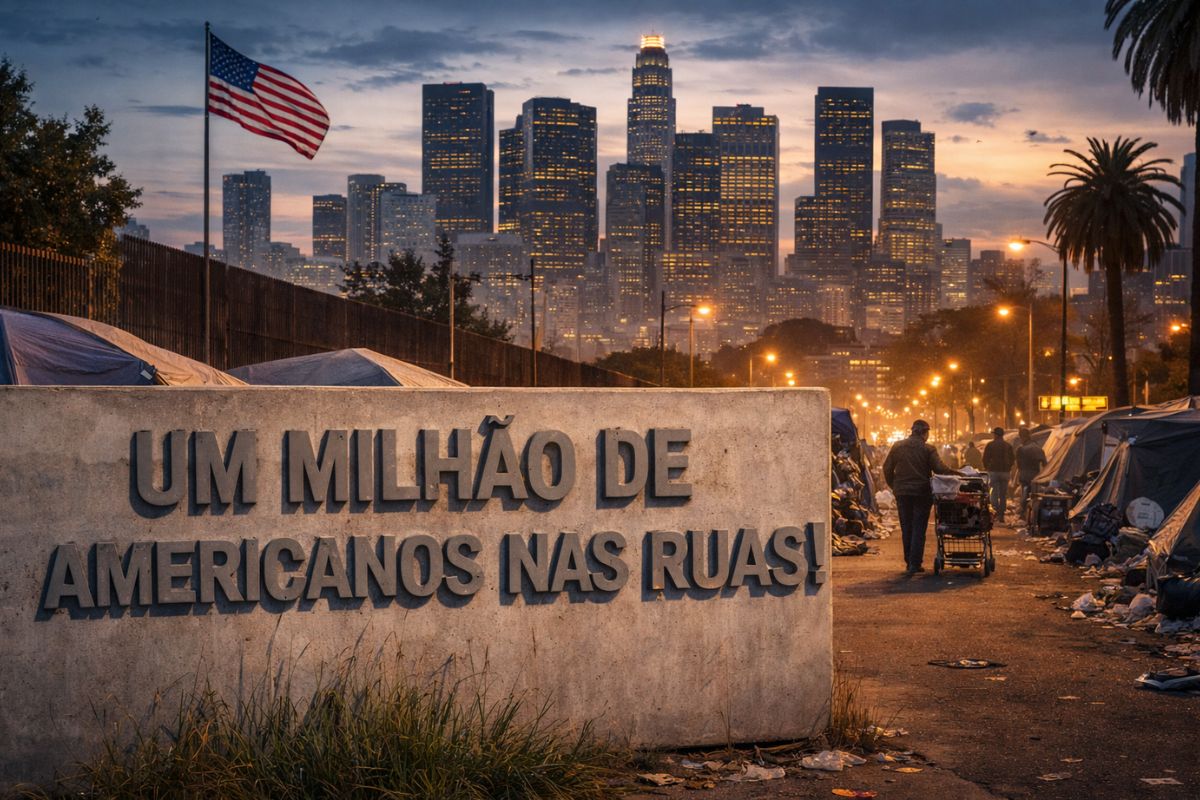


In The Richest Country On The Planet, The United States Records A Record Of Homelessness In 2024, With 771,480 People In One Night According To HUD. The Core, Experts Say, Is Affordable Housing: A Deficit Of 3.8 Million Units And Prices That Force Workers To Shelters, Vehicles, And Crowded Streets.
In the richest country on the planet, the contradiction has ceased to be an abstract data point and has become an administrative routine. In 2024, the United States recorded 771,480 people experiencing homelessness in a single night, according to HUD, and this number is now viewed as a symptom of a market that has grown without delivering affordable housing at the same pace.
The debate has gained traction because homelessness is not limited to old stereotypes and cannot be explained by a single factor. At the same time that the richest country on the planet projects economic strength, cities and states report pressure on shelters, services, and budgets, and formal workers enter the statistics due to an inability to pay rent.
What HUD Measured And Why 2024 Became A Milestone
HUD solidified the most cited snapshot of 2024 by estimating 771,480 people experiencing homelessness in a single night.
-
The government requests the Federal Revenue Service for a new system to automate the income tax declaration, reducing errors, time, and bureaucracy for millions of Brazilians.

-
Pix in installments, international Pix, and contactless payment without internet: the Central Bank revealed the new features coming to the tool that is already used by almost every adult in Brazil.

-
Mercado Livre has just started selling medications with delivery in up to three hours to your door, and this move could completely change the way Brazilians buy medicines on a daily basis.

-
In Dubai, rising tensions from the war in the Middle East are causing super-rich individuals to leave the Gulf and direct their fortunes to a new financial refuge in Asia.


The rate associated with this portrait, of about 23 people for every 10,000 inhabitants, helps to dimension the phenomenon in the richest country on the planet without reducing the discussion to isolated cases.
The lens is noteworthy because it redefines what is “normal” in the United States when it comes to housing.
When the indicator rises in a country with an estimated GDP of about R$ 162 trillion, the inevitable reading is structural, and not just conjunctural, since HUD treats the number as an official measurement that is comparable over time.
Where Homelessness Concentrates And How Geography Plays A Role
The largest contingents appear in states that already deal with high costs and intense competition for urban space.
California accounts for about 187,000 people experiencing homelessness, and New York exceeds 158,000, signaling that part of the pressure accumulates in markets where affordable housing has become a rare asset and, in many neighborhoods, inaccessible.
There are also areas where the deterioration has been rapid.
In Hawaii, the rate nearly doubled between 2019 and 2024, showing that deterioration can occur in just a few years when price, supply, and income get out of sync.
In the United States, the practical reading is simple: where rent skyrockets and supply does not keep pace, homelessness forcefully enters the public agenda.
Affordable Housing At The Center Of The Economic Diagnosis
Experts cited in the survey point out that the lack of affordable housing serves as the core of the problem.
Economist Sam Khater of Freddie Mac estimated that by the end of 2020, the United States had a deficit of 3.8 million housing units, a gap that tends to be reflected in higher rents and reduced margins for families with stable income.
The increase in costs did not arise from a single shock.
There was a labor shortage in construction, rising material costs, and during the pandemic, lumber prices surged more than 150%, squeezing projects and pushing final prices higher.
When the supply of affordable housing decreases, the market reorganizes the city by income, and homelessness becomes the most visible effect.
What Public Policy Can Address And What Remains Pending
The current debate avoids one-size-fits-all solutions because the crisis combines real estate markets, urban planning, financing, and service networks.
Still, the discussion around affordable housing appears as a point of convergence: expanding supply, reducing construction bottlenecks, and unlocking entry projects are cited as essential measures to reduce homelessness in expensive U.S. cities.
The problem is not unique to one country, even when it is the richest country on the planet.
The UN estimates that between 1.6 billion and 3 billion people lack access to adequate housing, and over 330 million live in extreme homelessness, and the growth of the phenomenon in developed economies like the United States, the United Kingdom, and Germany indicates a systemic failure in the connection between income, price, and access.
Homelessness exists, but how long will the richest country on the planet accept normalizing an indicator that HUD measures on a historical scale, while affordable housing continues to fall short of demand? In your city, what weighs more in pushing families out of the market: rent, lack of supply, wages, or urban regulations?









Em quais estados a droga é liberado no EUA?
e, em quais estados estão 90 por cento dessa população de rua?
Será coincidência?
Um pais que consegue ter proporcionalmente mais habitantes de rua que o Brasil. E aqui cheio de vira lata achando que lá é um paraíso