





 Portuguese
  English
  Spanish
  4 min of reading
  12 comments


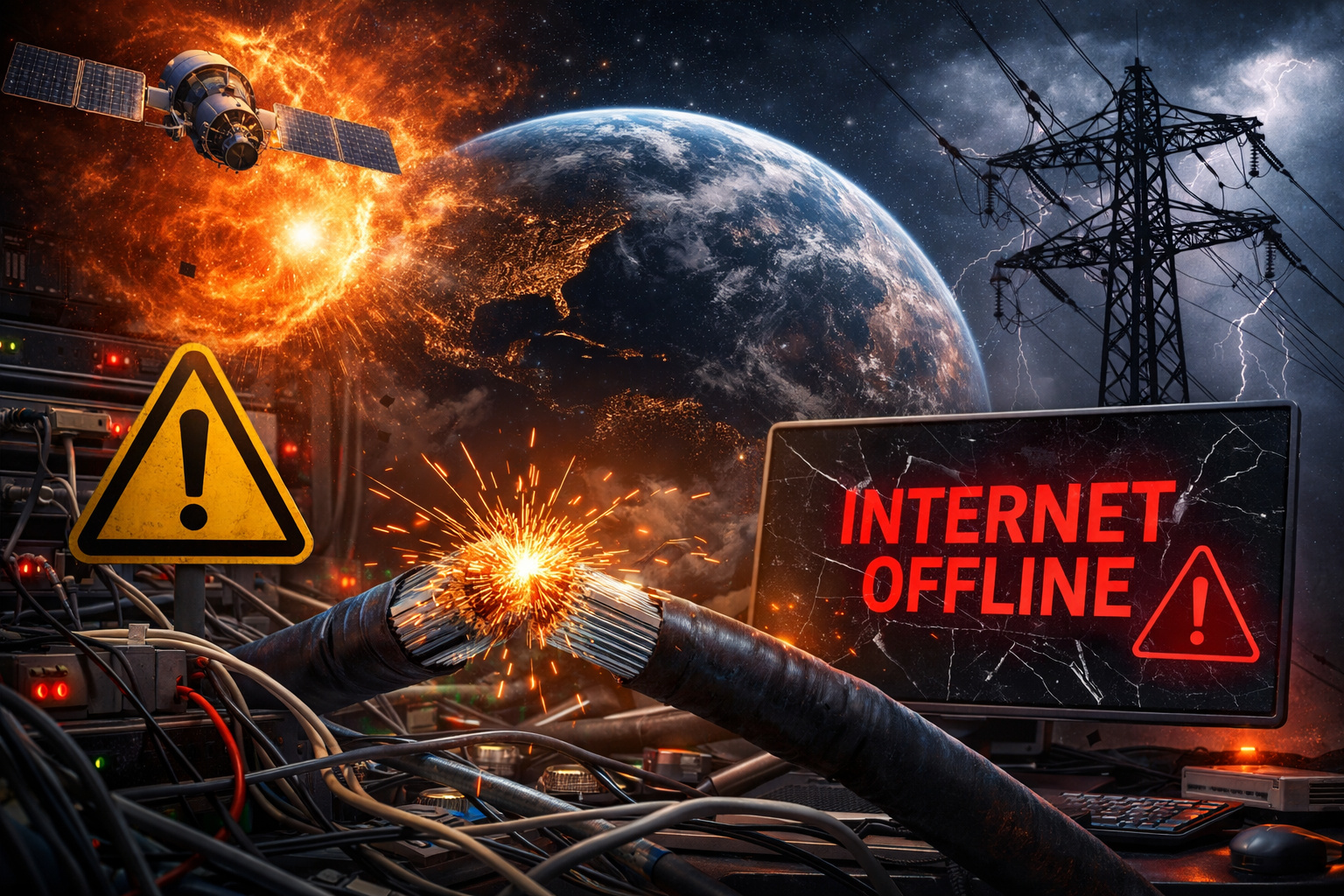


Professors and Researchers Warn About the Risk of a Global Internet Collapse and How It Could Bring Down Strategic Sectors of Oil, Gas, Energy, and Health, and What Makes This Situation Unlikely but Very Possible.
Imagine waking up and realizing that it’s not just your Wi-Fi that’s down. It’s everything. A global internet collapse. Banks, stock exchanges, industrial platforms, hospitals, refineries. A digital silence. It sounds like a movie script, but the pressing question is: could the entire internet go down at once?
Experts say this scenario is unlikely. However, it’s not impossible. And when it involves sectors that generate trillions of dollars, the conversation shifts from curiosity to industrial alert.
The Invisible Risk That Could Impact Oil, Hospitals, and Power Grids in Just a Few Hours
The Internet Is Not a Single Central System. It operates as a network of interconnected networks on a global scale. For everything to stop, it would require multiple layers of infrastructure to be affected almost simultaneously.
-
Motorola launched the Signature with a gold seal from DxOMark, tying with the iPhone 17 Pro in camera performance, Snapdragon 8 Gen 5 that surpassed 3 million in benchmarks, and a zoom that impresses even at night.

-
Satellites reveal beneath the Sahara a giant river buried for thousands of kilometers: study shows that the largest hot desert on the planet was once traversed by a river system comparable to the largest on Earth.

-
Scientists have captured something never seen in space: newly born stars are creating gigantic rings of light a thousand times larger than the distance between the Earth and the Sun, and this changes everything we knew about stellar birth.

-
Geologists find traces of a continent that disappeared 155 million years ago after separating from Australia and reveal that it did not sink, but broke into fragments scattered across Southeast Asia.

According to experts, this would require <strongmassive resources or an extreme coincidence of events.
The problem isn’t just losing social networks. Industrial platforms for oil and gas use connected systems for pressure monitoring, ship logistics, refinery control, and communication between offshore units.
Hospitals rely on connected IT systems for medical records, tests, assisted surgeries, and integration with laboratories.
Power grids utilize digital monitoring for load control, stability, and distribution. A prolonged failure could trigger a domino effect.
The economic impact would be immediate.
The Engineering Behind the Internet That Prevents a Total Blackout
The internet was designed to survive failures. From the beginning, it incorporated what experts call heterogeneity and distributed asynchrony.
In practice, this means that when you send a message, it is divided into small packets that take different paths to the destination.
If one route fails, another takes over.
This model protects against undersea cable cuts, outages of major providers, localized cyberattacks, and failures in regional hubs.
Even when infrastructure companies experience disruptions, the effect tends to be limited and temporary.
It is precisely this decentralized architecture that makes a global collapse extremely difficult.
When Governments Shut Down the Internet and What This Reveals About Real Vulnerabilities
There are precedents for intentional disruptions.
Some governments have reduced or cut off access during periods of protest by disabling physical infrastructure or limiting connections.
Even in these cases, recovery tends to be quick.
This highlights two important points.
First, the internet can be affected regionally.
Second, the restoration capacity is surprisingly fast.
But blocking a region is one thing. Bringing to a halt the global machinery that sustains entire supply chains is quite another.
Solar Storms, Attacks or Simultaneous Failures Are Extreme Situations That Worry Experts
Among the cited risks is an intense and unexpected solar storm.
An event of this magnitude could affect satellites, communication systems, and part of the electrical infrastructure.
There is no official number released regarding the exact recovery time in an extreme case like this. Estimates suggest that repairs could take time, depending on the extent of the damage.
Governments and large companies maintain contingency plans, including cloud storage and backup power generators.
Even so, the more dependent we become on connectivity, the greater the potential impact of any disruption.
Growth of the Network Strengthens or Weakens the Digital Economy
There is a recurring fear that the constant growth of the internet could overload its foundations.
Experts argue that the opposite occurs.
The more we are added, the greater the system’s resilience tends to be.
This means that the very industrial expansion of connectivity helps make it more robust.
However, economic dependency also increases. Sectors such as oil, energy, and health are becoming increasingly digitalized. Efficiency has increased. Productivity has skyrocketed.
In contrast, exposure to systemic risk has also grown.
The debate, therefore, is not whether the internet will go down tomorrow, but whether we are prepared if it does.
The possibility of a global collapse may be remote, but the mere fact of affecting hospitals, refineries, and power grids is enough to keep governments and companies in a state of permanent alert.
What about you, do you believe that the global economy could survive a few days without the internet? Share your opinion in the comments.








Como goi dito o problema o problema não é o fato, mas as consequências. Hoje a grande maioria das pessoas está dependente da Internet, não consegue resolver simples questões cotidianas, será um caos inimaginável. 🙏🇧🇷💀🤟
Fato, eu imagino o caos, pois os ser humanos, estão sendo robotizado, só lamento quanto a área da saúde, que já sofre por escarces de tudo, será um terror pra quem precisa respirar ou fazer uma cirurgia de emergência.
Veremos sou do signo de escorpião