





 Portuguese
  English
  Spanish
  6 min of reading
  20 comments


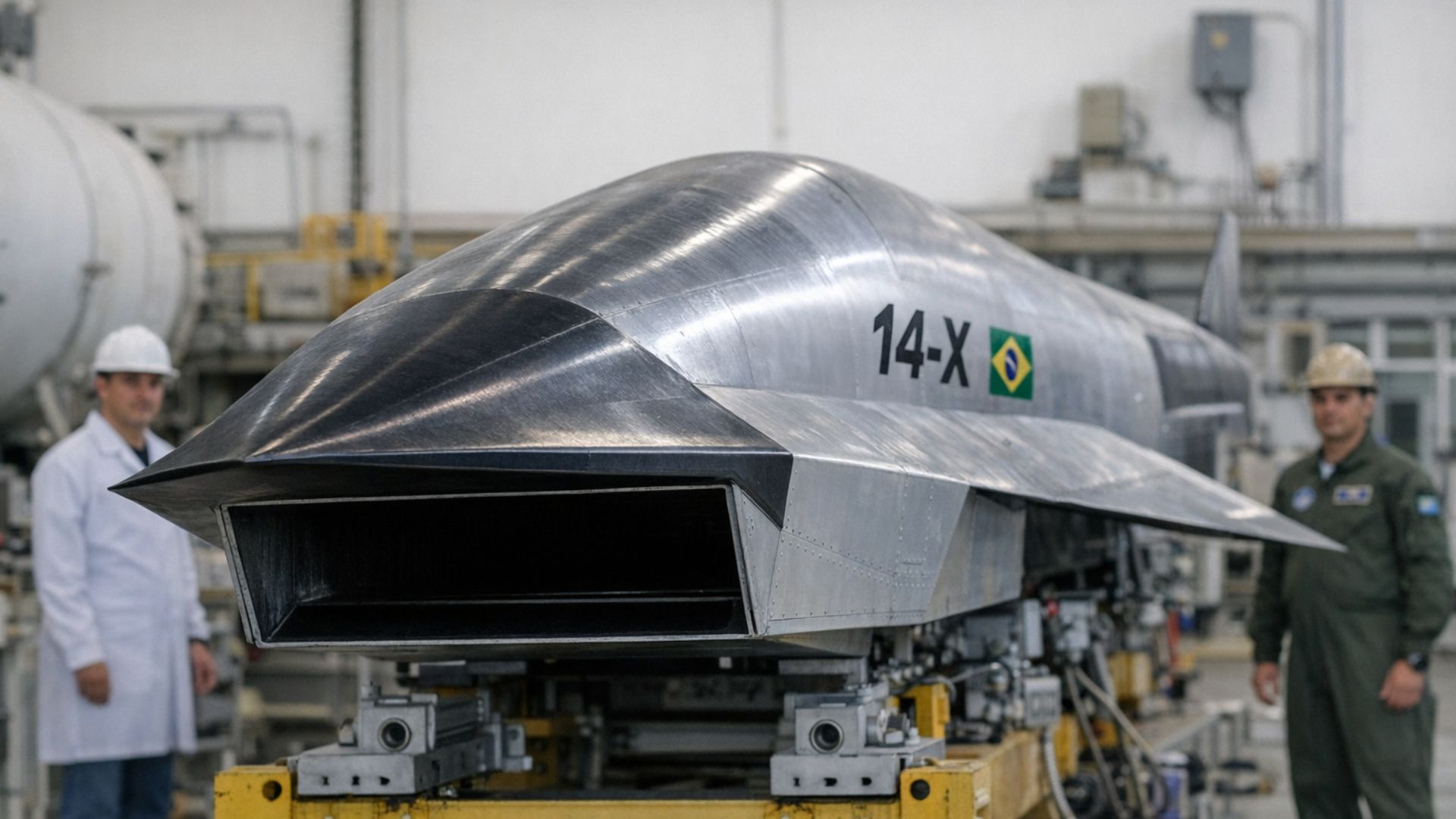


Brazilian Aerospace Research Project Brings Together Studies in Supersonic Combustion, Hypersonic Aerodynamics, and Systems Integration to Demonstrate in Flight the Operation of a Scramjet Engine at Extreme Speeds, Placing the Country Among the Few That Publicly Investigate This Type of Technology.
A Brazilian aerospace research project aims to demonstrate, under real flight conditions, the operation of a scramjet engine, a hypersonic propulsion technology that uses atmospheric oxygen for combustion in supersonic mode.
Known as 14-X, the program is conducted under the Brazilian Air Force and the Department of Aerospace Science and Technology, with technical development at the Institute of Advanced Studies in São José dos Campos.
The project appears in institutional documents and scientific publications as an initiative aimed at the experimental validation of air-breathing hypersonic propulsion systems.
-
Tourists were poisoned on Everest in a million-dollar fraud scheme involving helicopters that diverted over $19 million and shocked international authorities.

-
Hidden beneath the dense forest of the Sierra Nevada, Betoma emerges in a neighbor of Brazil as the greatest archaeological discovery of the century, revealing a colossal ancestral city covering over 18 km², with 8,334 stone structures and the potential to rewrite the history of South American civilizations.

-
Goodbye iron: new technology from Xiaomi promises to revolutionize the way we iron clothes with 500 kPa steam, continuous flow of 120 g/min, heating in 65 seconds, and six smart modes for different fabrics.

-
Rio Pardo, the most mysterious city in Rio Grande do Sul: untouched Pampas castle, the missing treasure of the Devil Boy, bride’s saint, invisible tunnels, and a 200-year curse today.


What Is the Scramjet Engine
The 14-X is officially described as a tech demonstrator associated with the use of a scramjet, an acronym in English for Supersonic Combustion Ramjet.
This type of engine is designed to operate only when the vehicle is already traveling at very high speeds.
Unlike conventional turbines, the scramjet does not use moving parts, such as compressors and turbines.
Its operation relies on the vehicle’s own motion to compress the incoming air, a necessary condition to maintain combustion in supersonic flow.
Technical Steps and Engineering Challenges


According to the technical documentation released by the Institute of Advanced Studies, the project involves specific steps to establish the initial operating conditions of the engine in flight.
Next, the focus is on demonstrating the thrust generation in an air-breathing hypersonic system, fed directly by atmospheric air.
This architecture is treated in reports as an engineering challenge, as the captured air needs to be decelerated and conditioned before entering the combustion chamber.
At the same time, the vehicle is subjected to intense aerodynamic heating and high structural stresses.
Waverider Aerodynamics and Mach 10
The concept of the 14-X is associated with an aerodynamic shape known as waverider.
Scientific articles describe this geometry as capable of leveraging shock waves to generate lift in hypersonic regime.
Published works in the Journal of Aerospace Technology and Management report experiments and analyses related to a waverider derived from conical flow.
These studies refer to Mach 10 conditions in aerodynamic analyses associated with the project.
Institutional References of the Brazilian Air Force
In the institutional materials of the Brazilian Air Force, the 14-X is presented within the context of research in hypersonic propulsion.
There is mention of speeds equivalent to ten times the speed of sound.
The FAB also uses values around 12 thousand kilometers per hour as a reference to illustrate the hypersonic flight regime sought by the demonstrator.
These references are always associated with the experimental and scientific nature of the program.
Tech Demonstration and Initial Acceleration
The focus of the program is on the demonstration of physical and engineering principles, and not on the regular operation of a vehicle for continuous use.

For a scramjet to function, the vehicle must first reach a high speed.
This typically requires an initial acceleration system, such as a sounding rocket, capable of bringing the assembly to the appropriate air entry conditions and combustion stability.
The project’s technical literature describes achieving these conditions and the measurement of the thrust generated as central steps for validating the concept.
Supersonic Combustion and System Integration
The engineering of a scramjet involves challenges relating to flow control, fuel mixing, and combustion in extremely short time intervals.
An article from Revista Pesquisa FAPESP, which discussed the 14-X in a scientific context, describes that the captured air must be decelerated, pressurized, and heated before entering the combustion chamber.
In this environment, the fuel is injected into a flow that remains supersonic.
The publication also emphasizes that the absence of moving parts differentiates this type of engine from those used in commercial aircraft.
Propulsion and Aerodynamics as an Integrated System
Besides the engine, the integration of propulsion and aerodynamics is presented as a central element of the project.
At hypersonic speeds, small variations in geometry and temperature can significantly alter the behavior of the airflow.
These changes directly impact both the lift and the engine’s performance.
For this reason, the 14-X is described in technical articles as an integrated system, in which the fuselage, air intake, and combustion chamber must operate in a coordinated manner.
PropHiper Program and Stepwise Organization
The program is often identified by the name PropHiper in public communications and institutional reports.
The research lines mentioned include aerothermodynamics, materials, and instrumentation.
In technical pages of ITA and in documents associated with the project, the 14-X appears divided into versions focused on specific objectives.
Among them are establishing the initial operating conditions of the engine and demonstrating the thrust generation.
This stepwise organization is presented as a common practice in technology demonstration programs.
Scientific Basis and Institutional Participation

At the project’s scientific base, articles and conference papers detail Brazil’s efforts in studies of waveriders and air-breathing hypersonic propulsion.
A technical document from the Brazilian Association of Engineering and Mechanical Sciences describes the 14-X as a hypersonic vehicle developed at the Institute of Advanced Studies.
The text links the project to research in aerothermodynamics and hypersonics conducted at the Prof. Henry T. Nagamatsu laboratory.
It also notes the participation of researchers from IEAv and DCTA.
Open Research and International Context
Internationally, scramjet technologies are featured in research and demonstration programs conducted by various countries.
These initiatives are often associated with environments of high technical complexity.
In the Brazilian case, the 14-X is documented by institutional sources and scientific literature as an open research initiative.
Declared objectives include generating knowledge in supersonic combustion, hypersonic aerodynamics, and flight instrumentation.
From Bench to Experimental Flight
The promotion of the 14-X by official bodies and scientific journals emphasizes the transition of results obtained in the laboratory to evidence collected in flight.
Wind tunnel tests and ground combustion tests are cited as relevant stages.
Validation under real conditions arises as the means to measure thrust, thermal behavior, and flow stability in the engine.
These measurements occur within a limited operational window, a characteristic of this type of experiment.
Scientific Reach of the 14-X Project
By bringing together technical references from the Institute of Advanced Studies, public communications from the Brazilian Air Force, and studies published in journals and scientific proceedings, the 14-X presents itself as a Brazilian project for developing air-breathing hypersonic technology.
The focus is on research in scramjet and waverider.
This type of investigation is followed by specialists as it involves strict engineering limits related to heating, control, and combustion at high speeds.
If the flight demonstration of a scramjet depends on precise integration between engine, vehicle, and initial acceleration systems, what industrial and scientific capabilities need to be consolidated to support this type of research continuously?









Na ficção tudo funciona. Na realidade…. bom na realidade os EUA não deixaram o Brasil construir algo assim.
Só tem propaganda caramba
O Brasil tem um programa especial dos mais antigos do mundo, mas nada de concreto se fez. Uma chance real teve mas sabotaram explodiu o foguete mataram os pesquisadores e nenhuma satisfação foi dado aos pagadores de impostos.
Muito papo, só vendo pra crê.