





 Portuguese
  English
  Spanish
  4 min of reading
  0 comments


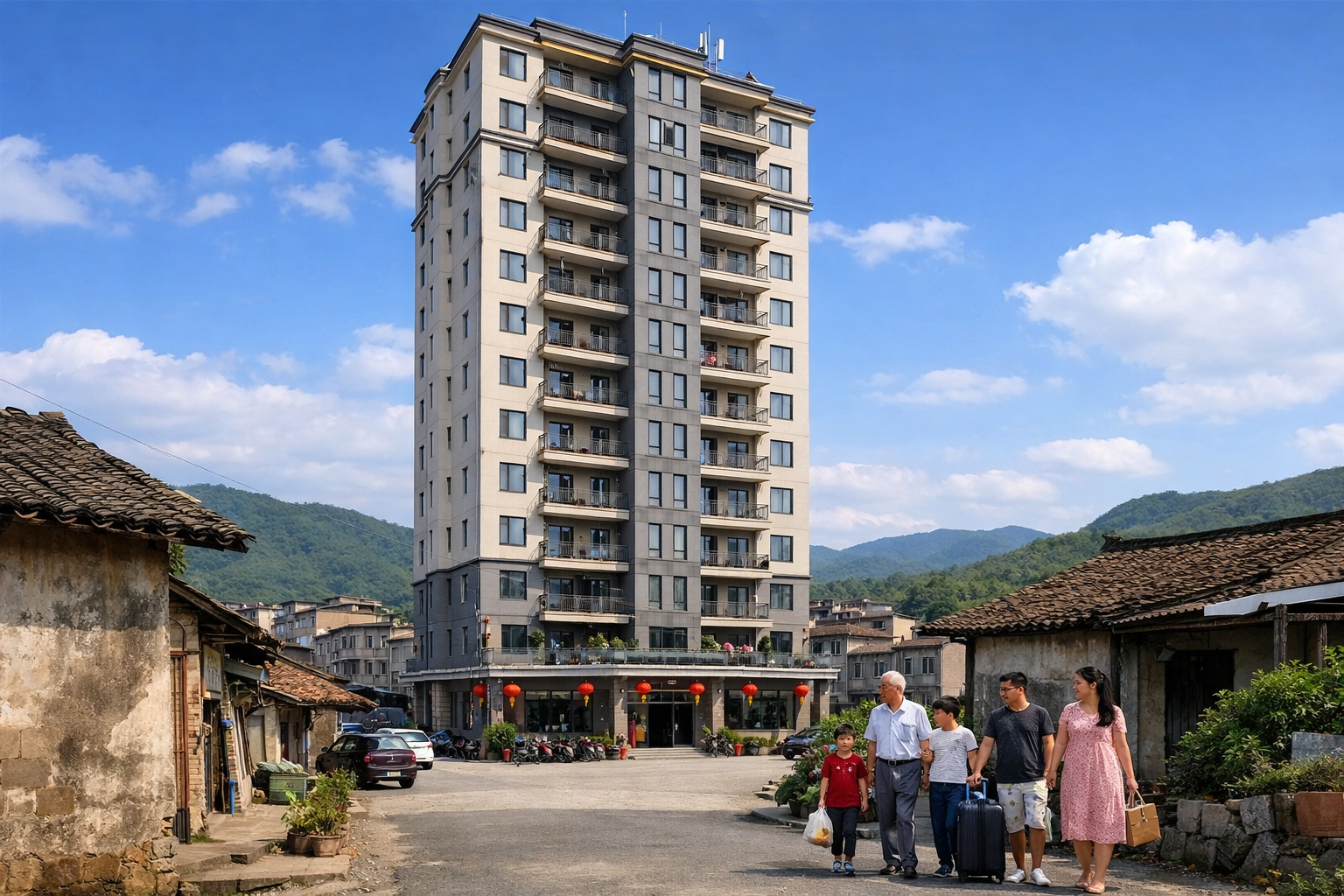
Neither Hotel Nor Condominium, Family Built a 15-Story Building with 22 Apartments on About 200 m² to Gather Relatives, Preserving the Address and Changing the Way of Living as a Family.
A 15-story building was constructed in the middle of a village where almost everything is, at most, six stories long. Just that scene already attracts attention. The story becomes even more curious when the reason comes into play. It wasn’t a hotel. It wasn’t a condominium for sale. It was a family decision to solve a very practical problem: limited space, many people, and a real desire to stay close.
The result became a local symbol. An entire building for a single family, with more than 100 relatives sharing the same surname, living under the same roof, but in separate apartments.
What Happened in Zhuyuan and Why a Building Attracted More Attention Than the Village Itself
The case became known in 2016 when it started to gain traction and attracted attention outside of China. In the village of Zhuyuan, in Fujian province, the Zhou family erected the tallest building in the region.
-
Friends have been building a small “town” for 30 years to grow old together, with compact houses, a common area, nature surrounding it, and a collective life project designed for friendship, coexistence, and simplicity.

-
This small town in Germany created its own currency 24 years ago, today it circulates millions per year, is accepted in over 300 stores, and the German government allowed all of this to happen under one condition.

-
Curitiba is shrinking and is expected to lose 97,000 residents by 2050, while inland cities in Paraná such as Sarandi, Araucária, and Toledo are experiencing accelerated growth that is changing the entire state’s map.

-
Tourists were poisoned on Everest in a million-dollar fraud scheme involving helicopters that diverted over $19 million and shocked international authorities.


The structure stands out because it deviates from the local standard. While the neighbors rarely exceed six stories, there appeared 15 floors with the appearance of an urban building, but with a very different logic inside.
Instead of a commercial enterprise, the construction became an expanded family address, designed to accommodate those who live there year-round as well as those who return on important dates.
The Reason That Pushed the Family to Build Upwards Instead of Outwards
The explanation has more to do with necessity than luxury. Over time, old houses were demolished and the number of relatives grew.
Dividing the same land into several small houses became unfeasible. The available space was limited, and if each unit built separately, the land would shrink for everyone and the property would fragment.
That’s when the vertical solution appeared as a practical agreement. Instead of each going to a corner, the family preferred to maintain a unified address and create enough housing for several generations, without giving up living together.
The Numbers Behind the Building and How It Was Designed for Real Life
About 20 family members pooled resources and requested from the city hall an area of approximately 200 square meters to put the plan into action. The construction took about ten years to complete.
The building ended up with 22 apartments, with two units per floor. This helped balance privacy and proximity, as each family has its space, but everyone remains at the same address.
The structure was also designed for the routine of real people. There are elevators, underground garages, and a multifunctional ground floor. The ground floor, which could be commercial, became a communal area and also a place for storing food.
A Condominium Without a Manager, with Rules Made by the Family and a Tradition That Became Routine
Despite its appearance as a condominium, there is no manager or administrative body. The management is familial, based on conversations, agreements, and collective discipline.
Expenses, living norms, and day-to-day decisions are defined by the residents themselves. This model helps reduce disputes over space and keeps the property as a shared asset, not dividing ownership into pieces.
Cultural explanation comes in as a backdrop, but without mystery. The idea of several generations living close has long been valued in China, and the building becomes a modern way to keep this working in an increasingly crowded urban setting. The case was detailed by the portal Xataka Brasil when recounting the construction and the building’s numbers.
How Festive Dates Change the Building and Why It Became a Kind of Meeting Point
There is a detail that brings the story to life. During times like the Lunar New Year, the building takes on a different face.
Busy corridors, luggage, arriving visitors, children running, and the smell of home-cooked food. It’s the kind of scene that transforms a building into something beyond concrete and elevator. It becomes a place of return.
And perhaps that’s the central point. For many people, living close to family is difficult due to lack of space and cost. In Zhuyuan, the answer was radical and simple at the same time: build upward to avoid separation.
So, what seems most surprising about this story to you: the scale of 15 stories, the idea of maintaining the property without fragmentation or the informal way of managing everything without a manager?










-

-

2 pessoas reagiram a isso.