





 Portuguese
  English
  Spanish
  6 min of reading
  0 comments


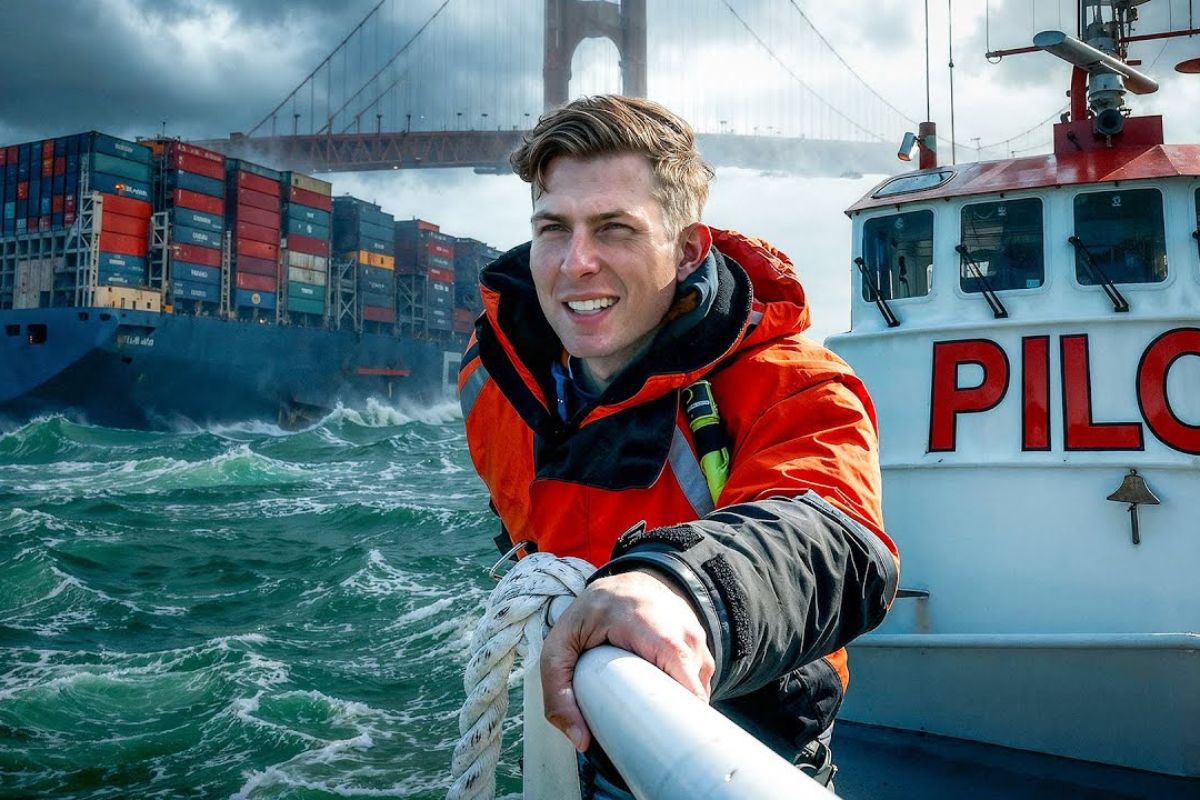
In San Francisco Bay, The Bar Pilots Board 11 Miles Offshore to Take Navigation of the World’s Largest Ships Through the Golden Gate. With a Draft Over 45 Feet, Fog and Cross Currents, Each Order Must Protect Ports and Avoid Accidents That Move $40 Billion Annually.
The world’s largest ships do not enter San Francisco Bay like a car enters a familiar street. They arrive with inertia, draft restrictions, and a margin of maneuver that shrinks with every meter, exactly where the Golden Gate concentrates current, wind, and a narrow channel surrounded by sandbars.
In this scenario, The Bar Pilots take the helm for a simple reason: the ship’s captain may be experienced in oceans, but lacks local knowledge of wind, current, hazards, and shallow areas that define what is safe in San Francisco. The routine is silent, technical, and leaves no room for hesitation.
Who Really Controls The World’s Largest Ships When They Arrive in San Francisco Bay

When a ship approaches the Golden Gate, the transfer of command occurs in a procedural manner, but with immediate practical consequences.
-
Motorola launched the Signature with a gold seal from DxOMark, tying with the iPhone 17 Pro in camera performance, Snapdragon 8 Gen 5 that surpassed 3 million in benchmarks, and a zoom that impresses even at night.

-
Satellites reveal beneath the Sahara a giant river buried for thousands of kilometers: study shows that the largest hot desert on the planet was once traversed by a river system comparable to the largest on Earth.

-
Scientists have captured something never seen in space: newly born stars are creating gigantic rings of light a thousand times larger than the distance between the Earth and the Sun, and this changes everything we knew about stellar birth.

-
Geologists find traces of a continent that disappeared 155 million years ago after separating from Australia and reveal that it did not sink, but broke into fragments scattered across Southeast Asia.

The Bar Pilots introduce themselves, check if “everything is functioning,” and exchange information with the captain, aligning course, speed, limitations, and any deficiencies that may compromise the crossing.
The central point is that from then on, The Bar Pilots direct the navigation with rudder orders to the helmsman and machine commands via the mate.
It is not a symbolic gesture; it is an operational transfer, built on locally accumulated knowledge tested in fog, currents, and heavy traffic within San Francisco Bay.
There is also an explicit regulatory aspect: above 750 tons, passage requires a pilot.
The practical consequence is that The Bar Pilots end up being, in practice, the most exclusive local license for the crossing, with authority to conduct any vessel that needs to traverse the Golden Gate and enter San Francisco Bay.
Golden Gate, Sandbars, and The Invisible Map That Decides The Maneuver

The reason for the term The Bar Pilots lies in a horseshoe-shaped sandbar that extends nearly five miles along the coast of the Golden Gate.
The main route passes through a narrow channel in the middle of this natural obstacle, a bottleneck that helps explain why San Francisco Bay is treated as one of the most treacherous waters on the planet.
To organize traffic, maritime navigation follows specific routes, like an invisible highway.
San Francisco Bay is divided into three routes, two deep water channels, north and south, and a shallow water channel that separates them for smaller ships.
Almost all incoming traffic, when not going up the river, uses the deep channel to the east south of Alcatraz Island, while outgoing traffic uses the channel heading west north of Alcatraz.
When the draft is too high, the choice of channel goes from preference to a safety condition, and some ships need to operate in the deep southern channel both on entry and exit.
Draft, Clearance Under The Keel, and “No Clutch”: What A Pilot Calculates Before Giving The Order

A 1,200-foot container ship does not “brake” like vehicles on land. The report is straightforward: to stop, the engine must go to stop and there is no clutch.
Quickly releasing anchors on such a large ship can lead to drag and damage, so planning begins before the bow reaches the bridge.
In practice, The Bar Pilots work with minimal margins. One cited example is the concern for clearance under the keel in shallow stretches, estimated to be around three feet in relation to a point known as Knoll Shoal.
When the draft becomes a critical number, each order is a choice between safety and available space.
Within San Francisco Bay, the typical cited speed is 15 knots, dropping to below 10 knots near anchorage areas and when passing under the Bay Bridge.
With a stated displacement of 150,000 tons, inertia demands anticipation, and the crossing requires fine reading of currents, wind, and trajectory to avoid turning a small adjustment into irreversible drift.
Fog, Waves, and 24-Hour Routine: When The Decision Is To Stop and Turn Back
The operation does not occur within a comfortable window. Control is continuous, 24 hours a day, 365 days a year, with pilots ready to bring a ship from the sea and communication via radio that establishes meeting points, position, and boarding arrangements.
Boarding usually occurs about 11 miles from the Golden Gate, with pilot ladder and relative movement between hull and launch.
The safety limit is not theoretical. Waves of 18 to 20 feet have been reported as a scenario faced, and in winter conditions, the risk of transfer may involve winds around 50 knots and seas of 20 feet, requiring second-timing for the transfer from the platform to the ladder.
In San Francisco Bay, fog is a critical factor, requiring at least half a mile of visibility at key points.
When visibility does not exist, the procedure is to anchor and wait, or to direct ships to maintain position and “turn back” until a new window opens.
The Offshore Logistics: Fast Launch, Station Boat, and The “Invisible Line” of The Golden Gate
The work of The Bar Pilots depends on an infrastructure that typically goes unnoticed by those observing the Golden Gate from the bridge or the coast.
The transport launch described as Golden Gate was commissioned as a monohull aluminum project, with complete instrumentation, radars, electronic nautical chart, and radio for communication with control.
The numbers help understand the operational design. The launch is cited as being 67 feet long, with seats to transfer pilots and a maximum speed of around 35 knots, with two engines of about 1,200 horsepower each.
The base boat, at 105 feet and steel hull, takes The Bar Pilots to the ships offshore, where they can eat, rest, and await the next call, keeping San Francisco Bay operating uninterrupted.
The Bar Pilots, Extreme Selection, and What Is At Stake In Each Crossing
The path to becoming a Bar Pilot is described as long, with years until obtaining a long course captain’s license and severe filtering in tests and simulators.
In a concrete example, 75 people took the written exam, about 15 made it to the simulator, and 12 passed, a funnel that clearly shows why the group operates as a technical elite.
The pressure is also justified by the human risk of the function. Every year, worldwide, a pilot is cited as someone who loses their life or is severely injured when boarding or disembarking, and this happens precisely when there are no safety nets and no harnesses, where a fall can mean water or deck between the launch and the ship.
The economic weight appears with numbers that tie the debate to the real world.
The Bar Pilots have been associated with the operation of about 8,000 ships that enter and exit and approximately $40 billion in revenue for the economy, covering ports like Oakland, Richmond, Martinez, Benicia, Stockton, Sacramento, and Redwood City, with missions that can include cruises. When the largest ships on the planet are delayed or stop, the cost is not abstract; it propagates in a chain.
The crossing through the Golden Gate is not a spectacle; it is a procedure. With each radio call, the same script occurs:
The Bar Pilots board, take the navigation, read wind, current, and draft, and make the ship fit into a water corridor with its own rules within San Francisco Bay.
If you were in the command bridge, what would make you most anxious: the boarding ladder 11 miles from the coast, the fog closing in on San Francisco Bay, or the feeling of steering the world’s largest ships knowing that the draft forgives no mistake?







-

-

2 pessoas reagiram a isso.