





 Portuguese
  English
  Spanish
  5 min of reading
  0 comments


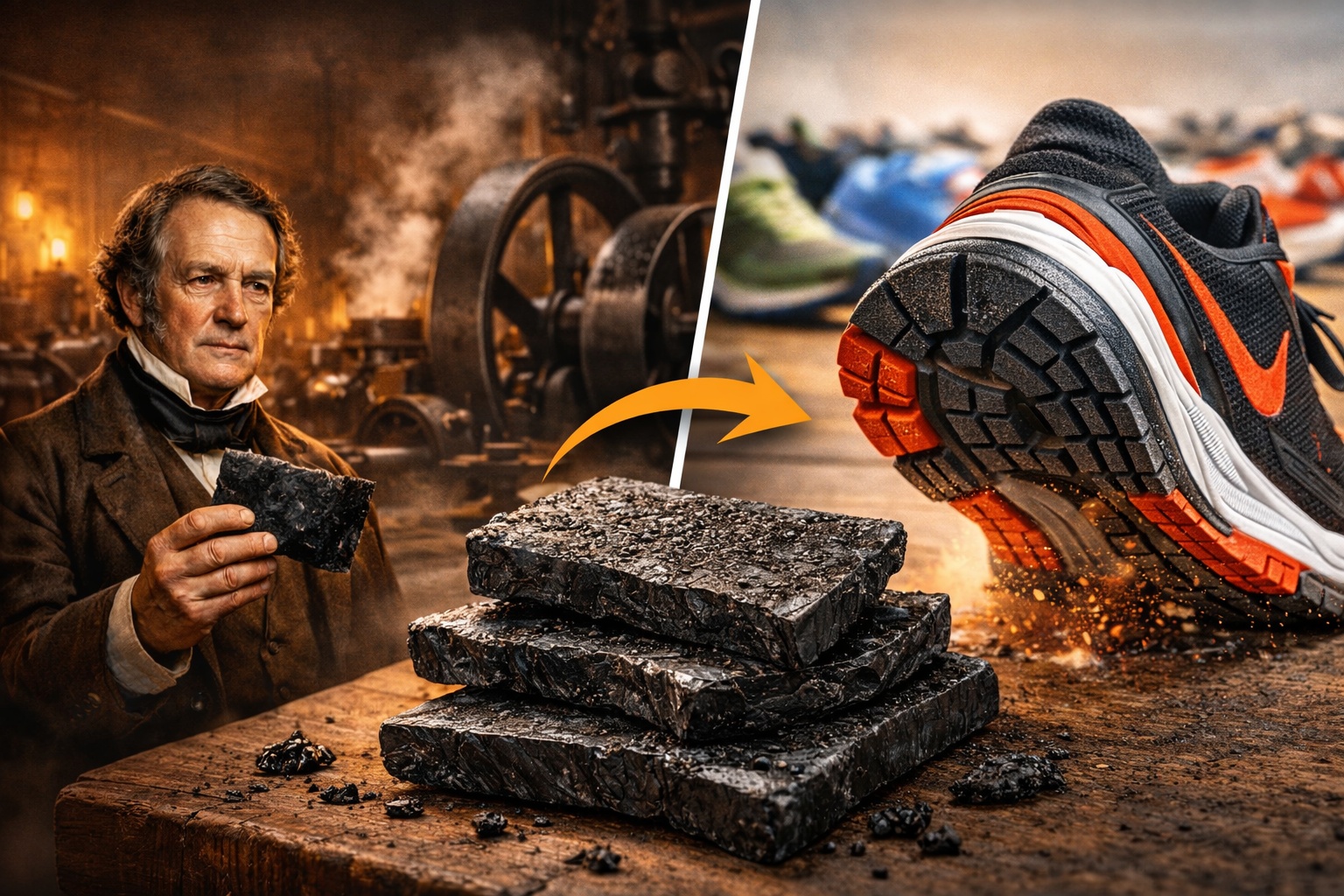
The Rubber Sole of Running Shoes Was Born from Vulcanized Rubber Created by Charles Goodyear in 1844. Discover How an Industrial Material Ended Up Revolutionizing Sports Footwear.
The rubber sole that seems like an obvious component of sports shoes today has a very distant origin from the world of athletics. In fact, the material that would revolutionize sports footwear was born within the heavy industry of the 19th century. The process that made it possible to use rubber on a large scale was discovered by Charles Goodyear, an American inventor who dedicated years of his life to solving a problem that rendered the material practically useless for industrial applications.
Until the early 19th century, natural rubber had two serious limitations: it became sticky on hot days and extremely rigid when exposed to cold. These characteristics prevented its use in machines, sealing equipment, and other devices that required mechanical stability. It was in this context that a chemical process capable of completely transforming the material’s properties emerged.
The Discovery of Rubber Vulcanization That Transformed the Industry
In 1839, after numerous experiments, Charles Goodyear discovered that by heating natural rubber mixed with sulfur, a structural transformation occurred in the material. This process created chemical bonds between rubber molecules, making the compound more durable, elastic, and stable. The discovery was patented in 1844, marking the birth of the so-called vulcanized rubber.
-
One of the most important lakes in the United States for birds, the balance of nature, and the climate has dried to historic levels, leaving boats stranded, revealing salt flats, and showing how the lack of water can transform an entire landscape.

-
It’s not Cristiano Ronaldo or Messi: the richest football player in the world is only 27 years old, has a fortune of 100 billion reais, and is the nephew of a sultan from an Asian country that few people know about.

-
At 77, the king of one of the most famous and powerful crowns on the planet is said to be under pressure to leave the throne, while behind the scenes there are already talks of a new coronation that could cost R$ 260 million.

-
Chinese researchers have created bamboo drones that fly with the same precision as conventional models and have released the flight control software for free to the entire world in a technology that could revolutionize sustainable aviation.


This process completely changed the industrial potential of rubber, allowing the material to be used in hoses, sealing gaskets, drive belts, insulators, and various mechanical components.


In the factories of the Industrial Revolution, vulcanized rubber began to be used primarily to protect equipment from moisture, heat, and excessive vibration. The material also started to appear in wheels, machine parts, and structures that required shock absorption.
At that moment, no one imagined that this chemical innovation would end up shaping one of the most important elements of the footwear industry.
How Rubber Left the Factories and Arrived in Shoes
For much of the 19th century, shoes were produced with leather, wood, or braided cord soles. These materials had significant limitations: they were rigid, not very durable, and offered low shock absorption. With the popularization of vulcanized rubber, some manufacturers began to experiment with the material in shoe soles.

The initial motivation was simple. Rubber offered a characteristic that no other material possessed at the time: the ability to absorb impact and deformation without breaking.
When applied to the sole of a shoe, rubber created a kind of primitive cushioning that made walking more comfortable. Another effect quickly caught attention: the steps were silent.
Traditional shoes produced noise when walking on wood or stone. In contrast, shoes with rubber soles were practically silent, a characteristic that gave rise to the English term “sneakers”, derived from sneak, which means to move quietly.
The First Shoes with Rubber Soles Emerged in the Late 19th Century
With the advancement of industrial rubber production, manufacturers began to explore the material in sports footwear. By the end of the 19th century, British companies began to develop specific models for track athletes. Among them was J.W. Foster and Sons, founded in Bolton, England.
The company created one of the first sports shoes with a rubber sole adapted for running, even introducing small metal spikes in the sole to improve traction on tracks.
This model is considered one of the first prototypes of modern running shoes. Decades later, the company J.W. Foster would evolve and change its name, becoming the brand now known worldwide as Reebok.
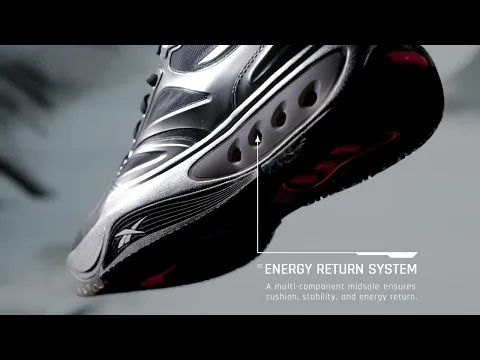
From this point on, the rubber sole ceased to be merely a technological curiosity and became a standard in sports footwear.
Rubber Changed the Way People Run
Before the introduction of the rubber sole, running was a much more aggressive activity for the body. Leather or wooden soles transmitted practically all the impact of contact with the ground to the feet, knees, and joints.
With the introduction of rubber, the scenario changed. The elasticity of the material allowed for the dissipation of part of the impact energy, reducing the load transmitted to the body. This effect not only increased comfort but also helped prevent injuries.
This characteristic became even more important when competitive sports began to gain popularity in the early 20th century.
Athletes started to seek equipment that improved performance and safety, and the rubber sole became a central part of this evolution.
The Foundation of the Modern Sports Shoe Industry
With the growth of sports culture and athletics, the footwear industry began to invest in improvements in sole technology.
Throughout the 20th century, various innovations emerged:
- more efficient traction patterns
- lighter rubber compounds
- combinations with foam and cushioning
- designs specific to different sports
But all of these evolutions have a common root. The technological foundation remains the same discovery made by Charles Goodyear in the 19th century: the vulcanization of rubber.
Today, almost all sports shoes — for running, basketball, soccer, or walking — use modern variations of this material.
From Industrial Material to a Symbol of Health and Performance
The transformation of vulcanized rubber illustrates how industrial technologies can find unexpected applications over time.
What started as a chemical experiment to solve stability issues of a natural material ended up creating a revolution in completely different sectors. First came the industry. Then came footwear. Next, the global sports culture emerged.

Today, billions of people use shoes with rubber soles daily — whether for sports, walking, or simply working.
Few people imagine that this seemingly simple element was born from the attempt to solve an industrial problem in the 19th century.
The rubber sole that now absorbs the impact of running began its story protecting machines inside factories. And it has become one of the most important components in the history of sports footwear.






-

4 pessoas reagiram a isso.