





 Portuguese
  English
  Spanish
  3 min of reading
  0 comments


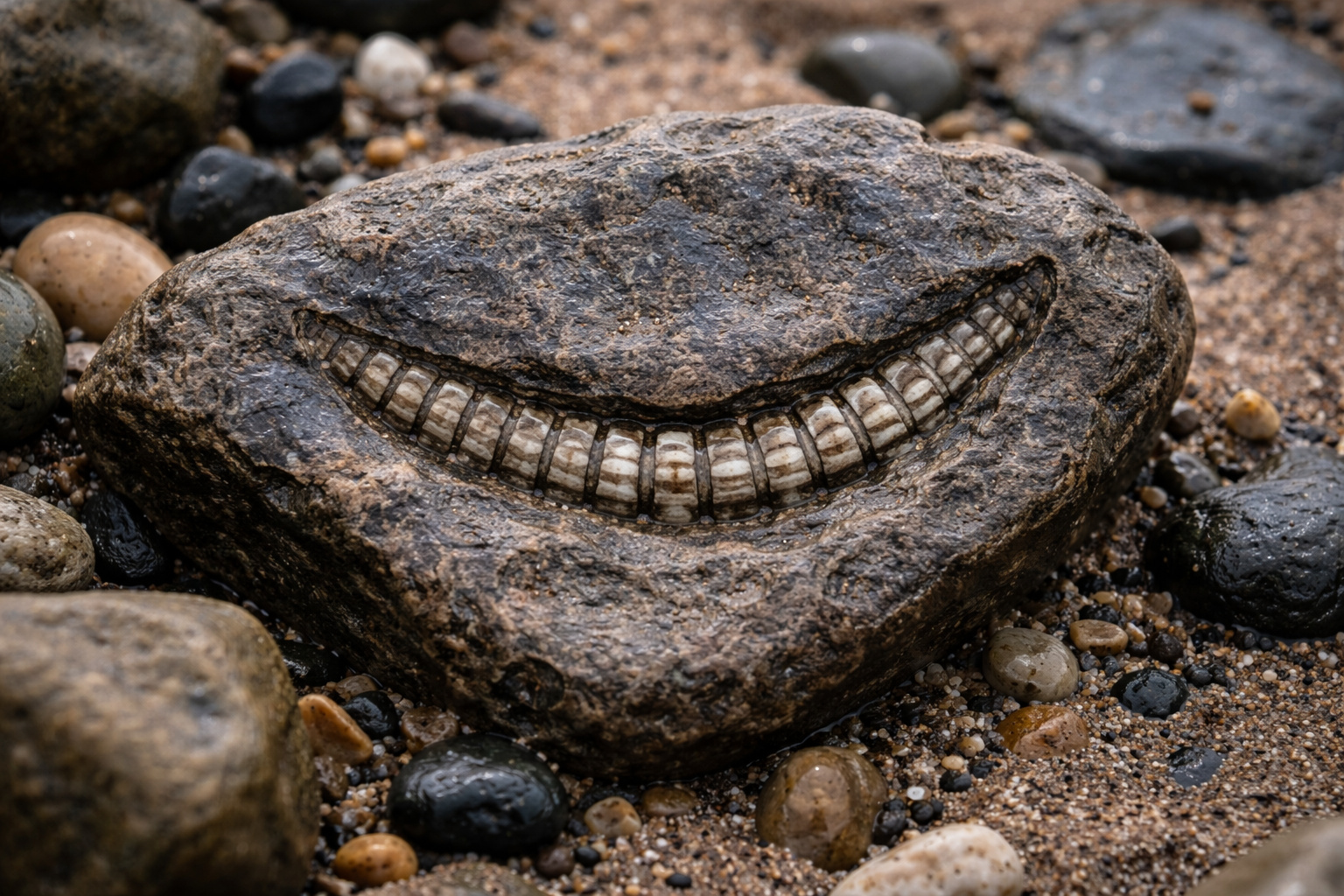
Discovery Made by Tourist While Searching for Fossils in Lindisfarne Analyzed by the British Geological Survey and Explained by Experts
A curious geological discovery caught attention in the UK and quickly gained international attention. A British tourist found a rock with an unusual appearance during a walk on Holy Island, also known as Lindisfarne, on the coast of Northumberland. The find occurred in 2025 while she was searching for fossils in the area, known for its geological significance.
The formation displayed a “smile” with darkened teeth, which is why the tourist took photos. Shortly after, she shared the image on social media, and the content went viral. According to the BBC, which reported the case after the online buzz, the protagonist is Christine Clark, 64 years old, who was on vacation with her husband when she noticed the object among rock fragments. “It looked like someone’s false teeth,” Clark told the British broadcaster.

Technical Investigation Explains Origin of the “Smile”
After the images were released, Clark posted the photos in a fossil identification group on Facebook, allowing experts to analyze the structure more precisely. According to paleontologist Dr. Jan Hennissen of the British Geological Survey, the formation does not contain human teeth or organic remains.
-
Motorola launched the Signature with a gold seal from DxOMark, tying with the iPhone 17 Pro in camera performance, Snapdragon 8 Gen 5 that surpassed 3 million in benchmarks, and a zoom that impresses even at night.

-
Satellites reveal beneath the Sahara a giant river buried for thousands of kilometers: study shows that the largest hot desert on the planet was once traversed by a river system comparable to the largest on Earth.

-
Scientists have captured something never seen in space: newly born stars are creating gigantic rings of light a thousand times larger than the distance between the Earth and the Sun, and this changes everything we knew about stellar birth.

-
Geologists find traces of a continent that disappeared 155 million years ago after separating from Australia and reveal that it did not sink, but broke into fragments scattered across Southeast Asia.

In fact, experts identified the supposed “smile” as a fossilized segment of crinoid, a marine invertebrate that lived hundreds of millions of years ago. These organisms belong to the same biological group as sea urchins and sea cucumbers. Additionally, researchers point out that the fossil is part of the Alston Formation, a type of dark limestone about 350 million years old, dating from the Carboniferous period.
Fossilized Structure Created Surprising Visual Illusion
Crinoids had a body supported by discs called ossicles, which acted as flexible parts of the stem while the animal remained fixed to the seafloor. In the case found in Holy Island, a sequence of these parts, called columns, remained preserved over geological time.
Over millions of years, these structures overlapped and curved, creating a shape that resembles a set of aligned teeth within a smile. Although the appearance caused initial surprise, geologists quickly clarified the natural origin of the formation.
Repercussions on Social Media and Scientific Interest
Initially, internet users classified the rock as “nightmare fuel” in a humorous tone. However, alongside the jokes, the case sparked scientific and educational interest. The British Geological Survey highlighted that natural forms often create patterns that seem familiar to the human eye, a common phenomenon when we associate natural structures with faces or known objects.
Moreover, the episode reinforces the geological richness of the Northumberland area. Holy Island attracts researchers and tourists interested in fossils and natural history, especially because of its ancient formations.
Geological Context of the Discovery in Northumberland
The Alston Formation, mentioned by Dr. Jan Hennissen, consists of dark limestones formed approximately 350 million years ago during the Carboniferous period. At that time, vast areas were covered by shallow seas, where organisms like crinoids thrived before disappearing and leaving fossilized records.
Today, visitors find fragments of these structures in coastal areas of the UK, especially in regions with significant geological history. Although the episode started as a tourist curiosity, it highlights how natural formations surprise the public and increase interest in paleontology.
In light of this, what else might be hidden in the seemingly ordinary rocks of the British coasts?








-

-

6 pessoas reagiram a isso.