





 Portuguese
  English
  Spanish
  3 min of reading
  0 comments


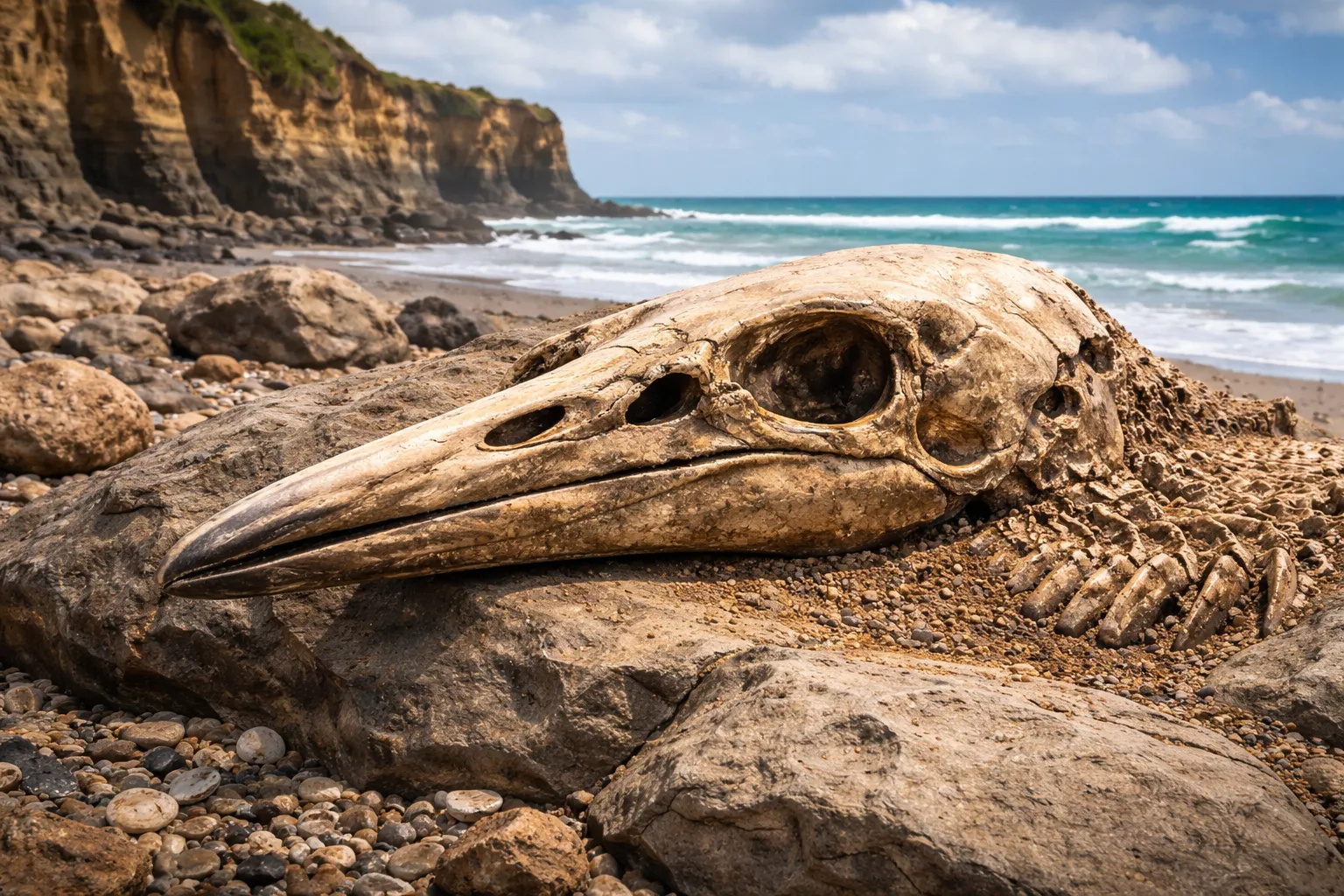
Fossilized Skull 31% Larger Than That of a Modern Emperor Penguin Indicates That Large Penguins Lived Along the Coast of Taranaki, New Zealand, 3 Million Years Ago, Thriving in Waters Up to 20 °C Before Disappearing from the Region
A fossilized skull of a giant penguin, 31% larger than that of a modern emperor penguin, was described from the coast of Taranaki, New Zealand, indicating that large penguins lived 3 million years ago in waters up to 20 °C.
The fossil belongs to an extinct relative of the modern emperor and king penguins and was found in coastal sediments formed when global temperatures were about 3 °C above pre-industrial levels.
The described skull exhibits significantly larger dimensions than that of the modern emperor penguin, a species that can exceed one meter in height and weigh more than 35 kilograms in current polar environments.
-
Motorola launched the Signature with a gold seal from DxOMark, tying with the iPhone 17 Pro in camera performance, Snapdragon 8 Gen 5 that surpassed 3 million in benchmarks, and a zoom that impresses even at night.

-
Satellites reveal beneath the Sahara a giant river buried for thousands of kilometers: study shows that the largest hot desert on the planet was once traversed by a river system comparable to the largest on Earth.

-
Scientists have captured something never seen in space: newly born stars are creating gigantic rings of light a thousand times larger than the distance between the Earth and the Sun, and this changes everything we knew about stellar birth.

-
Geologists find traces of a continent that disappeared 155 million years ago after separating from Australia and reveal that it did not sink, but broke into fragments scattered across Southeast Asia.

In addition to the size, the fossil indicates a longer and sturdier beak than that observed in emperor penguins, suggesting a closer appearance to that of the king penguin, though in considerably larger body proportions.
Warmer Environment and Expanded Geographical Distribution
The sediments that now form coastal cliffs in southern Taranaki were deposited when the region was located about 40.5° south latitude, further north than the current distribution of large penguins.
During this period, the waters utilized by these penguins for feeding reached temperatures close to 20 °C, much higher than the conditions faced by their modern relatives in sub-Antarctic and Antarctic regions.
Currently, the northernmost breeding colonies of king penguins are around 46.1° south, in the Crozet Islands, where water temperatures range between 3 °C and 10 °C.
These data indicate that, 3 million years ago, the large penguins of New Zealand tolerated marine environments considerably warmer than those occupied by equivalent species today.
Global Cooling and Regional Extinction
The warm period that favored the presence of these penguins ended with the onset of Pleistocene glaciations around 2.58 million years ago, when ice and sea levels began to oscillate intensely.
However, climate cooling alone does not explain the regional extinction of the giant penguin, as other species of smaller penguins survived the same environmental changes.
Adélie penguins and blue penguins, still present in New Zealand, traversed this period of temperature decline and maintained stable populations, suggesting that additional factors influenced the disappearance of the giant.
Modern large penguins, such as emperors and kings, adapted by migrating to cooler latitudes, mainly to Antarctica, a behavior that did not occur with the extinct relative from Taranaki.
Giant Aerial Predators as a Hypothesis
One of the hypotheses raised involves the pressure from large terrestrial and aerial predators that inhabited New Zealand until about 500 years ago, including the Haast’s eagle and the giant Forbes hawk.
These birds of prey were capable of capturing large prey, such as moas, and their ancestors would have arrived from Australia over the last 3 million years.
Based on the behavior of modern large penguins, the giant penguin of Taranaki likely formed extensive, exposed colonies along the coast, making them easy targets for aerial predators.
In contrast, smaller modern penguins exhibit more discreet reproduction, using burrows, natural crevices, and dense vegetation, and they cross beaches at night, which reduces exposure to attacks.
Other Possibilities and Climate Implications
Land predation is just one of the explanations considered for the regional extinction, while other hypotheses include changes in the marine environment and possible reductions in food availability.
It is known that food scarcity can be devastating for penguins, but it remains difficult to explain why this factor would have affected only the large penguins, sparing smaller species.
The study offers new insights into the environmental tolerance of large penguins, showing that current species can withstand temperatures up to 20 °C above those in which they normally feed.
3 million years ago, the extinct relative lived under these warmer conditions, reinforcing that the geographical distribution of species can change as the climate transforms over time.
As the planet warms again, the marine ecosystem of New Zealand may enter the habitable zone of new species, making the study of warm periods from the past even more relevant.







-

-

-

-

-

-

19 pessoas reagiram a isso.