





 Portuguese
  English
  Spanish
  5 min of reading
  1 comment


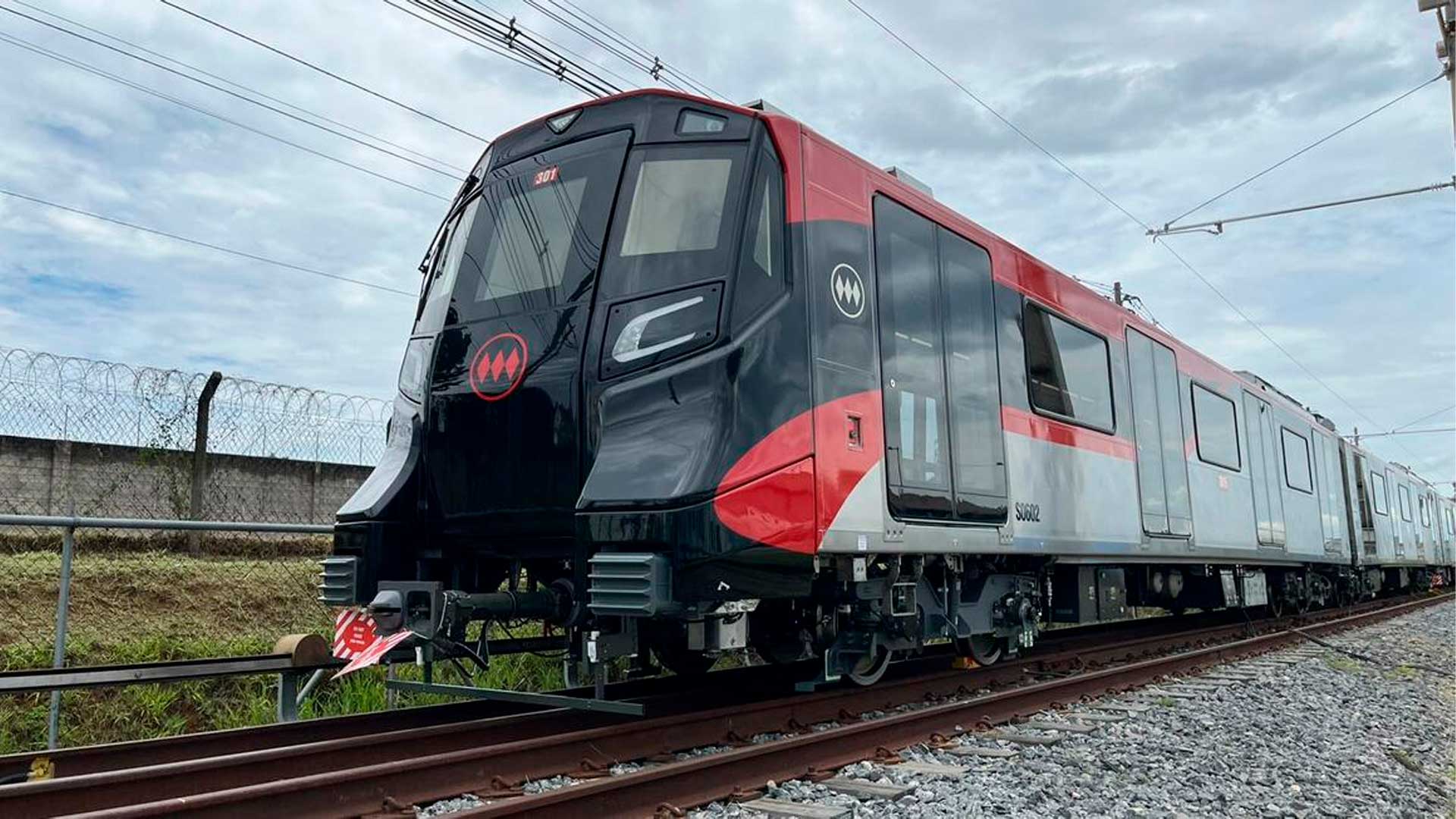


First Metropolis AS-22-UTO Presented in Taubaté and Starts Industrial Tests Before Deliveries Scheduled for the Second Half of 2026, According to Alstom
Alstom and the Santiago Metro presented, at the Taubaté factory in the interior of São Paulo, the first Metropolis AS-22-UTO train that will operate on the future Line 7 of the Chilean metro. The ceremony took place on January 20, 2026, and brought together executives and technical teams from both institutions, according to the manufacturer’s statement.
The train now enters the phase of industrial testing in Brazil. According to Alstom, the delivery of the first train is scheduled for the second half of 2026, paving the way for the supply schedule of the contracted lot.
The announcement also strengthens the industrial connection between Brazil and Chile in a large-scale urban mobility project. According to the company, the milestone coincides with the celebrations of 50 years of Santiago Metro and with a decades-long partnership between the organizations.
-
Church from 1888 becomes a mansion of over 330 m² in Canada after a renovation of R$ 3.4 million and is eventually sold for nearly R$ 4.3 million.

-
How an innovative city combines high technology, well-being, and sustainability to become the largest reference in clean energy on the planet.

-
Couple buys 1846 church in ruins for R$ 660,000, invests R$ 3.2 million in renovations, transforms it into a millionaire mansion, and even preserved a historic cemetery with over 300 graves.

-
He started running at 66 years old, broke records at 82, and is now a subject of study for having a metabolic age comparable to that of a 20-year-old, in a case that is intriguing scientists and inspiring the world.


In Chile, Line 7 is seen as a central piece to reduce travel times and expand access to rail transport. The expectation is to serve a population estimated at 1.6 million people when the line is operational.
Ceremony in Taubaté Marks the Beginning of Testing and the Supply of 37 Trains
The event in Taubaté showcased the first unit already configured for Line 7, with the train starting the industrial validation phase at the São Paulo plant. According to information released by Alstom, this stage precedes the release for delivery and the start of the shipping schedule.
Representatives from the Santiago Metro participated, including Guillermo Muñoz and Ximena Schultz, as well as Suely Sola, general director of Alstom Brazil. The company states that it has been manufacturing trains in Brazil for over 70 years, and regards the project as part of this regional trajectory.
In the contract, Alstom plans to produce 37 Metropolis trains, each with five cars, all assembled at the Taubaté facility. This volume is pointed out by the manufacturer as the beginning of a delivery cycle related to the expansion of the Chilean metro.
Metropolis AS-22-UTO Bets on High Capacity and Accessibility Features and Passenger Information
According to Guillermo Muñoz, the trains on Line 7 will be 102 meters long and have the capacity for up to 1,247 passengers per train, in addition to two spaces for people with reduced mobility in each train.
Alstom’s statement details that the vehicles will be built with stainless steel, a solution associated with greater durability and lower electricity consumption. The configuration includes four doors per car and wide, interconnected corridors between the carriages, aiming to improve the boarding and disembarking flow.
Urbalis CBTC Signaling Enables Automatic Operation and Package Includes 20 Years of Maintenance
One of the central points of the project is the Urbalis CBTC signaling, which, according to Alstom, will allow driverless operation, focusing on efficiency and safety. This type of system typically reduces intervals and improves regularity, especially in new lines that are already prepared for automation.
In addition to the supply of trains and the CBTC, the company has announced that it signed two other contracts related to the implementation. One involves tracks and catenary system, and the other addresses the electrical system of the line.
The three agreements include 20 years of maintenance. Alstom states that it intends to apply predictive maintenance technologies both on rolling stock and on infrastructure, with monitoring to anticipate failures and reduce unplanned downtime.
The model also signals a trend in metro projects that combine fleet procurement, signaling, and long-term maintenance in the same package. In practice, this shifts part of the lifecycle management to the supplier, while the operator focuses on planning and operation.
In the regional context, Alstom itself highlights that the Metropolis trains already total tens of thousands of units in operation or ordered worldwide. The company uses this history to support the reliability of the platform now applied to the Chilean project.
Line 7 Will Be 26 Km Long and 19 Stations and Promises to Cut Travel Time by Almost Half
The future Line 7 of the Santiago Metro will have 26 kilometers and 19 stations, crossing seven communes, with Renca, Cerro Navia, and Vitacura entering the network for the first time. This information is contained in the statement from Alstom and in publications from the transport sector in Chile.
When the line becomes operational, the estimate is that the trip between terminals will take 37 minutes, a reduction of about 49% compared to the current bus journey, which can take approximately 72 minutes. The disclosed forecast indicates the start of operations in 2028.
In terms of socioeconomic impact, Alstom projects that the project will generate 24,000 jobs from the start of construction until it becomes operational. The same text estimates an average demand of 194,000 passengers per business day in the first year, in addition to 60 million annual trips.
Santiago Metro Expands Network and Aims for Leadership in Length in Latin America by 2033
Currently, the Santiago Metro operates with seven lines, 143 stations, and about 149 km of extension, numbers that place it among the largest metro systems in the region. A survey by Estadão on Latin American networks ranks Santiago as the second largest in length in Latin America, behind only Mexico City, reinforcing its prominence in South America.
Alstom itself reports that, with the planned expansion package until 2033, the network could reach 199 stations and 231.5 km, becoming the largest in Latin America in length. This projection helps explain why Line 7 and its new trains are treated as a technological and operational showcase.
In Chile, planning documents and public communication also place Line 7 within a cycle of large investment works. A publication from the DTPM mentions an investment of US$ 2.528 billion for Line 7 and cites an impact on job generation during construction.
Ultimately, the discussion that should arise as Line 7 approaches operation with automated trains and a new fleet revolves around what matters more for the city: speed and reliability of the metro or the fear that automation may reduce traditional roles in operations. Please share your opinion in the comments and let us know if you view the technology as a solution or a problem.







A tecnologia no mundo atual é essencial em todas as áreas de atuação, juntando isso a automação industrial, más o fator negativo como poderíamos dizer é que “elimina” muitos empregos. Estamos na era da indústria 4.0, e não podemos fugir disso.