





 Portuguese
  English
  Spanish
  6 min of reading
  0 comments


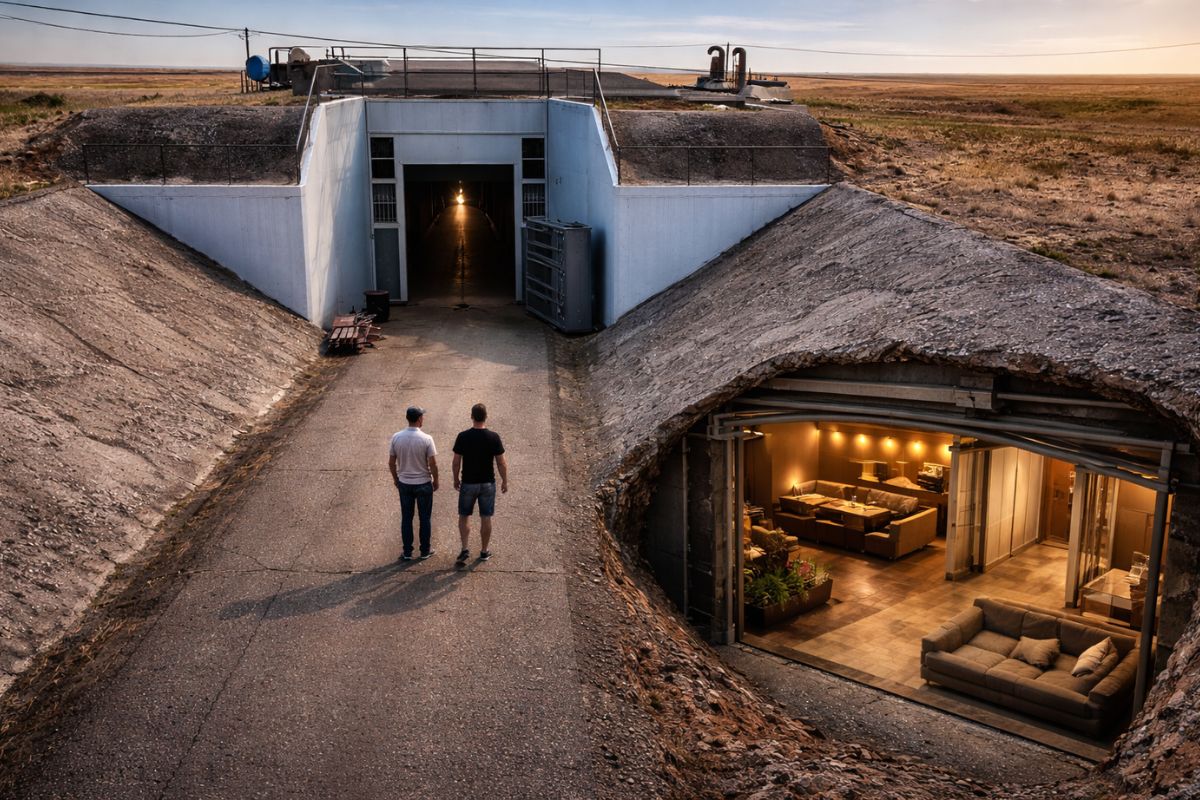
In Rural Washington, The Nuclear Relic That A Retired Engineer Bought In 1991 Turned Into A Two-Bedroom Home Inside The Atlas E Missile Silo; A Few Miles From Sprague, The 20,000 PSI Concrete And The Insulating Soil Support Comfort, But Also A Silence That Disconcerts Visitors To This Day.
In 1991, retired engineer David McIntyre bought, on the outskirts of Sprague, in eastern Washington, a town described with a population of 525, what many would see merely as a nuclear relic: an abandoned Atlas E missile silo, buried beneath the prairie about 3 kilometers east of downtown.
Three decades later, those who descend the ramp and cross the blast doors find something else: a two-bedroom home carved from 20,000 PSI concrete, with a kitchen, storage rooms, a loft, and a tunnel that alters the temperature along the way, while the outside still looks like “kind of nowhere.”
From Atlas E Base To The Underground Home That No One Imagines When Passing By On The Road

The complex was built in 1959 and became operational in 1960 as part of a network of Atlas E sites linked to the 567th Strategic Missile Squadron, under Fairchild Air Force Base.
-
Friends have been building a small “town” for 30 years to grow old together, with compact houses, a common area, nature surrounding it, and a collective life project designed for friendship, coexistence, and simplicity.

-
This small town in Germany created its own currency 24 years ago, today it circulates millions per year, is accepted in over 300 stores, and the German government allowed all of this to happen under one condition.

-
Curitiba is shrinking and is expected to lose 97,000 residents by 2050, while inland cities in Paraná such as Sarandi, Araucária, and Toledo are experiencing accelerated growth that is changing the entire state’s map.

-
Tourists were poisoned on Everest in a million-dollar fraud scheme involving helicopters that diverted over $19 million and shocked international authorities.


It was active for only a few years and was decommissioned in 1964, before becoming a rare private asset, one of 27 silos of this model erected in the country.
Today, the nuclear relic serves as a home and material memory. McIntyre’s daughter and son-in-law live in the space, surrounded by ducts, anchor points, and corridors where valves, pumps, and panels once existed.
The logic was simple: live above, work below, and use the old missile silo as a cool space in the summers and a quiet shelter when the weather turned bad.
20,000 PSI Concrete And 60 Cm: The Material That Drives The Project

Entering the missile silo means realizing that concrete is not just a backdrop, it’s a rule.
The described walls are 60 cm thick and made of 20,000 PSI concrete with rebar, a level far above standard residential concrete.
The location itself is described as “semi-hardened,” capable of withstanding a 3-megaton explosion 2.4 kilometers away, the kind of specification that helps explain the excessive mass.
This changes everything: drilling, opening passages, embedding conduits, and installing plumbing becomes an engineering problem, not a home renovation issue.
McIntyre opened paths for wiring and plumbing, took advantage of existing ducts and spaces, and built internal partitions to transform empty areas into bedrooms, kitchen, and living rooms.
Part of what seemed impractical became routine, including a homemade elevator linking the outside world to the interior, without solely relying on stairs.
Doors Of 2, 47, And 400 Tons: The Physical Ritual Of Entering A Nuclear Relic

On the way in, weight reveals itself as a language. There is a door weighing about 2 tons that, according to those living there, opens surprisingly easily because it is very well balanced.
Further in, a 47-ton door seals access to critical sections of the complex, and the largest, the 400-ton door, was designed to slide and release the opening of the silo.
These numbers matter because they explain the design of the place and the operational discipline of the Atlas E.
The missile remained horizontal, was raised, fueled with liquid oxygen and kerosene, and only then launched, in a sequence described as capable of being ready in 12 to 15 minutes, with refueling consuming most of the time.
The house was born inside a system designed for quick operation, but with rigid steps, and that remains in the way the space is perceived today, by both residents and visitors.
The Flame Furnace And The Pool That Never Happened
On the other side of the blast doors, the old launch path still exists, with a flame furnace and a concrete ramp that directed the jet at an angle of about 45 degrees outward.
There, during firing, the combustion chamber was “washed” with water to keep the cement cool and reduce the risk of crystallization and cracking, while another blast-proof opening released pressure.
Today, this section has become the point where curiosity and fear meet. The depth is described by visual estimates that reach about 7.5 meters, and there is water in some areas.
McIntyre even dreamed of transforming the area into a pool, an idea that seems like a joke until someone approaches the edge.
In practice, the nuclear relic continues to impose physical limits, even when its purpose has ceased to be military.
Air, Water, And Septic Field: How The Basement Becomes Real Housing
The basement does not function without air. The complex maintains military ventilation ducts, with caps that, in the original design, could seal out contaminants.
Today, these pathways have become part of the adaptation: air input and output, fans, and a sense of a stable environment that contrasts with the prairie outside.
Water and sewage also required direct engineering. There is mention of wells on the property, including one that remains active, as well as a power line sized for 200 amps.
For sewage, the solution involves a pump that pushes effluents to an outdoor septic field, and floor drains connected to this system. None of this “shows” when viewed from above, but it is what makes the missile silo habitable.
The Temperature Changes, The Silence Increases: The Psychological Aspect Of Underground Comfort
As one crosses an internal tunnel, the thermal sensation changes, and this transition has become a hallmark of the place.
In depth, the temperature tends to be more stable, which reduces heat stress and avoids extremes, creating a type of comfort that the open surface rarely delivers. For those who live there, this effect is not theory: it is daily experience, reinforced by a sense of protection beneath layers of earth.
But comfort comes at a symbolic price. One resident describes that total silence is more frightening than any imagined explosion because the house does not creak, moan, or “speak.”
When the only sound is a clock or the fridge compressor, any noise becomes an alert, and complete darkness can disorient those who wake up without a sense of time.
Sprague, Nine Sites And An Invisible Neighbor: Why Does This Still Exist
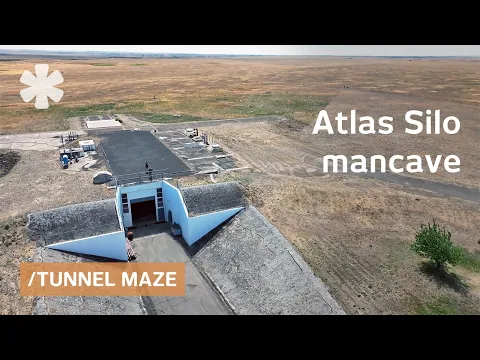

The missile silo is not an isolated piece. In the Spokane area, there are mentions of nine Atlas E bases scattered about, with varying uses and, in some cases, deliberately discreet: agricultural equipment storage, data security depot, and, in the case of Sprague, a house.
The nuclear relic is referred to as “site four of nine,” in a neighborhood where some owners avoid explaining what they do there.
This social silence combines with the landscape: from the outside, the structure blends with the terrain, and many only grasp the scale when they enter.
It serves as a reminder of how the Cold War left objects too large to be dismantled, and how, decades later, the fate of these structures depends less on the State and more on the imagination, budget, and effort of those who decide to occupy them.
The story of the Atlas E in Sprague shows that a nuclear relic can become a home without becoming a fantasy: what supports the project is 20,000 PSI concrete, doors weighing dozens and hundreds of tons, ventilation, energy, water, and a functioning septic field, along with a rare dose of persistence.
The underground area is described as being between 16,000 and 20,000 square feet, with potential for expansion using mezzanines.
And this is where the personal part comes in, which no military manual addresses: would you trade natural light and street noise for thermal stability and silence? What would scare you more in a house like this: the history of the nuclear relic or the routine of living inside the missile silo?










-

-

-

7 pessoas reagiram a isso.