





 Portuguese
  English
  Spanish
  4 min of reading
  1 comment


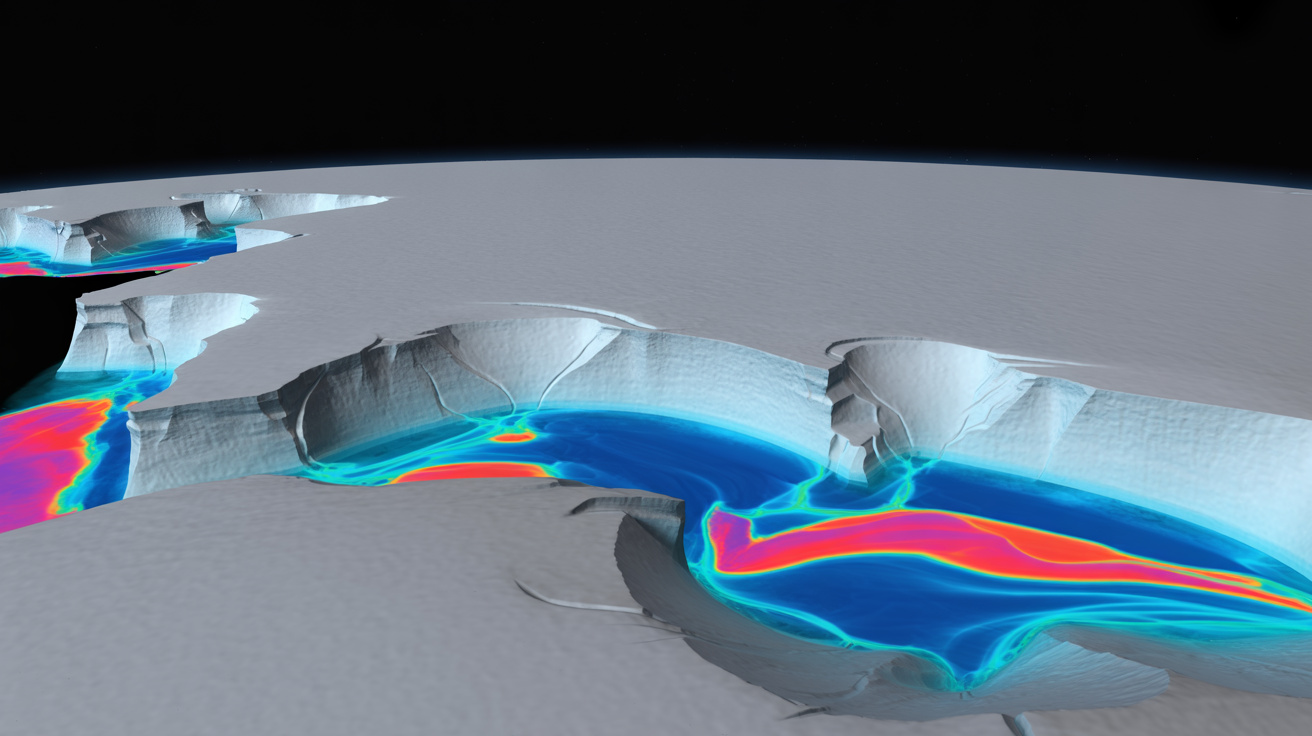


NASA and ESA Satellites Revealed Rivers and Lakes Hidden Under 4 Km of Ice in Antarctica. The Subglacial Network Could Accelerate Glaciers and Impact Sea Levels.
For decades, Antarctica has been described as a frozen and stable continent, a massive white expanse seemingly motionless from space. But recent data obtained by satellites such as NASA ICESat-2 and ESA CryoSat-2 revealed a much more complex reality: beneath up to 4 kilometers of ice, there exists an active network of liquid water lakes, channels, and true “invisible rivers” that slowly move beneath the frozen layer.
What the satellites showed is not merely a geological detail. It is a subglacial hydrological system capable of altering the behavior of entire glaciers and, potentially, influencing the pace of global sea level rise. Antarctica is not a solid block. It is dynamic on the inside.
Satellites That “See” Water Under Kilometers of Ice
The advancement began with laser altimetry and radar technologies. The satellite ICESat-2, launched in 2018, fires laser pulses toward the Earth’s surface and measures minute variations in ice height with centimeter-level precision. On the other hand, CryoSat-2 uses radar to map the thickness and variations of the ice layer.
-
Motorola launched the Signature with a gold seal from DxOMark, tying with the iPhone 17 Pro in camera performance, Snapdragon 8 Gen 5 that surpassed 3 million in benchmarks, and a zoom that impresses even at night.

-
Satellites reveal beneath the Sahara a giant river buried for thousands of kilometers: study shows that the largest hot desert on the planet was once traversed by a river system comparable to the largest on Earth.

-
Scientists have captured something never seen in space: newly born stars are creating gigantic rings of light a thousand times larger than the distance between the Earth and the Sun, and this changes everything we knew about stellar birth.

-
Geologists find traces of a continent that disappeared 155 million years ago after separating from Australia and reveal that it did not sink, but broke into fragments scattered across Southeast Asia.
By comparing repeated measurements over time, scientists noticed something intriguing: certain areas of the ice surface would rise a few centimeters, then sink back down months later.
There was no visible melting on the surface. There were no apparent rivers. The only plausible explanation was below.


When water accumulates under the ice, it pushes the surface upward. When it drains to another point, the surface sinks. This cycle revealed the existence of active subglacial lakes interconnected by underground channels. Today, over 230 active subglacial lakes have been identified in Antarctica.
A Hidden Network That Connects Giant Lakes
Among these reservoirs is the colossal Lake Vostok, one of the largest subglacial lakes on the planet. Buried under approximately 4 km of ice, it has dimensions comparable to those of large surface lakes and has remained isolated for millions of years.
But the most surprising aspect is not just the size of these lakes. It is the fact that they are not static.
Studies show that water can travel hundreds of kilometers under the ice, moving through valleys and depressions in the bedrock of Antarctica. This flow creates an invisible hydrological network that continuously redistributes water.
In some cases, entire lakes partially drain within a matter of months, transferring billions of liters to adjacent regions. It’s as if there were a circulatory system beneath the frozen continent.
The Silent Effect That Could Accelerate Glaciers
The presence of liquid water at the base of the ice has a direct and physical consequence: it reduces friction between the glacier and the underlying rock.
Without water, the ice meets resistance when moving. With water, it slides. This process is known as basal lubrication. And it can accelerate the flow of large ice streams toward the ocean.
In critical regions of West Antarctica, where some glaciers are already unstable, the presence of subglacial water could influence the speed at which massive ice masses advance toward the sea.
This does not mean that the continent will suddenly collapse. But it means that climate models need to consider this dynamic variable.
Ignoring the subglacial system underestimates the complexity of the behavior of the ice sheet.
A Landscape Hidden Under 4 Km of Ice
Radar mapping revealed something even more impressive: Antarctica hides a complete topography beneath the ice.
There are mountain ranges buried, deep valleys, basins that collect water, and natural channels that guide underground flows.
This invisible geography determines where water flows and where it accumulates. In certain areas, water forms stable reservoirs. In others, it flows through narrow channels like an underground river.
This combination creates a dynamic system that can respond to changes in temperature, ice thickness, and internal pressure.
Antarctica is not merely a frozen white desert. It is an active hydrological system, sealed under millennia-old ice.
What Does This Mean for the Future
The big question is not just scientific, but climatic. If global warming continues to reduce ice thickness in certain regions, the pressure on these subglacial systems may change. This could alter drainage patterns, redistribute water, and potentially accelerate glacial flows in vulnerable areas.
Researchers emphasize that understanding these “invisible rivers” is essential for more accurately predicting sea level rise in the coming decades.
Antarctica contains enough ice to significantly raise the oceans if large portions become unstable. The subglacial system is not the only factor in this process, but it is a crucial piece of the puzzle.
A Continent That Has Never Been Static
For a long time, it was thought that Antarctic ice was a rigid, solid layer and practically immobile.
The satellites showed otherwise. There is movement beneath the ice. There is circulation. There is liquid water flowing in absolute silence, invisible from the surface, but detectable from space.
Antarctica is not a frozen block standing still in time. It is a dynamic, interconnected system and much more complex than previously thought, and each new orbital measurement reveals that what is hidden beneath the ice can directly influence the future of the planet’s oceans.








friction causes heat, therefore water