





 Portuguese
  English
  Spanish
  4 min of reading
  0 comments


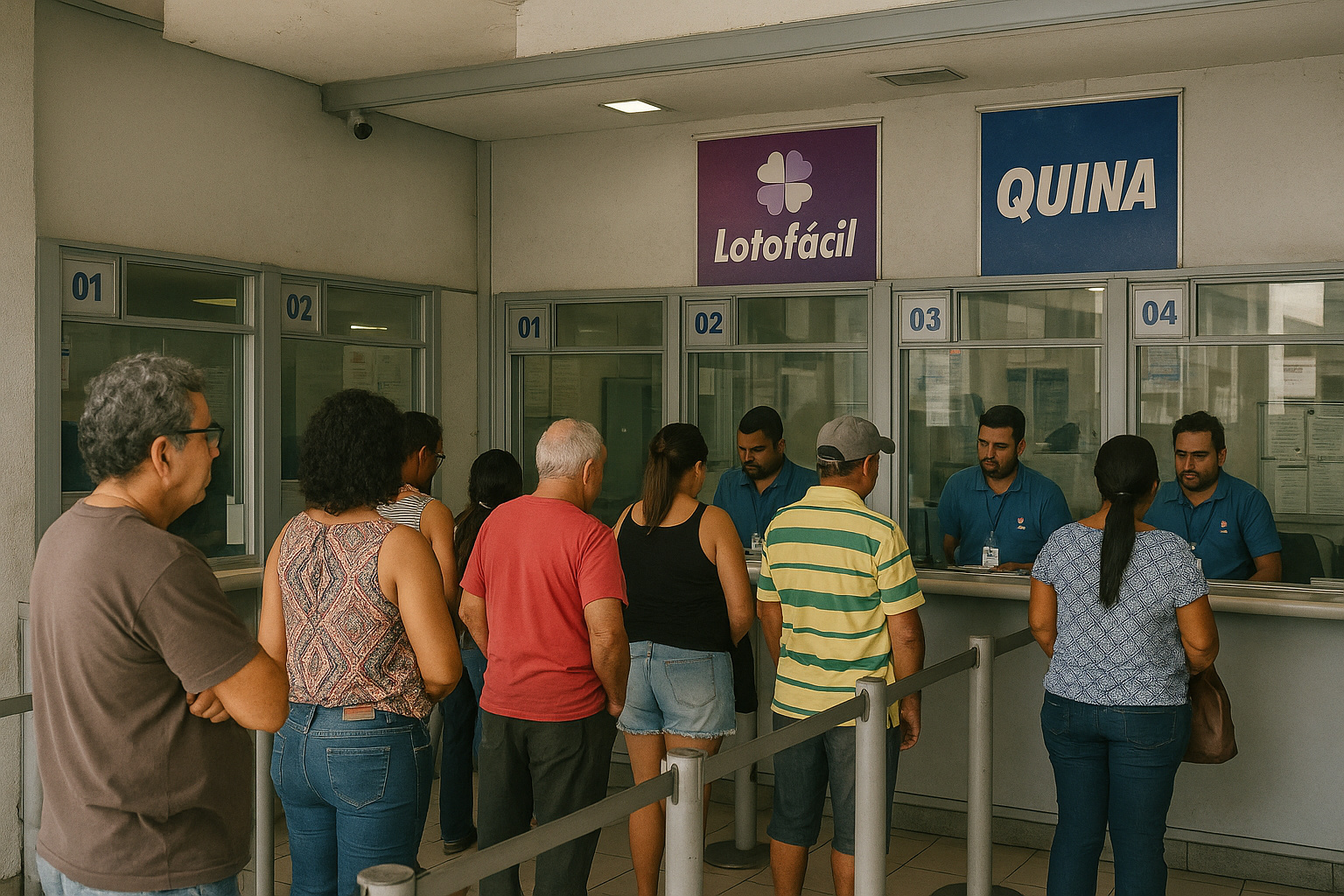
Even With PIX, Caixa Tem And Digital Banks, Nearly Half Of The Population Still Depends On Lottery Houses — A Phenomenon That Mixes Culture, Distrust And State Exclusivity
In Brazil, there are more than 13,000 lottery houses spread across all states. They are easily recognizable places: long lines, cramped counters, and that muffled microphone behind five-centimeter bulletproof glass. Inside, the metallic sound of betting and payments mixes with posters of Lotofácil, Quina, and Dupla Sena.
Even in a world dominated by apps and instant transfers, thousands of Brazilians still prefer to settle their issues there. According to a survey by Buscapé, 48% of the population still uses lottery houses — and among them, 54% only go to pay bills. The second motivation is to bet: 32% regularly place “a small bet”, while 14% go there for withdrawals and bank inquiries.
But after all, why do these establishments survive in 2025, when almost everything fits on a cell phone screen?
-
A couple who only has Sundays free has built a hand-dug pool, a hamburger joint, a dance hall, and a playground in their own home without hiring a mason, and even with breaks due to accidents and the pandemic, the work has never truly stopped.

-
Furniture made with aluminum and glass does not warp and has become an alternative to replace MDF in Brazil.

-
Finland, the happiest country in the world, wants to hire 140,000 technology professionals and is eyeing Brazilians: visas are issued in just two weeks and salaries with a 37-hour workweek are surprising.

-
Mr. Mário reveals the technique of the caipira papaya: he cuts the fruit in half, discards the seeds from the tip, and plants the ones from the back to increase the chance of a productive female tree.


From Elitist Bets To Caixa’s Monopoly
Lottery houses did not emerge as popular payment counters. Their origin goes back to the Decree-Law No. 204 of 1967, which centralized the control of lotteries at the Federal level and gave the Caixa Econômica Federal the role of exclusive operator of the system. Before that, each state and municipality organized their own lotteries in a decentralized manner.


The information was released by Elementar, in a study detailing how the decree transformed gambling into a public service and, at the same time, a secure source of revenue for the government. With the monopoly, Caixa began to manage the entire network — which decades later, would prove to be a strategic decision.
In the 1990s and 2000s, lottery houses evolved from simple betting points to official banking correspondents, allowing withdrawals, deposits, inquiries, and payment of benefits such as Bolsa Família, INSS, and PIS/PASEP. In peripheral regions or small towns, they became the only bridge between citizens and the national financial system.
Currently, lottery houses generate over 100,000 direct jobs and handle about R$ 18 billion a year just from betting, according to data from SEBRAE. Part of this revenue is allocated to education, health, and public safety, consolidating their social and economic role.
Culture, Distrust, And The Future Of Lines
Even with the advancement of digital banks, technological distrust is still high. Millions of Brazilians do not have stable internet, use basic cell phones, or simply do not trust making financial transactions online. For this audience, human contact with the attendant still represents security — even if it is through a muffled microphone and thick glass.
The expert Francisco Donato summarizes: “Lottery houses have built a relationship of loyalty with Brazilians, and this explains their longevity.” Furthermore, they continue to be standardized institutions supervised by Caixa, which reinforces the sense of trust.
However, what was once the state’s exclusivity is now beginning to be challenged. Since the Law No. 13.756/2018, the online betting sector was legalized and, beginning in 2025, will be regulated by the Ministry of Finance. This opens the market to national and foreign private companies, including international giants like MGM Grand and Caesars Palace.
According to Magno José, president of the Instituto Brasileiro Jogo Legal, Brazil is “the jewel in the crown of the global betting market” — a country with a passion for football, economic inequality, and millions of potential bettors. It is estimated that there are already over 2,000 betting sites operating in the country, putting pressure on Caixa’s historical monopoly.
This movement, while bringing innovation and competition, also raises alarms about indebtedness, addiction, and lack of advertising control, especially among youth and low-income individuals.
Queue, Paper, And Trust: The Portrait Of Real Brazil
Even with all these advancements, lottery houses continue to faithfully represent Brazil outside of 5G. They exist because the country is still deeply unequal in digital access. In many locations, the internet signal is unstable, and the most modern cell phone in town belongs to the owner of the internet café.
While the elite makes PIX transactions with facial recognition, millions continue submitting their bills at the counter and waiting for Caixa’s blue stamp. It is a country of paper and digital existing side by side — a paradox that, far from being a setback, reveals the complex social and technological reality of Brazil in 2025.
The future may indeed be 100% digital. But the present still has queues, little papers, and bulletproof glass. And perhaps this says more about us than about the lottery houses.








-

-

-

-

-

-

66 pessoas reagiram a isso.