





 Portuguese
  English
  Spanish
  3 min of reading
  5 comments


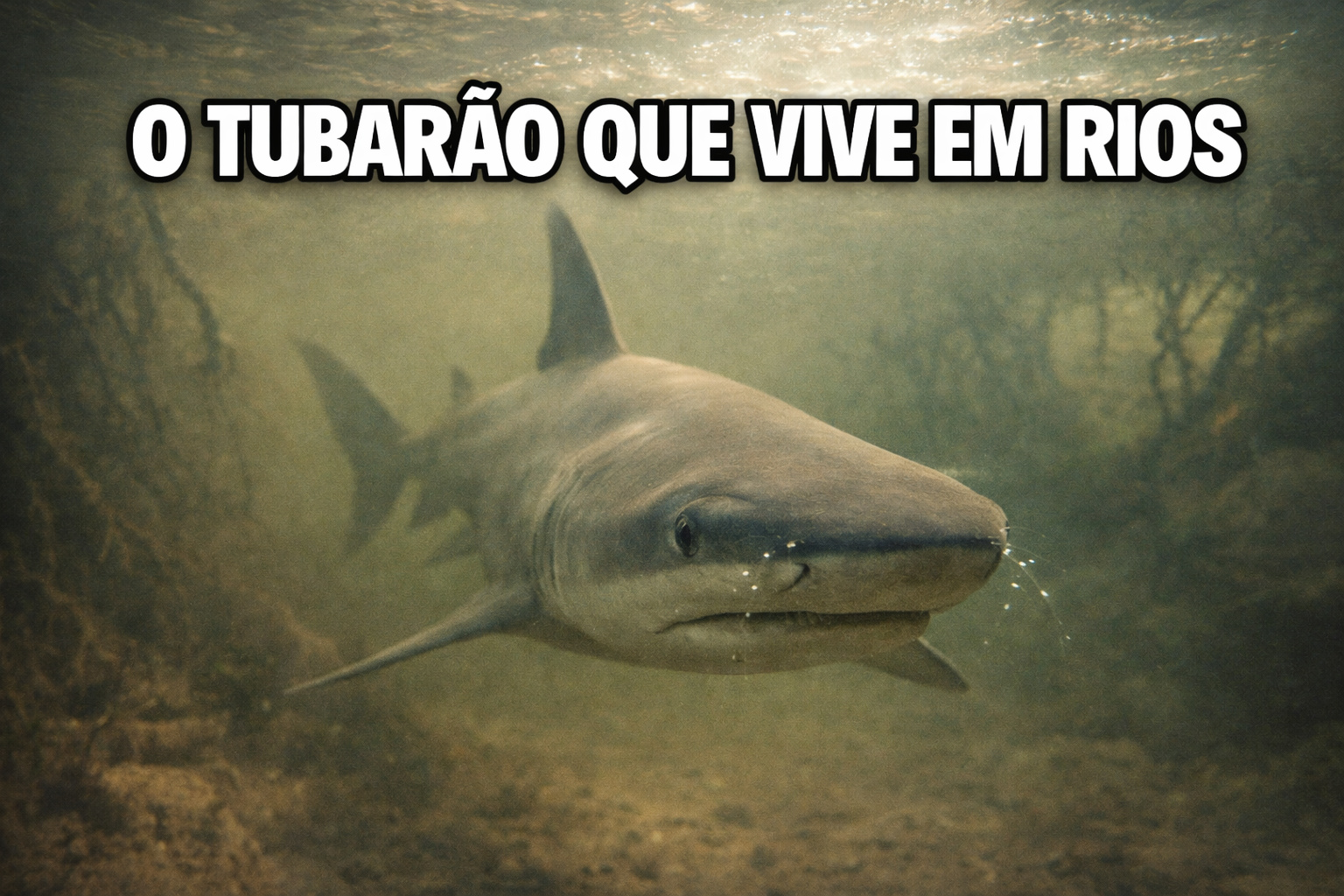


Capable of Living in Freshwater Rivers and Murky Waters, the Ganges Shark Has Advanced Electric Sensors and Is One of the Rarest and Most Endangered Predators on the Planet.
Popular imagination associates sharks exclusively with oceans, deep salty waters, and large marine schools. However, one of the most intriguing cases in modern biology completely breaks this logic. It is the Ganges shark (Glyphis gangeticus), one of the rarest and least understood species in the world, capable of living exclusively in freshwater rivers, far from the open sea, in murky, shallow, and highly challenging environments.
This species is neither a living fossil nor an extinct animal, but a real shark, scientifically documented, that inhabits river systems in South Asia and represents one of the most extreme examples of evolutionary adaptation among elasmobranchs.
A Shark That Never Needed the Ocean
Unlike coastal species that occasionally enter rivers, the Glyphis gangeticus is considered functionally riverine. It lives, hunts, reproduces, and completes its entire life cycle in freshwater, primarily in the Ganges River system and its tributaries in India and Bangladesh.
-
Motorola launched the Signature with a gold seal from DxOMark, tying with the iPhone 17 Pro in camera performance, Snapdragon 8 Gen 5 that surpassed 3 million in benchmarks, and a zoom that impresses even at night.

-
Satellites reveal beneath the Sahara a giant river buried for thousands of kilometers: study shows that the largest hot desert on the planet was once traversed by a river system comparable to the largest on Earth.

-
Scientists have captured something never seen in space: newly born stars are creating gigantic rings of light a thousand times larger than the distance between the Earth and the Sun, and this changes everything we knew about stellar birth.

-
Geologists find traces of a continent that disappeared 155 million years ago after separating from Australia and reveal that it did not sink, but broke into fragments scattered across Southeast Asia.


This behavior places it in an extremely rare group of sharks truly adapted to continental environments. The almost null salinity, irregular currents, and extremely low visibility would be hostile to most marine sharks, but the Ganges shark has evolved precisely for these conditions.
Extreme Adaptation to Murky Waters and Zero Visibility
The rivers where this species lives are among the murkiest in the world. In many stretches, underwater visibility is practically nonexistent, making visual hunting inefficient. To survive in this environment, the Ganges shark has developed one of the most refined sensory systems among known sharks.
The ampullae of Lorenzini — organs responsible for detecting electric fields generated by other animals — are extremely sensitive, allowing the shark to locate prey solely by muscle contractions, even without any visual stimulus. This makes it a highly efficient predator in environments where “seeing” is not an option.
Size, Anatomy and Predatory Behavior
Although it is not a giant, the Ganges shark impresses with its numbers. Estimates suggest it can reach between 2 and 2.6 meters in length, with a robust body, short snout, and small eyes — another adaptation to the low-light environment.
Its diet includes bony fishes, catfishes, crustaceans, and small aquatic vertebrates, captured by ambush. The behavior is discreet, silent, and stealthy, which helps explain why the species has remained poorly studied for so long.
One of the Rarest Shark Species in the World
From a conservation standpoint, the Ganges shark is in critical condition. The IUCN classifies the species as Critically Endangered, with extremely fragmented populations that are rarely observed.
The main risk factors include intense river pollution, dams, accidental fishing, destruction of river habitats, and constant human traffic. In some regions, it is believed that the species is functionally extinct, surviving only in isolated stretches.
Why This Species Changes Everything Known About Sharks
The Glyphis gangeticus challenges classical concepts of marine biology. It proves that sharks are not exclusively ocean animals, that they can evolve to extreme continental environments, and that electric sensors can be more important than sight or speed in certain ecosystems.

Furthermore, its existence reinforces the importance of rivers as habitats for large predators, not just as secondary ecological corridors. The loss of this shark would not only signify the extinction of a rare species but also the collapse of a unique ecological role within Asian river systems.
An Invisible Predator That Few Know Exists
Little known outside scientific circles, the Ganges shark is one of the most impressive examples of extreme adaptation in animal life. It lives where most sharks would die, hunts without seeing, and survives in one of the most pressured environments on the planet.
As science attempts to better understand its biology, one thing is certain: not all sharks belong to the ocean — some have chosen rivers, and pay a high price for it.








Falando em tubarão. Os que me preocupam ultimamente são os do Planalto e STF que já deveriam ter sido extintos, por se tratarem de “espécies exóticas invasoras. “
Mais conhecido como tubarão Cabeça-Chata, se não for esse, o Cabeça-Chata, também se adapta na água doce.
Como está escrito na matéria, ele nasceu e vive até morrer neste ambiente, o cabeça chata e o tubarão touro adentram do oceano até esse ambiente
Cabeça-chata e touro, são denominações do mesmo tubarão, da espécie Carcharhinus leucas.
É conhecido como Cabeça-chata no Brasil, na maioria dos países é denominado bull shark( tubarão- touro) ou ainda tubarão- do – Zambeze ( visto que já foi identificado em águas do Rio Zambeze)
Vale citar que tubarão-touro também é o nome popular de outra espécie de tubarão, o Charcharhinus taurus, comumente chamado de tubarão-mangona.
O tubarão cabeça-chata é de outra espécie (Carcharhinus leucas), mas também consegue adentrar e ficar intervalos de tempo consideráveis nesse ambiente.