





 Portuguese
  English
  Spanish
  3 min of reading
  0 comments


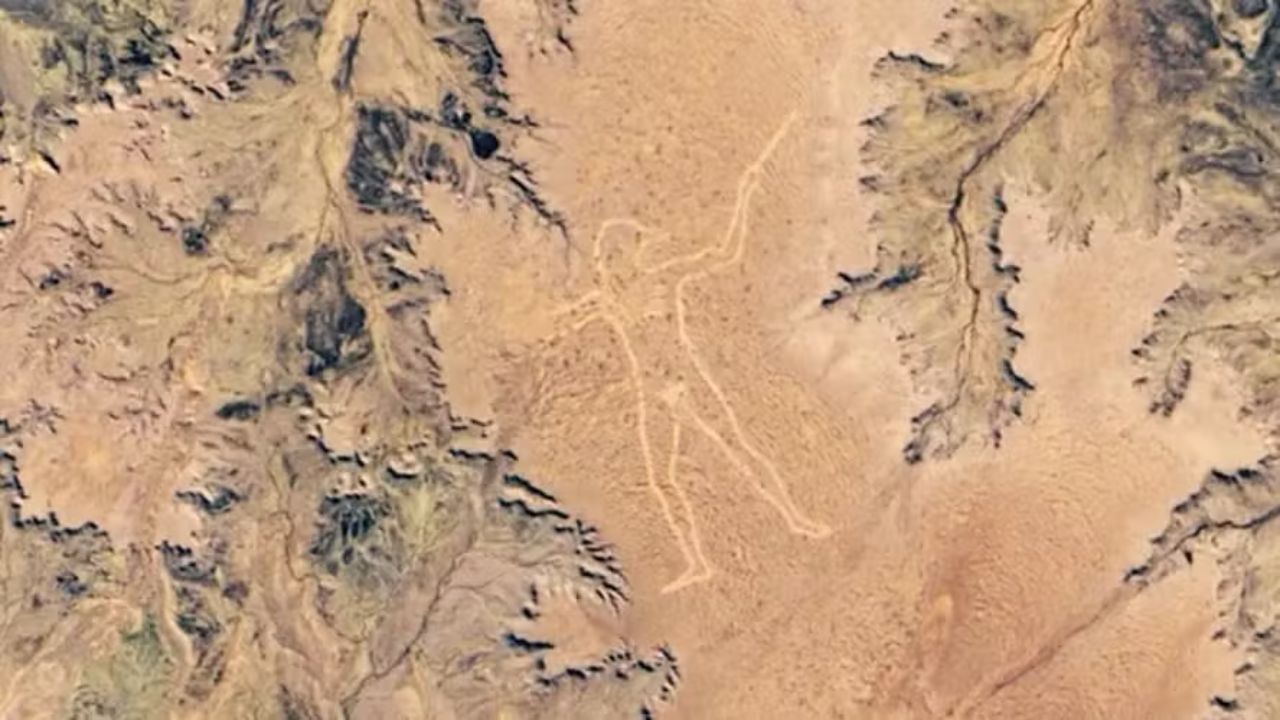
An Enigmatic Human Drawing of 3.5 Km Appeared in the Australian Desert in 1998. Learn All About Its History, Authorship Theories, and Restoration.
In June 1998, pilots flying over the arid desert of southern Australia encountered something unexpected: a giant human drawing, etched into the red earth, visible only from above.
The figure depicted a naked man holding what appeared to be a stick or boomerang, measuring an impressive 3.5 km in length and 28 km in perimeter.
Since its discovery, the Marree Man, also called the Stuart Giant, has become one of the largest geoglyphs on the planet.
-
Friends have been building a small “town” for 30 years to grow old together, with compact houses, a common area, nature surrounding it, and a collective life project designed for friendship, coexistence, and simplicity.

-
This small town in Germany created its own currency 24 years ago, today it circulates millions per year, is accepted in over 300 stores, and the German government allowed all of this to happen under one condition.

-
Curitiba is shrinking and is expected to lose 97,000 residents by 2050, while inland cities in Paraná such as Sarandi, Araucária, and Toledo are experiencing accelerated growth that is changing the entire state’s map.

-
Tourists were poisoned on Everest in a million-dollar fraud scheme involving helicopters that diverted over $19 million and shocked international authorities.


Located on the Finniss Springs plateau, about 60 km from the small town of Marree, the geoglyph emerged mysteriously between May 27 and June 12.
Just a few days after its appearance, hotels in the region received an anonymous fax with the exact location of the drawing, written in American slang, raising suspicions about possible foreign authorship.
Techniques Used and Difficulty of Creation
The magnitude of the human drawing raises questions about how it was created. According to NASA’s Earth Observatory, primitive GPS-guided earth-moving machines would have been used — a remarkable technological feat for the late 1990s.
This technique suggests detailed planning and knowledge of geolocation, something uncommon for an artistic work in a remote desert area.
Despite the analyses, no one has been able to accurately identify who was responsible for the creation.
The lack of records or direct witnesses keeps the geoglyph shrouded in mystery.
Possible Authors of the Marree Man
Various theories have emerged over the years regarding the authorship of the human drawing. One hypothesis points to artist Bardius Goldberg from Adelaide, who allegedly confided to friends that he was the creator before he died in 2002.
Another line of investigation suggests the involvement of American military personnel linked to a Royal Australian Air Force base.
Near the head of the giant, a small plaque with the U.S. flag reinforces this possibility.
In 2018, Australian explorer Dick Smith offered 5,000 Australian dollars — about R$ 17,500 — for anyone who presented concrete evidence of authorship. No one stepped forward, keeping the mystery intact.
Restoration and Preservation of the Geoglyph
Over time, wind and erosion began to erase the outline of the human drawing.
To preserve the figure, local residents decided to restore it in 2016, using excavators and modern GPS systems.
The new design included grooves intended to retain water, promoting the growth of vegetation and ensuring the drawing remains visible even decades after its creation.
This intervention transformed the Marree Man into a landmark that can be seen even from space, consolidating its cultural and tourist importance in the region.
A Cultural and Scientific Symbol in the Desert
More than a mysterious work, the human drawing in the Australian desert has become part of the local identity. Scientists, curious individuals, and tourists are drawn to the giant that blends art, technique, and mystery.
Its impressive scale and the precise way it was traced raise questions about planning, intent, and human creativity.
The Marree Man also represents the relationship between man and environment.
In the desert, where life is scarce and the climate harsh, such a gigantic trace highlights humanity’s ability to interact with space, leaving marks visible even from the sky.
Source: Galileu Magazine










-

-

-

-

11 pessoas reagiram a isso.