





 Portuguese
  English
  Spanish
  4 min of reading
  0 comments


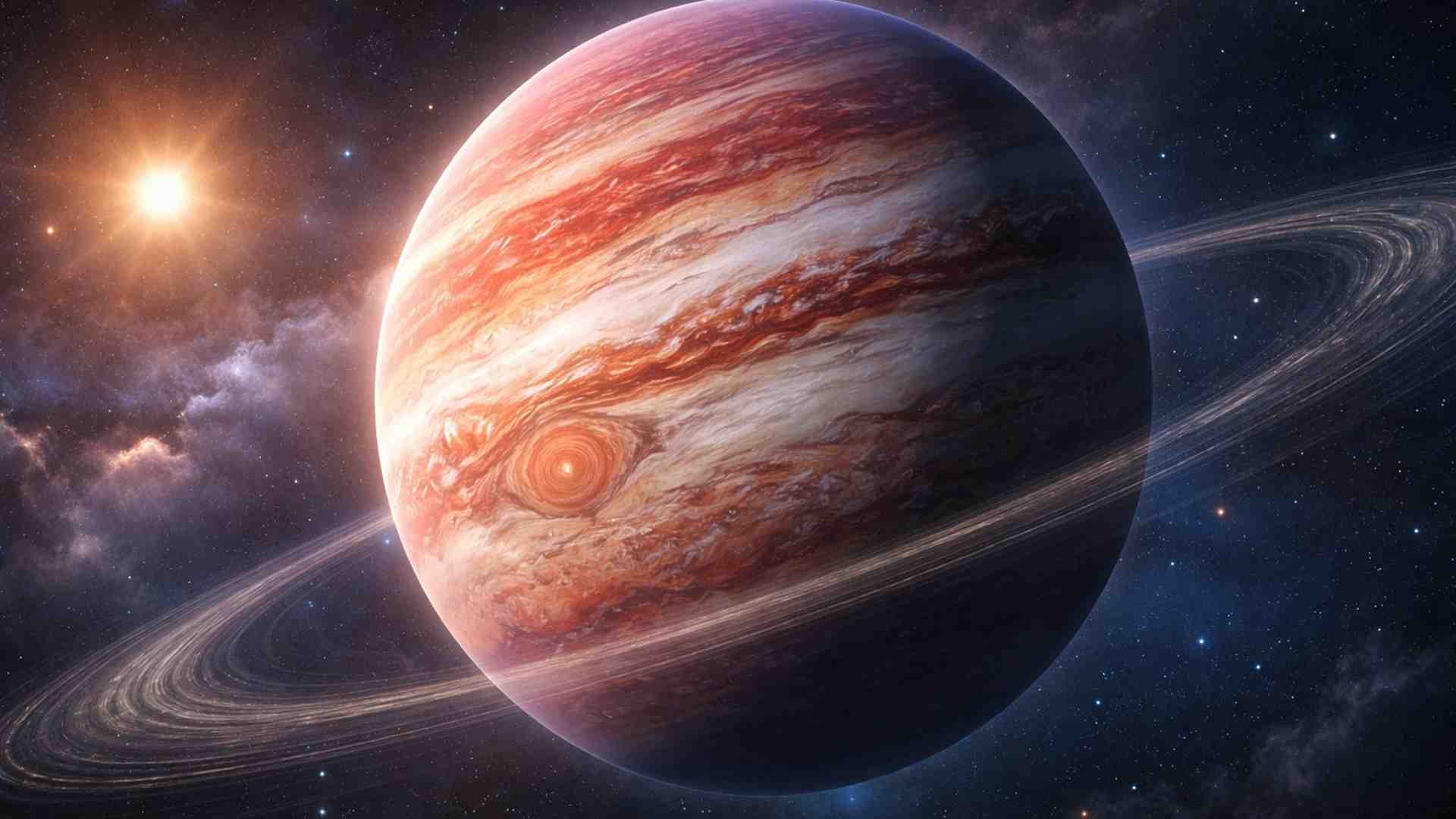
Identified at 271 and 169 Light-Years, a Planet with Nearly 18 Jupiter Masses and a Brown Dwarf of 60 Masses Were Detected by the OASIS Project, Combining European Spatial Data and Direct Images from the Subaru Telescope, Paving the Way for NASA’s Roman Space Telescope Tests
Astronomers have discovered two rare companions – a giant planet and a brown dwarf – orbiting stars 271 and 169 light-years away, using European spatial data and advanced images from the Subaru Telescope, creating strategic targets for technological tests of NASA’s future Roman Space Telescope.
Inaugural Discoveries of the OASIS Survey
The two detections represent the first discoveries of OASIS (Observing Accelerators with SCExAO Imaging Survey), a project that combines high-precision spatial measurements with direct images obtained from the ground. The strategy was developed to reveal giant planets and brown dwarfs that remain invisible to traditional observation methods.
Currently, only about 1% of known stars host massive planets or brown dwarfs that can be directly imaged with existing telescopes. Even in young systems, where these bodies still emit residual heat from formation, their brightness is largely overshadowed by the light from their host stars.
-
Motorola launched the Signature with a gold seal from DxOMark, tying with the iPhone 17 Pro in camera performance, Snapdragon 8 Gen 5 that surpassed 3 million in benchmarks, and a zoom that impresses even at night.

-
Satellites reveal beneath the Sahara a giant river buried for thousands of kilometers: study shows that the largest hot desert on the planet was once traversed by a river system comparable to the largest on Earth.

-
Scientists have captured something never seen in space: newly born stars are creating gigantic rings of light a thousand times larger than the distance between the Earth and the Sun, and this changes everything we knew about stellar birth.

-
Geologists find traces of a continent that disappeared 155 million years ago after separating from Australia and reveal that it did not sink, but broke into fragments scattered across Southeast Asia.

This limitation imposes one of the main challenges of contemporary observational astronomy: identifying where to search for faint companions before investing time in complex direct observations. OASIS was designed precisely to reduce this degree of uncertainty.
How OASIS Selects Promising Systems
The program analyzes extremely precise measurements of position and stellar motion obtained from the European missions Hipparcos and Gaia. Small variations in these movements indicate the gravitational influence of massive objects not directly visible.
Once stars with this behavior are identified, they are observed with Subaru’s Extreme Adaptive Optics Coronagraphic system, known as SCExAO.
This instrumental setup provides the resolution and contrast necessary to isolate very faint objects close to bright stars.
The combination of these approaches – precise spatial tracking and advanced ground imaging – allows the location of companions that would otherwise remain hidden. This observational model is the methodological core of OASIS and underpins its initial results.
A Giant Planet 271 Light-Years Away in the Constellation Leo
The first identified object is the giant planet HIP 54515 b, which orbits a star located 271 light-years away in the constellation Leo. With nearly 18 times the mass of Jupiter, it is one of the most massive planets ever directly imaged.
The planet’s orbit has a separation comparable to the distance from Neptune to the Sun. Nevertheless, when viewed from Earth, the planet appears extremely close to its star, with an angular separation equivalent to the apparent size of a baseball seen at 100 kilometers.
The SCExAO system produced sufficiently sharp images to distinguish the planet, even with the host star being obscured by a coronagraphic mask. This capability was essential to visually confirm the existence of the object.
A Brown Dwarf of 60 Jupiter Masses in Bootes
The second discovery, HIP 71618 B, is a brown dwarf located 169 light-years away in the constellation Bootes. The object has about 60 Jupiter masses and orbits its own star, in a distinct system from the newly identified planet.
Brown dwarfs are often described as “failed stars,” as they form similarly to stars but do not accumulate enough mass to sustain nuclear fusion reactions in their cores. As a result, they occupy an intermediate range between giant planets and stars.
The direct identification of HIP 71618 B reinforces OASIS’s ability to detect different types of massive companions, expanding the scientific scope of the survey and providing new observational benchmarks.
Decisive Target for Tests of the Roman Space Telescope
HIP 71618 B has characteristics considered ideal for the future technological demonstration of NASA’s Roman Space Telescope. The mission will test coronagraphic systems designed to image Earth-like planets, which can be up to ten billion times fainter than their host stars.
Before this discovery, astronomers lacked a single confirmed target that simultaneously met all the technical criteria required for this test. HIP 71618 B fulfills these conditions, as its star is sufficiently bright and the brown dwarf occupies the appropriate position.
At the operational wavelengths of the Roman coronagraph, the object will be faint enough compared to the star to validate the performance of new technologies, becoming an essential reference point for the mission.
Scientific Impact of Joint Observations
The initial discoveries of OASIS demonstrate the potential of integrating high-precision spatial measurements with direct images obtained from Earth. This approach allows for the revelation of planets and brown dwarfs that would remain invisible if observed by only one isolated method.
The results also indicate that the Subaru Telescope will continue to play a central role in international astronomy, even with the operation of new observatories and space missions. Its instrumental and methodological adaptability maintains its scientific relevance.
This model of joint observation sets a precedent for future searches for massive companions and reinforces the importance of systematic surveys to guide next-generation space missions, expanding the scope of planetary exploration beyond the Solar System.
This article was based on information released by teams of astronomers involved in the OASIS project, based on data from the European Space Agency’s Hipparcos and Gaia missions and images obtained with the Subaru Telescope, as well as institutional communications related to NASA’s Roman Space Telescope.








-

-

-

8 pessoas reagiram a isso.