





 Portuguese
  English
  Spanish
  8 min of reading
  0 comments


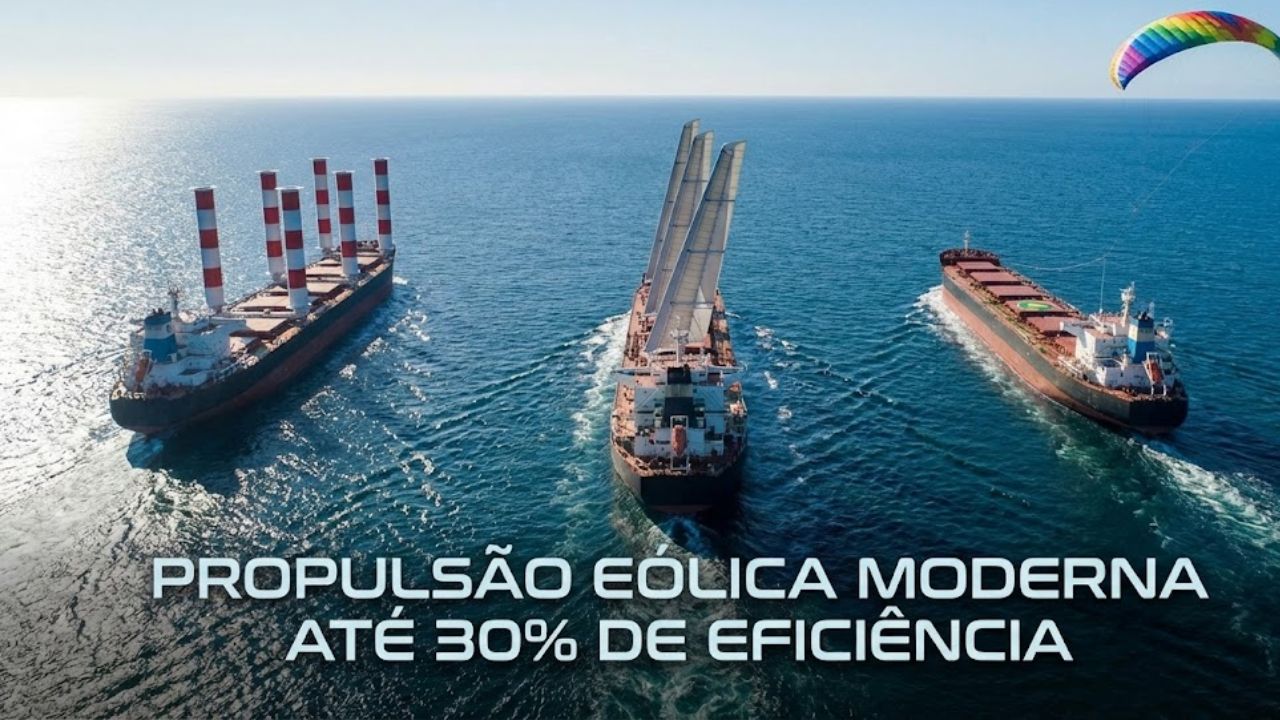
From Rotating Sails to Rigid Wings and High-Altitude Kites, Giant Ships Are Receiving Modern Wind Systems That Already Deliver Fuel Savings of Up to 30 Percent on Specific Routes and Pave the Way for Much Cleaner Maritime Transport.
While combustion engines continue to do the heavy lifting, a new generation of wind propulsion technologies is starting to push giant ships using something that has always been available and doesn’t send a bill at the end of the month: the wind. Every percentage point of savings on these colossi represents tons of CO₂ less in the atmosphere and cheaper freight for almost everything the world consumes.
In the background of this transformation is a simple yet powerful fact. Maritime transport is, on average, the cargo mode with the lowest emissions per ton transported per kilometer, but moves over 80 percent of the planet’s goods and accounts for about 3 percent of global CO₂ emissions, roughly 847 million tons per year. When it comes to efficiency for giant ships, any improvement of 5, 10, or 20 percent becomes an immediate global impact.
Why Are Giant Ships Chasing the Wind Again?
When comparing pollutant weight per ton-kilometer, ships and trains are far ahead of trucks and airplanes in terms of environmental and cost efficiency.
-
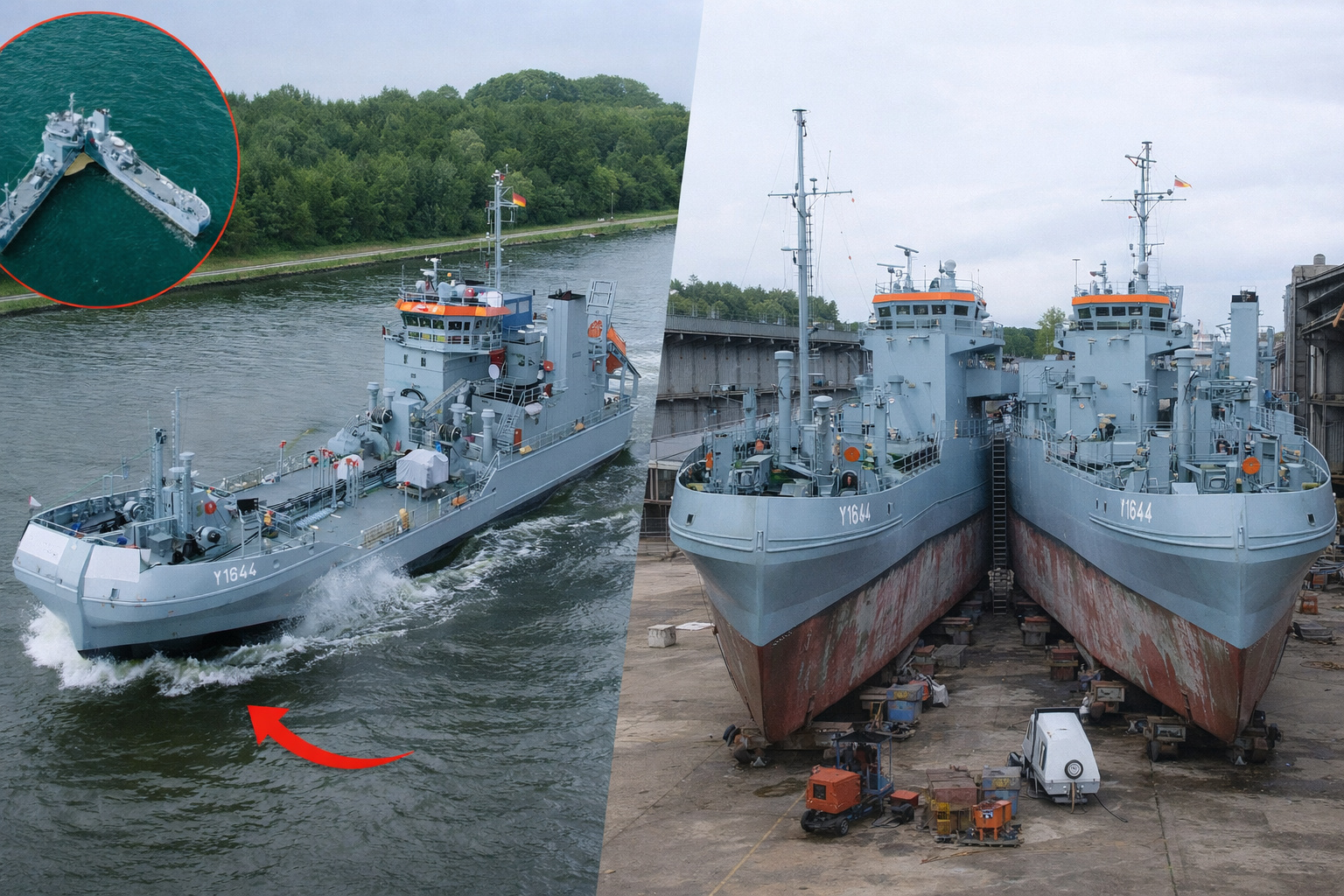
The German ship Bottsand splits its hull in two halves in the middle of the ocean to swallow spilled oil on the surface, separating the oil from the water inside a 790 cubic meter tank and then closing again. It is the only ship in the world factory-designed to split in half as part of normal operations, and the crew of six people who operate everything is civilian.
-
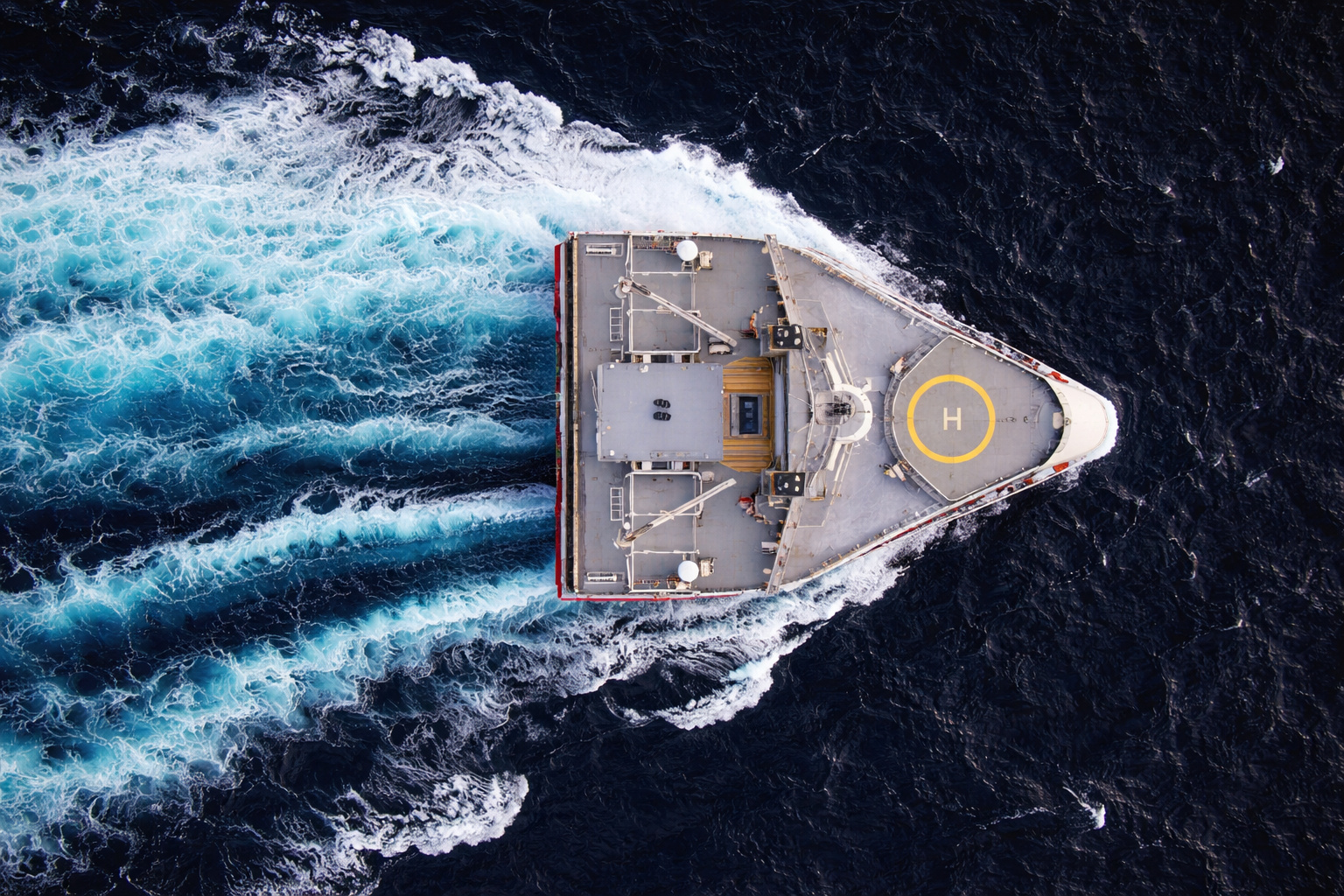
With almost 70 meters in width at the stern and a shape resembling a “giant slice of cheese,” the Ramform Titan tows up to 24 seismic cables to sweep the ocean floor in 3D and reveal oil reserves hidden beneath kilometers of sediment.
-
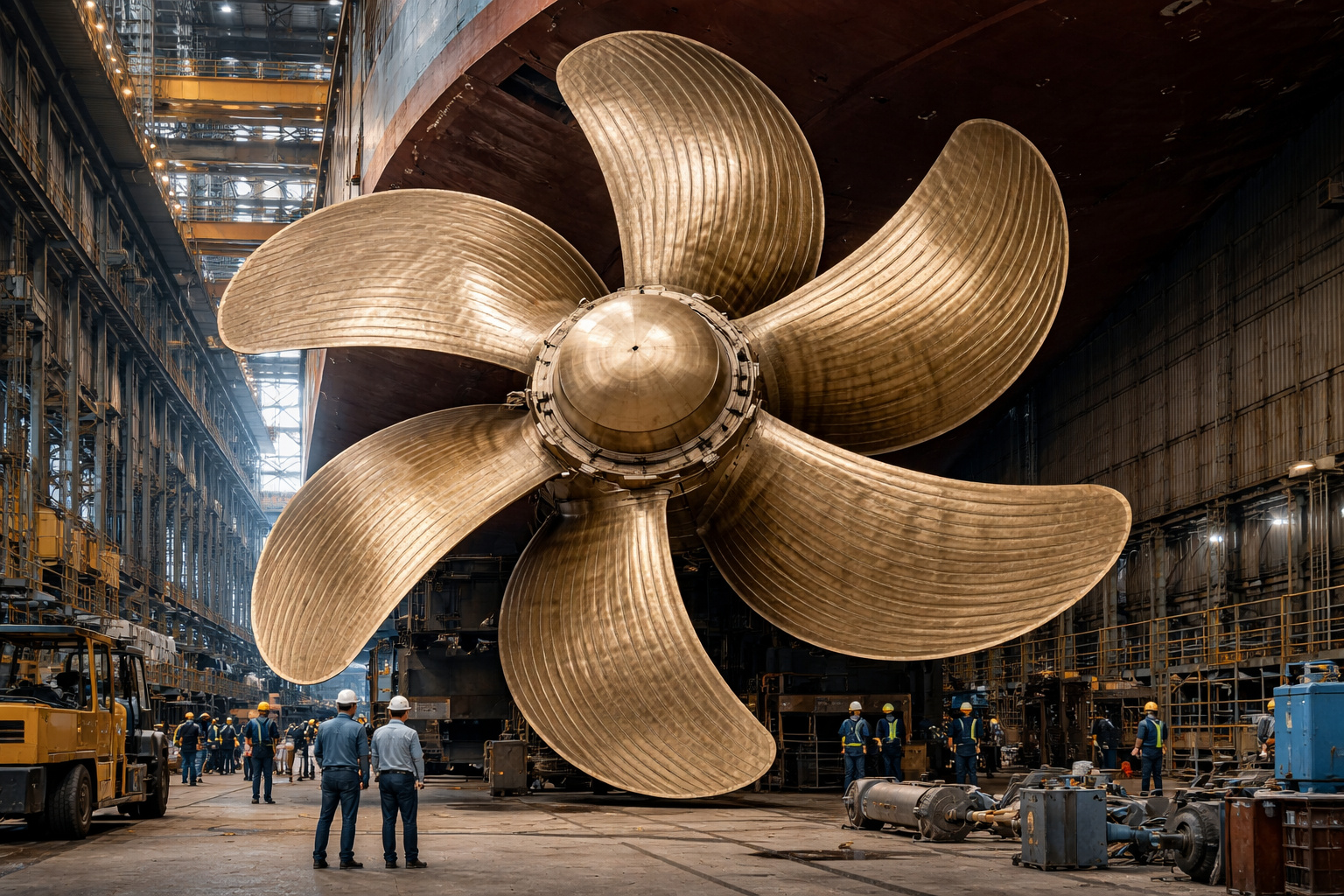
How a 131-ton, 11-meter propeller supports 90% of global trade and transforms the largest container ships on the planet.
-
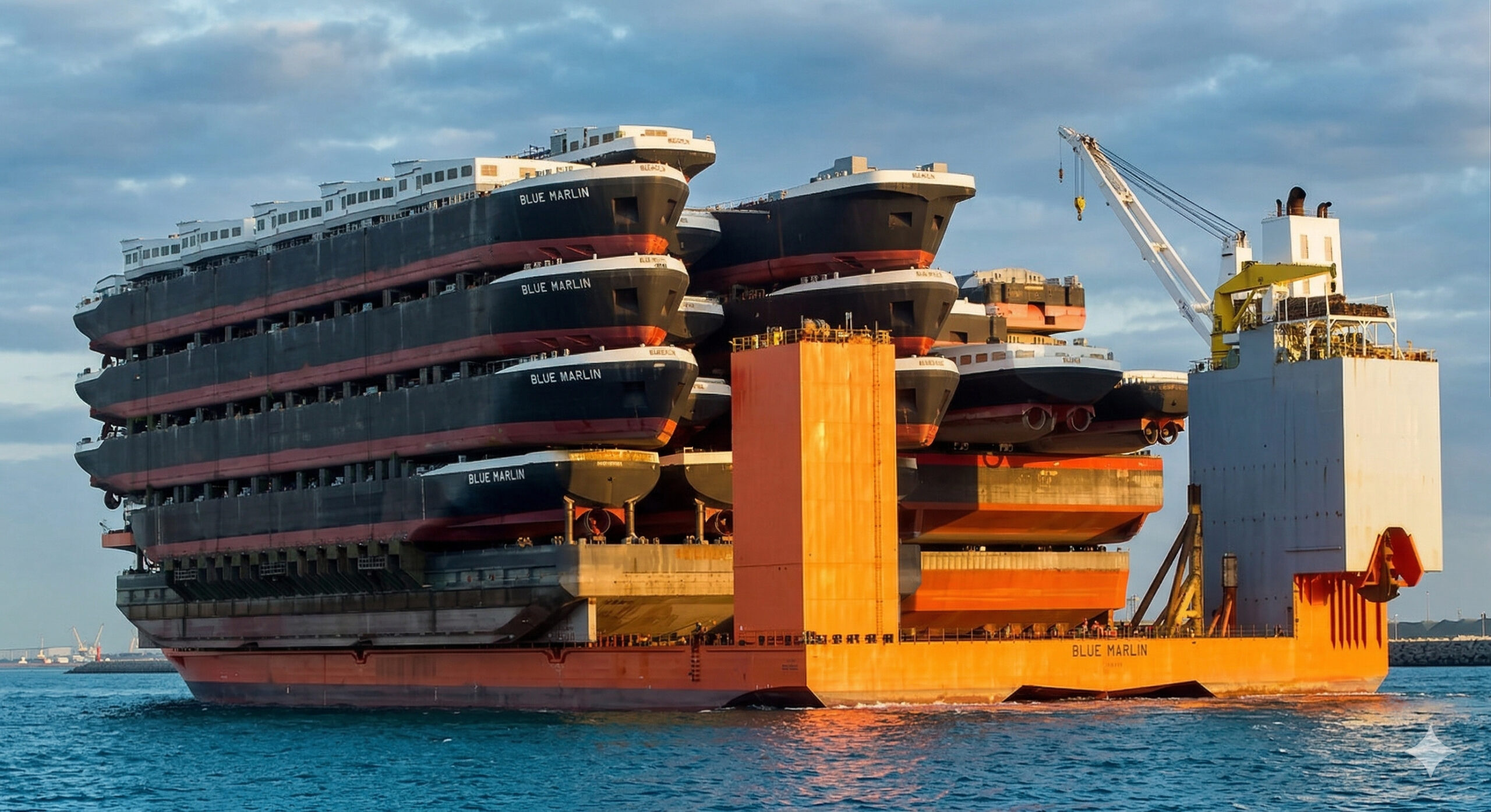
With a length of 225 meters and a capacity of 76 thousand tons, this ship “sinks” its own deck down to 28 meters deep to accommodate war destroyers, oil platforms, and giant radars floating above, and then emerges with everything intact on top like a colossal tray crossing oceans.

However, the scale of maritime transport is so large that it becomes a direct target for regulatory pressure, decarbonization targets, and, of course, cost-saving opportunities.
If a single ship saves a few percentage points of fuel, a fleet of giant ships with wind technology can mean millions of liters of diesel burned less per year.
This lowers freight costs, relieves pressure on merchandise prices, and helps companies meet often stricter environmental targets than those required by governments.
Hybrid systems that combine conventional engines and wind propulsion work essentially in two ways.
In favorable wind conditions, the extra force from the sails can increase the ship’s speed, reducing travel time, or allow the main engines to operate at lower power, saving fuel and polluting less.
Since giant ships still operate with combustion engines, they can take advantage of the wind without being held hostage by its variability.
Rotating Sails: Cylinders That Spin and Push Giant Ships With the Magnus Effect


Among the most advanced technologies in use today are Flettner rotors, the so-called rotating sails, which turn spinning cylinders into sources of lateral thrust.
At first glance, they look like just cylindrical towers installed on the decks of giant ships, but it is here that the Magnus effect takes effect.
When wind passes over a rotating cylinder, the side where the surface spins in the same direction as the wind accelerates the airflow and reduces pressure, while the opposite side decelerates the flow and generates high pressure.
This difference creates a force perpendicular to the wind that, when oriented correctly, converts into thrust for the hull. It’s the same physical principle as a curved kicked ball, applied on an industrial scale.
This concept is not new. In 1924, there was already a vessel with two 15-meter tall rotors by 3 meters in diameter sailing successfully, followed by another with three rotors in 1926.
The combination of the 1929 economic crisis, cheap oil, and world war shelved the advancement of this technology for decades.
With the oil crises of the 1970s and, later, climate pressure starting in the 2000s, rotors came back to the forefront.
In 2008, a large transport ship carrying components for wind turbines was equipped with rotating sails and recorded about a 15 percent reduction in fuel consumption compared to similar ships.
In another bulk carrier with four rotors, 16 meters high and 2 meters in diameter, the savings were around 12.5 percent.
Specialized manufacturers have already reported typical savings ranges between 5 and 30 percent, depending on the number of rotors, size, routes, and wind intensity.
In 15-knot winds, theoretical studies indicate savings of around 5 percent, reaching over 20 percent in strong winds of around 30 knots.
The cylinders are powered by motors, usually electric or hydraulic, and can reach rotations in the hundreds of RPM.
It is true that energy is needed to make them spin, but the thrust gain they provide far exceeds the consumption of these auxiliary motors.
In practice, it’s like trading a bit of shaft energy for a large aerodynamic “lever” that pushes giant ships forward.
Rigid Wings and Fabric Sails: When the Hull Becomes an Upright Airplane Wing
Another family of solutions for giant ships is based on wings in the shape of sails. Instead of traditional flexible cloths, there are rigid or semi-rigid structures with aerodynamic profiles similar to those of aircraft wings.
Simply put, these sails work like this: by adjusting the angle of the wing relative to the wind, airflow accelerates on one side and decelerates on the other, generating a pressure difference and useful lift for navigation.
In some designs, a movable rear flap helps to “asymmetrize” the profile, further increasing the generated force, just as flaps and slats do on an airplane during takeoffs and landings.
There are designs with telescopic sails that can reach dozens of meters in height when fully extended but retract to pass under bridges or reduce strain in storms.
In a large ro-ro ship with a capacity of about 7,620 vehicles, for example, a single wing sail is designed to reduce about 7 to 10 percent of fuel consumption, avoiding the burning of hundreds of thousands of liters of diesel per year.
Just this sail could represent, in a year, the equivalent of a month’s journey in terms of avoided emissions.
Another 235-meter grain carrier received a telescopic wing sail approximately 54 meters high and 15 meters wide, with panels made of composite material reinforced with fiberglass, similar to wind turbine blades.
Sensors automatically control the angle of the sail and the extension of the segments to take advantage of lateral or trailing winds while protecting the structure in extreme conditions.
The advantage of rigid wings is aerodynamic efficiency. The disadvantage lies in structural weight, interference with cargo handling, and the need for specific designs to accommodate tall masts and large tipping moments.
Even so, when well integrated into the design of giant ships, they generate solid gains of 5 to 10 percent, with even greater potential in configurations with multiple sails.
From Tires to Wind: Inflatable Sails and Flexible Wings
An interesting variation is the inflatable sails, such as those being developed by traditional manufacturers from other sectors.
In this design, a telescopic mast supports a special fabric sail inflated by compressed air, taking on a wing profile with calculated ripples to maintain its aerodynamic shape.
The inflatable reduces mechanical stresses on the structure, facilitates complete retraction on the deck, and allows installation of the system on ships already in operation with less structural intervention.
Initial estimates suggest savings between 5 and 20 percent on adapted ships, with theoretical numbers of up to 50 percent on hulls designed from the start to work with multiple inflatable sails.
In practice, data from giant ships are still awaited to consolidate these percentages, but the concept has advanced from laboratory tests to real-world scale.
There are also flexible wings with a lightweight internal structure and PVC coating, which can reach tens of meters in height and be retracted or laid down on the deck.
Some promise to withstand winds equivalent to maximum category hurricanes, although in actual operation they are retracted early to preserve the ship’s stability and integrity.
Giant Kites: When Lift Comes From the Sky, Not Just the Deck
The third major category of wind systems for giant ships is kites, giant kites towed by high-strength cables operating at altitudes between 100 and 300 meters.
At these heights, the wind is usually stronger and more constant than near the sea surface, enhancing the available lift.
The control is done by a smart capsule hanging from the kite. It measures wind direction and speed, automatically adjusts the angle and trajectory design, and commands actuators that move the control lines. The main cable transmits both the pulling force and navigation data.
In tests with container ships between 2006 and 2009, kite-type systems recorded average reductions of around 5 percent in fuel consumption, with peaks of up to 12 percent on some routes. More recent manufacturers design for savings of up to 20 percent in ideal conditions.
Since a kite doesn’t take up deck space and can be retracted relatively simply, it interferes very little with the loading and unloading operations of giant ships.
Moreover, kite profiles with double walls generate aerodynamics similar to that of a wing, allowing efficient navigation even with the wind coming at relatively tight angles to the bow, around 50 degrees, like a well-trimmed sail.
Typical Gains, Limits, and Why We Still Don’t See Sails on All Giant Ships
Considering all these solutions, efficiency gains tend to concentrate in the range of 8 to 15 percent fuel savings, potentially reaching 25 or 30 percent in very favorable scenarios with strong winds and optimized designs.
For giant ships, these percentages are immense in absolute terms, but still face practical obstacles to mass adoption.
The first is the aversion to technological risk. Shipowners and fleet operators hesitate to invest millions in relatively new systems, especially when profit margins are tight and reliability is a top priority.
Even technologies nearly a century old, such as Flettner rotors, only became viable at scale thanks to modern materials, advanced automation, and an economic context with expensive oil and stricter environmental targets.
The second challenge is structural and operational. Modern ships have been designed to maximize cargo space, with open decks for cranes, containers, and port operations.
Adding sails, wings, or kites requires layout reworking, structural reinforcements, and adaptations in port procedures, which is not always trivial.
There is also the issue of wind variability. Although weather models today are much more accurate and ocean winds relatively stable on certain routes, the fact is that wind propulsion does not have the direct predictability of turning a diesel engine key.
Thus, the ideal combination has been hybrid systems, where wind reduces the engines’ effort but does not completely replace combustion on traditional commercial routes.
On the other hand, regulatory pressures and targets set by large companies are accelerating the shift. Many global supply chains already measure the environmental impact of maritime transport in detail and demand cleaner routes and technologies from their suppliers.
With fuel prices high and reputation at stake, every percentage of savings offered by wind solutions is increasingly seen less as an “experiment” and more as a competitive advantage.
The Future of Giant Ships With Wind, Hydrogen, and Stored Energy
Wind technologies on giant ships are not limited to pushing the hull. There are already projects using wind energy not only for direct propulsion but also to power submerged generators, produce hydrogen through seawater electrolysis, and store it in tanks to fuel fuel cells during calm periods.
In this scenario, on windy days, sails and wings not only help advance but also transform the ship into a floating renewable energy plant, carrying its own “clean fuel” for later use.
If this consolidates, the need for fossil refueling on some routes could be significantly reduced, directly impacting freight costs and the global carbon footprint.
What today begins with some spinning cylinders on the deck, a rigid wing on a bulk carrier, or a giant kite discreetly pulling the bow could, in a few years, redesign the design standard of the giant ships crossing the oceans.
And you, which of these wind systems do you think is most likely to become standard on giant ships: rotating sails, rigid wings, or giant kites?








Seja o primeiro a reagir!