





 Portuguese
  English
  Spanish
  5 min of reading
  0 comments


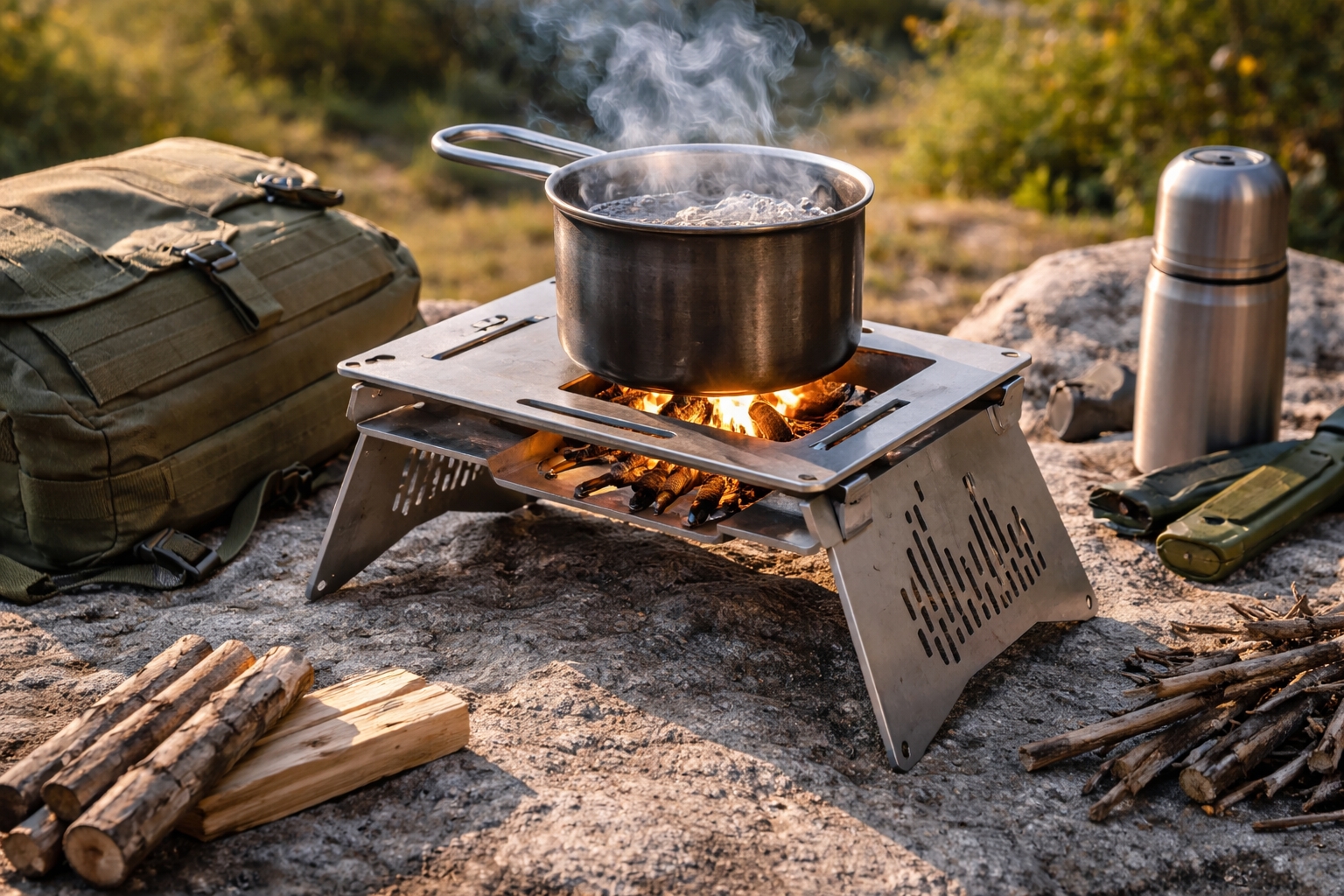
In Hong Kong, Camprit developed a titanium stove with 5 pieces and a weight of 620 g to reduce carrying weight on movements, creating more autonomy in field routines and drawing attention for its multifunctionality in a single kit.
A camping stove may seem like a leisure subject. However, in practice, this type of equipment serves as a logistical piece in remote activities, where cooking and heating water are part of the minimum package to sustain a long journey, such as operations away from base, where weight and volume become factors that dictate routine.
When the team needs to walk, climb, cross rough terrain, or work far from any support, every extra gram matters by the end of the day. And the food, which should be simple, often depends on improvisation.
It is at this point that a compact titanium kit, weighing less than 700 g, draws attention. It was designed to reduce weight while still keeping preparation options beyond the basics, without turning the backpack into a storage unit for pots and accessories.
-
Motorola launched the Signature with a gold seal from DxOMark, tying with the iPhone 17 Pro in camera performance, Snapdragon 8 Gen 5 that surpassed 3 million in benchmarks, and a zoom that impresses even at night.

-
Satellites reveal beneath the Sahara a giant river buried for thousands of kilometers: study shows that the largest hot desert on the planet was once traversed by a river system comparable to the largest on Earth.

-
Scientists have captured something never seen in space: newly born stars are creating gigantic rings of light a thousand times larger than the distance between the Earth and the Sun, and this changes everything we knew about stellar birth.

-
Geologists find traces of a continent that disappeared 155 million years ago after separating from Australia and reveal that it did not sink, but broke into fragments scattered across Southeast Asia.


Titanium Portable Stove Is Ultra-Lightweight, Disassemblable, and Multifunctional
Camprit, an outdoor equipment company from Hong Kong, launched on Kickstarter a portable titanium stove designed to be ultra-lightweight, disassemblable, and multifunctional. The brand had previously introduced a similar product, the FireNest, and now bets on a set that fits in a flat plate format.
The kit targets those who try to minimize weight while still needing to cook, boil water, grill, and keep preparations protected from the wind. In logistics, this translates to less volume transported and fewer separate items to inventory, store, and clean.
New Atlas presented the stove as a compact alternative for cooking in nature without being limited to instant meals, precisely because the set concentrates multiple functions in the same format.
How the 5-Piece Design Reduces Volume, Assembly, and Failure Points
The set consists of five titanium components: two foldable legs and three cooking panels. The proposal is for simple assembly, with quick fitting, and stability on any surface, according to the creators.
The base panel acts as a frame mounted on the legs. It becomes a structure to support a pot or serve as a rack. In the field, this modularity is interesting because it replaces multiple supports and reduces the number of different pieces circulating within the team.
The three panels do not act as “extra” accessories. They form the logic of the product. The same element that helps grill can also become a support, windbreak, and preparation area. This reduces failure points and decreases the chance of missing a specific piece during assembly.
Functions That Change Use: Grill, Support, Windbreak, and Dual Heating

The creators describe that the sear panel can be used as a frying pan when the idea is not to carry a pot. However, titanium has its own behavior in heat, which weighs on the decision of those working in the field who seek predictability.
The material heats unevenly and is not non-stick. For some foods, like fish and eggs, it may still be worth bringing along an appropriate frying pan. In other words, the kit delivers function, but the type of food and the level of demand dictate whether improvisation is worth it.
The grill panel can act as a grill or as a support for boiling. Both the grill and the sear can become windbreaks to protect the flame. In logistics, a windbreak is not a minor detail. An unstable flame increases fuel consumption and delays routine.
The most curious feature is the possibility for simultaneous cooking. By using one panel at the bottom, it is possible to cook on top while another food bakes below. The example cited by the creators is cooking meat on the upper part and baking potatoes underneath in the same process.
Compatibility With Fuels and Weight in Operational Planning

The kit attempts to reduce the risk of reliance on a single fuel source. Besides traditional gas cartridges, it accepts solid fuel, alcohol burners, and small twigs. Practically speaking, anything that burns can work.
For logistics, this means flexibility in fuel supply. When one cannot carry a sufficient gas reserve or when the route is long, the ability to switch the heat source changes the strategy. At the same time, the real efficiency will vary depending on the type of fuel and the environment.
The creators also highlight a characteristic of titanium with repeated use: the panels slightly change color after each use. This is described as a natural and safe process. Cleaning may also require more effort, especially if any panel is used as a frying pan.
Numbers, Measurements, and What They Reveal About Transport and Team Use

The product has two sizes. The Mini model is designed for individual use and measures 182 x 105 x 12 mm. The Plus model measures 272 x 148 x 17 mm and tends to serve better when more than one person is involved in preparation.
The panels are 1.5 mm thick in both versions. In terms of weight, the contrast is direct: the Mini weighs 310 g and the Plus weighs 620 g. Even the larger one stays below 700 g, keeping the kit in an ultra-lightweight category.
The stove opens quickly and locks into a flat panel, making it easy to store. The Mini can fit in a pocket, according to the product’s proposal. There is also a hole for hanging the kit outside the backpack, which helps when the equipment is dirty and needs to dry or be accessible.
These numbers explain the appeal: less volume, less weight, quick assembly, and various functions in the same set. In remote operations, this type of item is often chosen not for “comfort,” but to reduce friction in routine and cut carrying weight.
Would a kit like this make sense in field routines and remote logistics? Leave your comment.








-

-

-

-

16 pessoas reagiram a isso.