





 Portuguese
  English
  Spanish
  4 min of reading
  0 comments


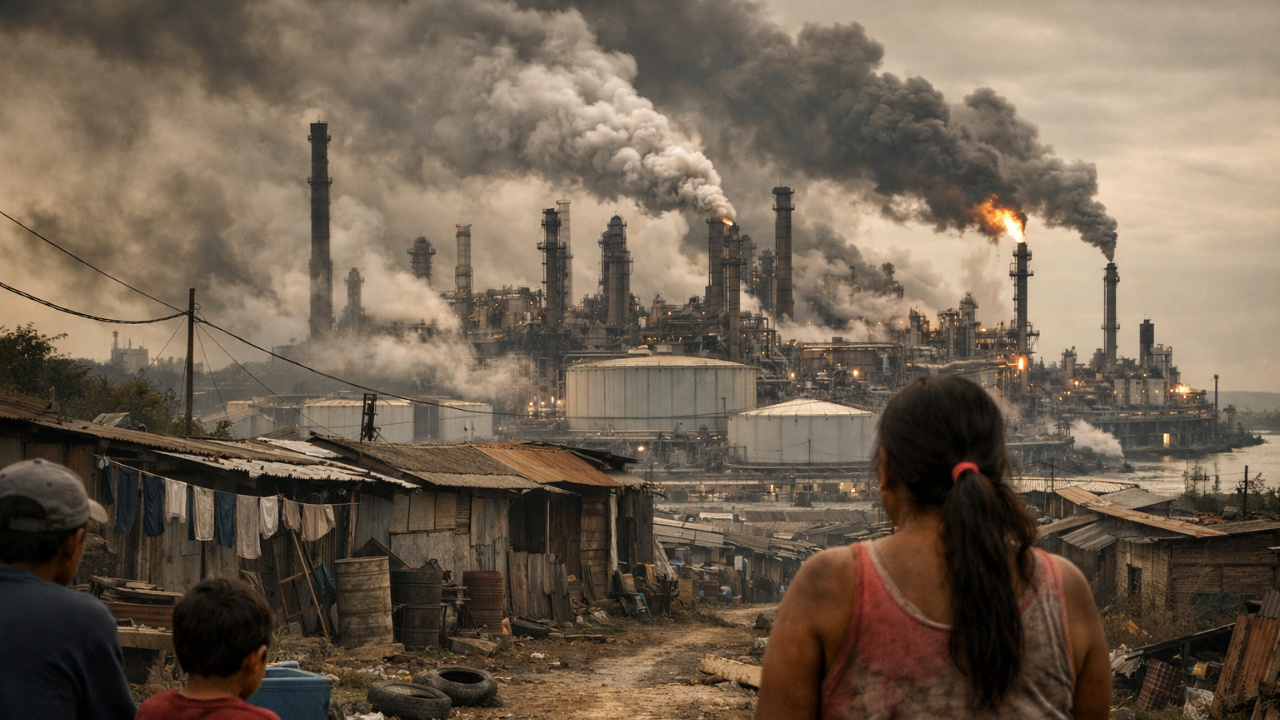
International Study Warns That Oil Companies’ Green Projects Do Not Replace Fossil Fuels, Prolong Oil Dependency, and Reinforce Social and Climate Inequalities.
An international analysis conducted by researchers from ICTA-UAB and the University of Sussex raises an alert regarding the so-called “green” projects promoted by oil companies. According to the study, these initiatives are not structured to replace the use of fossil fuels, but rather to prolong the current energy model under a climate-friendly narrative.
The survey evaluated 48 socio-environmental conflicts across different continents. The conclusion is that, although presented as transition solutions, many of these actions maintain the extraction and use of oil, gas, and coal for decades, while also reinforcing the economic and political power of companies in the sector.
Systematic Strategy Maintains Fossil Assets in Operation
According to the authors, these are not isolated initiatives or minor failures. The study points to a deliberate strategy by oil companies to integrate new facilities classified as “low carbon” into existing infrastructures, such as refineries, gas pipelines, and thermal power plants.
-
The rise in oil prices could ensure an extra revenue of R$ 100 billion for the Federal Government, indicates a recent economic study.

-
Naturgy begins an investment of R$ 1.6 million to expand the gas network in Niterói and benefit thousands of new residences and businesses.

-
A major turn in the Justice system suspends tax increases and directly impacts oil and gas companies in Brazil by affecting costs, contracts, and financial planning, leaving uncertain what could happen to the sector if these costs had increased.

-
Brava Energia begins drilling in Papa-Terra and Atlanta and could change the game by reducing costs in oil while increasing production and strengthening competitiveness in the offshore market.


This connection, according to the researchers, creates technical and economic justifications for keeping fossil assets operational. One cited example is the H2Med pipeline, between Barcelona and Marseille, promoted as a hydrogen project but also designed to transport fossil gas, prolonging the relevance of a network that, in theory, should be gradually deactivated.
Transition Solutions Do Not Reduce the Climate Crisis
The study maintains that none of these technologies effectively contribute to mitigating climate change unless there is a real replacement of fossil fuel extraction and burning. Among the questioned solutions are blue hydrogen, which relies on fossil methane, and biofuels that compete with food production and encourage deforestation.
This group also includes carbon offset mechanisms. According to the researchers, these practices allow emissions to continue occurring in certain locations while being neutralized only on paper in other regions.
Social Impacts Fall on Vulnerable Populations
In addition to emissions accounting, the work documents persistent local effects associated with oil companies’ projects. Among them are air pollution in areas near refineries, land expropriation for energy crops, and the construction of large infrastructure corridors.
These impacts, according to the study, disproportionately affect Global South countries and indigenous peoples. The result is the reproduction of historical inequalities under a new climate labeling, which masks the real social and environmental costs.
Public Money Supports Projects with Questionable Climate Benefits
Another highlighted point is the role of state financing. The report points out that public subsidies and favorable regulatory frameworks end up directing resources toward projects with limited climate gains. Meanwhile, social and ecological costs remain off the financial balance sheets.
Moreover, the transition technologies promoted by oil companies end up creating alliances with other emission-intensive sectors. Aviation seeks “drop-in” biofuels, agribusiness integrates into energy supply chains, and mining partners with hydrogen expansion.
This movement, according to the authors, consolidates a network of dependencies that strengthens the fossil industry’s influence in financial markets, logistics chains, and climate governance spaces.
Impact Assessment of Oil Companies Needs to Change
Researcher Marcel Llavero-Pasquina states that the climate impact of oil companies should be measured by the fossil fuels they cease to extract, rather than by the number of green projects announced.
The study warns that turning these solutions into structural public policy could block deeper changes, leading to slow, centralized transitions controlled by the same historical actors in the energy sector.
Alternative Paths Stand Out in the Study
Outside of this model, the authors advocate for alternatives considered more effective. Among them are the accelerated expansion of renewable energies, direct reduction of energy demand, and the establishment of clear timelines for phasing out fossil fuels.
The work also highlights the importance of community-led processes. Carbon capture, according to the study, would only make sense if accompanied by the rapid closure of fossil facilities. Hydrogen should be exclusively green, produced with renewable electricity and intended for hard-to-electrify uses.
In the case of biofuels, researchers advocate for strict social justice and land use criteria. Carbon offsets, in turn, should not replace real emission reductions.
The study’s final alert is direct: oil companies’ green projects function as complements to the fossil model, not as substitutes. For the authors, public money should prioritize the reduction of supply and demand for fossil fuels, equitable access to clean energy, and the redress of historical harms, rather than supporting strategies that perpetuate energy dependency under a misleading climate narrative.









Seja o primeiro a reagir!