





 Portuguese
  English
  Spanish
  5 min of reading
  0 comments


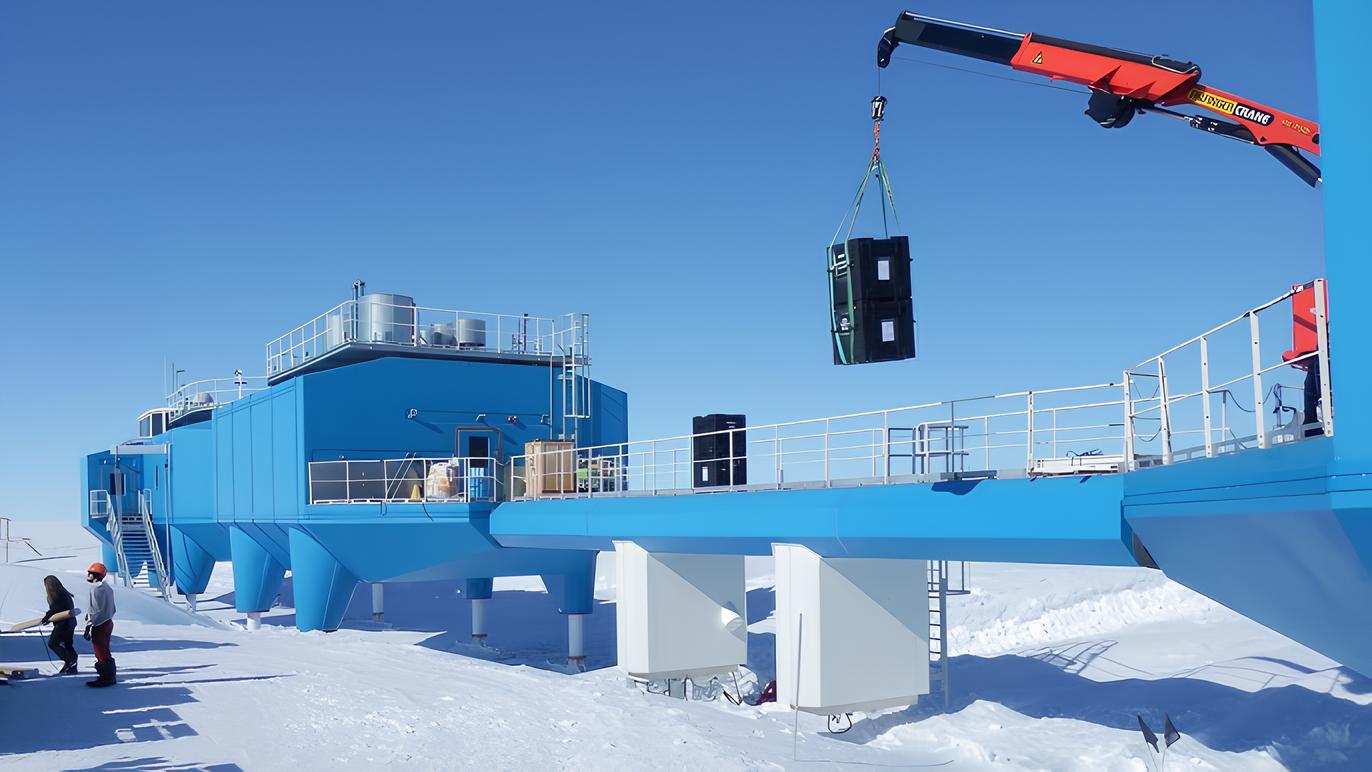
With Modules on Hydraulic Skis, Halley VI Is the Mobile Scientific Base in Antarctica Created to Escape Cracks and Survive Moving Ice.
Antarctica is a paradoxical continent. At first glance, everything seems still, frozen, and stable. In practice, however, Antarctic ice is in continuous motion. Ice shelves slide towards the ocean, cracks open unpredictably, and areas considered safe can become uninhabitable in just a few years. It was this very behavior of ice that forced British engineers and scientists to completely rethink the concept of a polar research station. The result of this extreme challenge is the Halley VI Research Station, a scientific base unlike any other ever built. Rather than fighting against the ice, Halley VI was designed to move with it, literally.
The Problem That Doomed All Previous Versions of Halley Base
The British presence in the region where Halley VI is located dates back to the 1950s. Since then, five previous versions of Halley base have been built in the same sector of the Brunt ice shelf. All ended up with the same fate: they were abandoned or buried by ice over time.
The reason was always the same. The ice shelf moves towards the sea, accumulating internal tensions. Over the years, large cracks suddenly appear, threatening fixed structures. In addition, snow continuously accumulates, burying buildings that were not designed to “rise” with the ice level.
-
Motorola launched the Signature with a gold seal from DxOMark, tying with the iPhone 17 Pro in camera performance, Snapdragon 8 Gen 5 that surpassed 3 million in benchmarks, and a zoom that impresses even at night.

-
Satellites reveal beneath the Sahara a giant river buried for thousands of kilometers: study shows that the largest hot desert on the planet was once traversed by a river system comparable to the largest on Earth.

-
Scientists have captured something never seen in space: newly born stars are creating gigantic rings of light a thousand times larger than the distance between the Earth and the Sun, and this changes everything we knew about stellar birth.

-
Geologists find traces of a continent that disappeared 155 million years ago after separating from Australia and reveal that it did not sink, but broke into fragments scattered across Southeast Asia.
Halley VI was born from the realization that it no longer made sense to build fixed bases in an environment that is, by definition, unstable.
A Radical Concept: Mobile Architecture in the Most Hostile Place on the Planet
The central concept of Halley VI was simple in theory and extremely complex in practice: to create a modular scientific base, elevated off the ground, and capable of being moved whenever necessary.
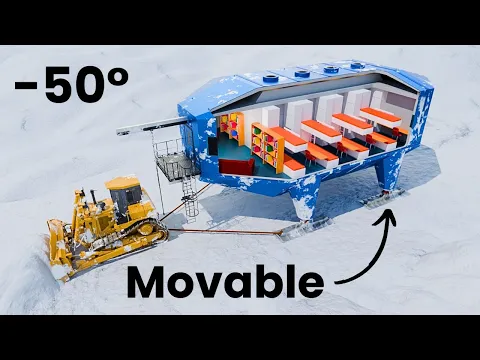

To achieve this, engineers adopted three fundamental principles:
- The base needed to be modular, allowing for partial disassembly and controlled relocation.
- Each module should be elevated off the ice, preventing progressive burial by snow.
- The entire structure would need to be towable, even in extreme temperatures and over uneven surfaces.
These principles gave rise to one of the boldest solutions ever applied to polar engineering.
How the Hydraulic Legs and Giant Skis System Works
Halley VI is composed of eight interconnected modules, each mounted on adjustable hydraulic legs, which in turn rest on large metal skis. These skis are not decorative: they turn each module into a sort of giant sled.
The hydraulic legs allow the modules to be periodically elevated, keeping up with snow accumulation. When it is time to relocate the base, the modules are uncoupled, positioned on the skis, and slowly towed by specialized tractors across the surface of the ice shelf.
This system allows the station to be moved several kilometers, something unthinkable for any traditional polar base.
The Historic Move That Proved the Concept Works
The definitive proof that Halley VI was not just a theoretical experiment came between 2016 and 2017. Studies indicated that a large crack, later called Chasm 1, was dangerously approaching the base.
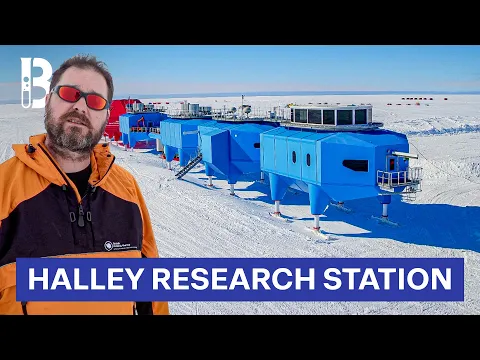
Instead of abandoning the station, as had happened in the past, the British made an unprecedented decision: move the entire base.
During a complex logistical operation, the modules were separated and towed to a site considered safer on the Brunt ice shelf.
The operation took weeks and required meticulous planning, but it was successful. For the first time in Antarctic history, an entire scientific base escaped a geological threat simply by moving.
Dimensions, Capacity, and Scientific Function of Halley VI
In addition to mobility, Halley VI also impresses with its dimensions and operational capabilities. The base was designed to accommodate around 70 people during the Antarctic summer, when scientific activities reach their peak, and approximately 16 occupants during the winter, a period marked by total isolation, continuous darkness, and extreme temperatures.
The modules include:
- Accommodation and living areas
- Specialized scientific laboratories
- Power generation systems
- Communication infrastructure and medical support
One of the main focuses of the research conducted at Halley VI is atmospheric monitoring, including studies on the ozone layer, climate change, and global atmospheric composition. The location of the base is strategic for measurements that cannot be made anywhere else on the planet.
Engineering Designed for Temperatures Below −50 °C
Designing a mobile structure is already a challenge in itself. Doing so in an environment where steel becomes brittle, conventional oils freeze, and electronics suffer from extreme thermal variations elevates the difficulty to another level.
Halley VI was conceived to operate in temperatures that can drop below −50 °C, with intense winds and long periods without sunlight. Materials, hydraulic systems, cables, and connections needed to be tested and adapted to ensure reliable operation under these conditions.
Even the external design of the base was conceived to reduce snow accumulation and minimize structural stresses caused by the wind.
Why Mobile Bases Are the Future of Human Presence in Antarctica
Halley VI represents a deep change in how engineering views extreme environments. Instead of rigid and permanent structures, the design shows that flexibility and adaptation can be more effective than pure resistance.
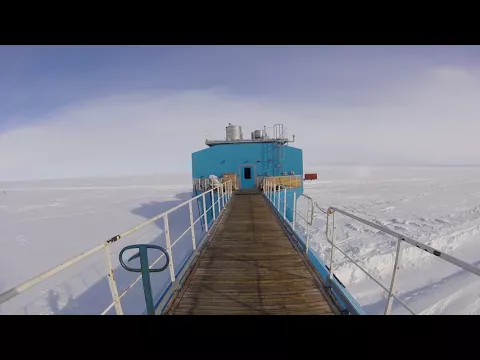
As global warming alters the behavior of ice shelves, fixed bases are likely to become increasingly vulnerable. The concept of elevated and relocatable mobile bases emerges as a logical response to this new scenario.
This model applies not only to Antarctica. It paves the way for projects in other unstable regions of the planet and even for future human bases in extraterrestrial environments, where the ground can also be unpredictable.
A Living Laboratory of Extreme Architecture
Halley VI is not just a scientific center. It functions, in practice, as a real-scale engineering laboratory. Each winter, each storm, and each move provide valuable data on materials, structures, and human behavior in extreme isolation.
This knowledge transcends polar research. It impacts areas such as construction in remote regions, modular architecture, military engineering, and even space habitat planning.
The Symbolism of a Base That Refuses to Be Swallowed by Ice
For decades, the ice of Antarctica has defeated all human attempts to establish permanent structures at that point on the continent. Halley VI represents the first time that human engineering decided not to confront the ice directly, but to accept its movement and adapt to it.
In a continent where nothing is truly static, the self-moving scientific base has become a symbol of a new construction philosophy: to survive is not to resist the environment, but to learn to move with it.
The Halley VI proves that, even in the most hostile place on Earth, engineering can find elegant solutions to problems that seemed insurmountable, as long as it is willing to abandon old ideas and literally move when the world around it begins to crack.







-

-

4 pessoas reagiram a isso.