





 Portuguese
  English
  Spanish
  6 min of reading
  0 comments



Harley-Davidson Faces The Biggest Crisis in Its History, Enters a Transition Year, Bets on Entry-Level Motorcycles, and Revises Its Electric Bikes to Try to Stay Relevant.
With losses in the hundreds of millions of dollars and a sharp drop in sales, Harley-Davidson classifies 2026 as a “transition year” and is accelerating a survival plan that involves a cheaper entry-level motorcycle, a complete portfolio overhaul, and distancing the LiveWire electric division from the center of its strategy.
Far from being just another bad cycle, the current moment indicates a structural change. Harley-Davidson’s revenue plummeted about 28% in the last quarter, and losses doubled compared to 2024, resulting in a deficit of approximately US$ 279 million, a figure that pressures cash flow and forces the company to abandon the idea of surviving solely on very expensive motorcycles for a limited audience. At the same time, tariffs, inflation, and high interest rates are driving up operational costs, while the traditional fanbase is aging and the new generation has yet to find a Harley that fits their budget.
What The Latest Numbers Show About Harley-Davidson
The latest results leave little room for optimistic interpretations. Harley-Davidson is currently in the red, with significantly decreased revenue and rising losses, which the company itself publicly acknowledges by treating 2026 as a period of adjustment, not growth.
-
The government requests the Federal Revenue Service for a new system to automate the income tax declaration, reducing errors, time, and bureaucracy for millions of Brazilians.

-
Pix in installments, international Pix, and contactless payment without internet: the Central Bank revealed the new features coming to the tool that is already used by almost every adult in Brazil.

-
Mercado Livre has just started selling medications with delivery in up to three hours to your door, and this move could completely change the way Brazilians buy medicines on a daily basis.

-
In Dubai, rising tensions from the war in the Middle East are causing super-rich individuals to leave the Gulf and direct their fortunes to a new financial refuge in Asia.


In addition to the 28% reduction in quarterly revenue, losses have doubled compared to the previous year, pushing the deficit to around US$ 279 million, approximately R$ 1.5 billion.
The gross margin has been shrinking, and tariffs add an extra layer of pressure, costing about US$ 22 million in just one quarter.
Even producing most of its motorcycles in the United States and using about 75% domestically sourced components, Harley-Davidson remains reliant on semiconductors and imported parts, exposing it to additional costs in a global landscape of trade tensions.
When The Strategy of Selling Less But at a Higher Price Stops Working
For years, Harley-Davidson relied on a simple equation: sell fewer units, but at a very high average ticket, focusing on customers with high purchasing power. The logic seemed viable as long as there was a solid base of consumers willing to pay for large, iconic, and emotional motorcycles.
Today, that premise is under question. In an environment of persistent inflation, high interest rates, and more selective consumers, the decision to invest in a motorcycle costing around 30,000 euros, close to R$ 189,000, has stopped being a priority for many buyers.
The brand continues to count on an older and extremely loyal audience, but this base is not refreshing at the same pace. The new generation of motorcyclists, for the most part, has less disposable income and different expectations regarding price, technology, and daily use.
The result is a mismatch: Harley-Davidson should be consolidating itself among young riders, but fails to do so with a portfolio focused on pricey niche models.
The pressure for more accessible sales volume has now become part of the internal strategic discussion.
Sprint: The Entry-Level Motorcycle Trying to Reposition Harley-Davidson in 2026

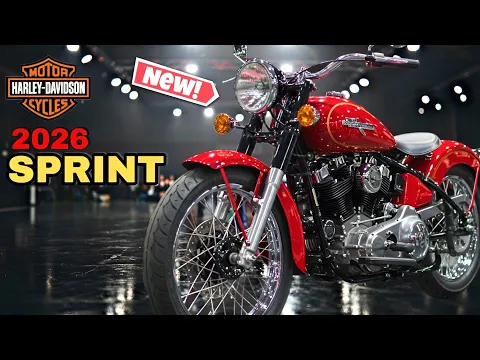
The company’s first concrete response to this diagnosis is the Sprint, an entry-level motorcycle, priced more accessibly, planned to hit the market in 2026.
The idea is to provide a stepping stone for those who have always viewed the brand as a distant dream but have never found a Harley-Davidson compatible with their budget.
The Sprint is treated internally as a course correction. After years prioritizing only the top tier, Harley-Davidson is once again looking at the entry-level segment, where other global brands have been operating strongly for a long time.
The challenge will be to balance cost, identity, and perceived value: the bike needs to be cheaper, yet still recognizable as a Harley, both in design and in user experience.
At the same time, executives make it clear that 2026 should not be understood as a year of definitive turning point.
The CEO himself indicates that this is a period to “refine the product line, simplify the offering, and adjust the overall strategy,” a movement that does not conclude in a few months.
Tariffs, Supply Chain, and The Side Effect on Cash Flow
Another central point of the current crisis is the impact of tariffs and the supply chain on fixed and variable costs.
Even with much of the production concentrated in the United States, Harley-Davidson relies on semiconductors and components brought from abroad, making it vulnerable to regulatory changes, trade disputes, and currency fluctuations.
The new tariffs, according to data used by the company itself, totaled about US$ 22 million in just one quarter.
For a company already facing declining revenue and increasing losses, this amount is non-trivial. Every cost increase is partially passed on to the final price, which makes motorcycles even less accessible in a high-interest context and tight budgets.
This vicious circle complicates the task of repositioning Harley-Davidson with an entry-level product. The Sprint needs to be competitively priced, but it is being developed in an environment where raw materials, logistics, and electronic components are likely to increase project costs.

LiveWire Split: What The Separation From Electric Bikes Means
In parallel to the discussion about price and portfolio, Harley-Davidson has made another important strategic decision: to separate the electric motorcycle division LiveWire, created with the expectation of representing the brand’s future mobility.
In practice, this move is a recognition that LiveWire, under current conditions, has not achieved the expected volume and impact.
The adoption of electric motorcycles on a large scale still faces barriers of cost, charging infrastructure, and public acceptance, especially in the high-displacement niches.
By placing LiveWire in a more independent model, Harley is trying to preserve the main brand from greater financial risks while keeping the technological option open for the long term.
This separation also signals priorities: in the very short term, Harley-Davidson’s focus returns to financial survival with more accessible combustion models, while the electric bet is repositioned at a more cautious pace.
This is not a total abandonment of electrification, but a shift in prominence within the overall strategy.
Investors, Fanbase, and The Challenge of Navigating The Transition Year
Despite the difficult scenario, the announcement of a recovery plan had a limited but symbolic effect on the financial market.
Harley-Davidson’s shares saw a slight increase after the disclosure of the guidelines for the upcoming years, partially reversing pre-market declines. The message from investors seems clear: there is no enthusiasm, but there is relief that there is at least a plan in motion.
On the consumer side, the picture is more delicate. The historic fanbase continues to sustain a good portion of revenue, but is aging and not renewing at the necessary pace, while the younger audience still doesn’t see the brand as a compatible option with their purchasing power and usage style.
Between preserving the classic identity and engaging with new generations, Harley-Davidson needs to decide how much it is willing to change.
Whether the Sprint will be enough to reopen the entry door, and whether the separation of LiveWire will bring relief or a loss of technological relevance, will only become clear after this period that the company itself defines as a “transition year.”
In light of this scenario, do you think Harley-Davidson will be able to reinvent itself with a cheaper entry-level motorcycle and an electric division in the background, or has the brand taken too long to react to market changes?








Seja o primeiro a reagir!