





 Portuguese
  English
  Spanish
  5 min of reading
  22 comments


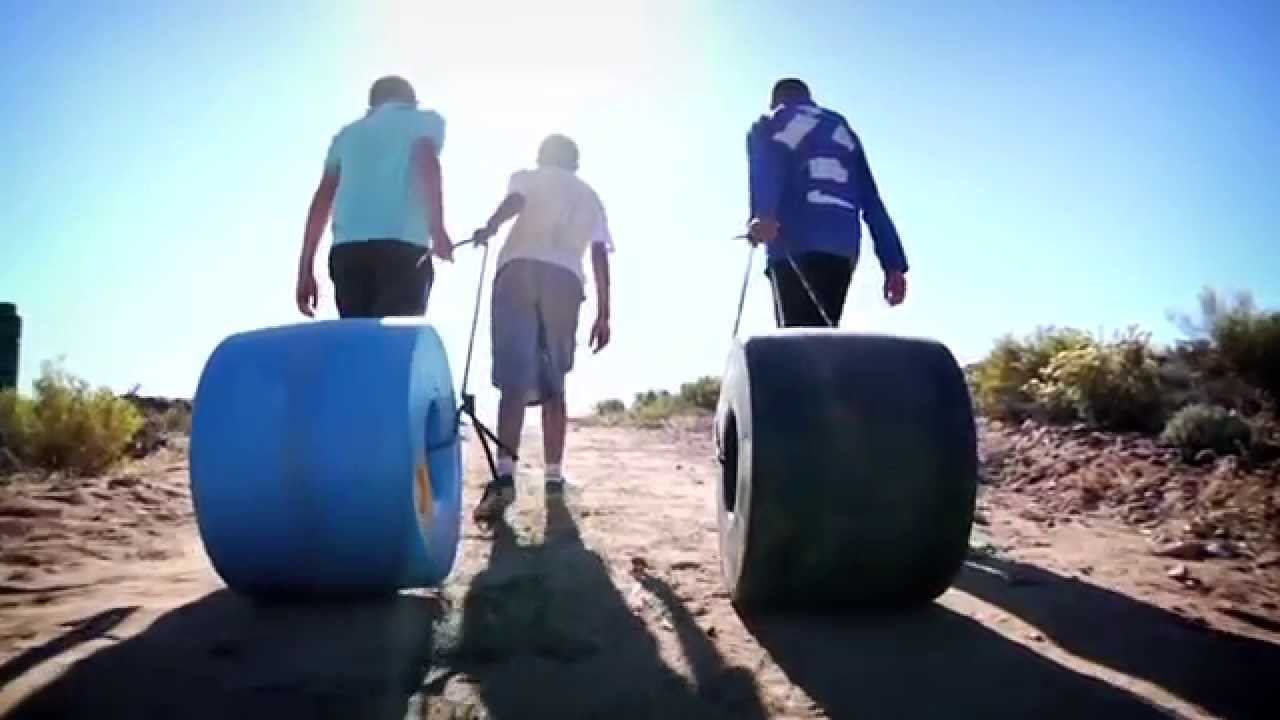


South African Architect Created Giant Donut-Shaped Drum Called Q-Drum, Which Allows Transporting Between 50 And 90 Liters Of Water By Rolling On The Ground, Reducing Physical Effort Of Women And Children Who Walked Up To 6 Km Per Day.
In the early 1990s, Hans Hendrikse traveled through rural villages in Northern South Africa as part of his work as an architect. What he repeatedly saw troubled him too much to ignore: women and children carrying water jugs on their heads for up to 6 kilometers every day, spending up to 8 hours a day just on that task. There was no water infrastructure. There was no alternative. There was only the weight.
Hendrikse left construction projects, called his brother Piet — also an architect — and the two spent years trying to solve a problem that seemed too simple not to have a solution: how to transport large volumes of water without carrying anything on their backs?
The answer, which came after many attempts, took the form of a giant donut.
-
Motorola launched the Signature with a gold seal from DxOMark, tying with the iPhone 17 Pro in camera performance, Snapdragon 8 Gen 5 that surpassed 3 million in benchmarks, and a zoom that impresses even at night.

-
Satellites reveal beneath the Sahara a giant river buried for thousands of kilometers: study shows that the largest hot desert on the planet was once traversed by a river system comparable to the largest on Earth.

-
Scientists have captured something never seen in space: newly born stars are creating gigantic rings of light a thousand times larger than the distance between the Earth and the Sun, and this changes everything we knew about stellar birth.

-
Geologists find traces of a continent that disappeared 155 million years ago after separating from Australia and reveal that it did not sink, but broke into fragments scattered across Southeast Asia.

The Drum That Rolls Instead Of Being Carried: Q-Drum
The Q-Drum is a cylindrical container made of high-density polyethylene, with a hole in the center, just like a wide tire or an industrial donut. A strong rope passes through this hole. The user simply ties the rope around their waist or holds it in hand and pulls the container across the ground, as if rolling a wheel.
The result is radical: a 10-year-old child can transport 50 liters of water, equivalent to 50 kilograms, with no effort comparable to conventional carrying. The same volume that would require multiple trips carrying jugs on the head is transported in a single trip, in a fraction of the time.


The load capacity is not the only impressive detail. In tests conducted by the South African Bureau of Standards, the Q-Drum supported a compression load of 3.7 tons before collapsing, equivalent to 40 full containers stacked 25 meters high. The 5 mm polyethylene walls were specifically designed to withstand rough ground, stones, sand, and daily use without maintenance.
A single Q-Drum lasts an average of 5 years of intense use. There are records of units with 8 years in continuous operation, pulled 6 kilometers a day, still intact.
Why Had No One Thought Of This Before
The logic of the donut drum seems obvious once you see it. Before, it appears invisible. For centuries, the solution for transporting water was always the same: rigid containers carried on the human body. Jars on the head, buckets in hand, jugs on the shoulder. All evolution was in the material from clay to metal, from metal to plastic, but never in the mechanics of transport.
What Hendrikse did was change the question. Instead of asking “how to make a lighter container?”, he asked “how to transform the act of carrying into rolling?”. The answer required a complete redesign of the object’s geometry.
The hole in the center is not an aesthetic detail; it is the heart of the invention. Without it, the container would just be another bucket. With it, the low center of gravity, the increased contact surface with the ground, and the effort needed drop dramatically. The physics of the Q-Drum is the same as that of the wheel, applied to the transport of liquids.
The Problem That Money Couldn’t Solve
In 1993, when the Q-Drum was patented, Hendrikse believed the solution would quickly reach the communities that needed it. Thirty years later, the reality is more complex.
The container costs about US$ 65 per unit, an affordable price by Western standards, but prohibitive for rural African families who need it most. The irony is cruel: those who can pay don’t need it. Those who need it can’t pay.
The manufacturing cost is inflated by an inevitable technical limitation. To create the central hole with the necessary specifications for strength, the only viable process is rotational molding, a slower and more expensive technique than conventional plastic injection. Each unit takes longer to produce, and that time costs money.

Transportation exacerbates the problem. Sending small quantities of Q-Drums to remote communities results in shipping costs that exceed the cost of the product itself. The logistics that work for high-value unit products completely fail for bulky and cheap items.
Piet Hendrikse, who took over commercial management after his brother Hans passed away in 2012, has spent years building partnerships with international organizations and governments to solve this knot. The strategy includes local manufacturing licensing in countries with the highest demand — which would reduce both the production and transportation costs.
2 Billion People, A Distribution Problem
The number that defines the scale of the problem is simple: 2 billion people in the world do not have safe access to drinking water near their homes. Most of them are in Sub-Saharan Africa and South Asia, exactly the type of flat, semi-arid terrain for which the Q-Drum was designed.
The container is already operating in five African countries — South Africa, Mozambique, Democratic Republic of the Congo, and regions of the eastern continent. It was displayed at the Cooper-Hewitt Smithsonian Design Museum in New York as an example of humanitarian design. It received the Rolex Award for Enterprise Initiative. It has been studied at engineering and design universities as a case of creative problem solving.
But the speed of adoption has been much slower than the urgency of the problem would require.
The Q-Drum SA company, based in Johannesburg, continues to operate with a focus on institutional partnerships. Each contract with a humanitarian aid organization or local government represents thousands of units distributed at once — the only logistical model that makes the cost viable.
Piet Hendrikse’s stated goal is to achieve sufficient scale for the manufacturing cost to fall to the point of making the Q-Drum affordable for individual purchase. He hasn’t reached there yet. But the drum keeps rolling.
The Most Elegant Reinvention Of The Wheel
There is a specific beauty in inventions that seem inevitable once they exist. Velcro. Post-it. The spoked wheel. The Q-Drum belongs to that category.

Hans Hendrikse didn’t need a research lab, million-dollar funding, or a team of engineers to create the donut drum. He needed observation, free time from construction projects, and a question that no one had asked before in the right form.
What he left behind is not just a product. It is a demonstration that the world’s most urgent problems sometimes wait for solutions that could have existed for centuries — and that the distance between the problem and the solution can be measured in millimeters of plastic and a hole in the right place.







Isso sempre existiu aqui no Brasil.
Não é novidade nenhuma.
Sempre que uma solução simples beneficia quem mais precisa,aparece alguém criticando.
A ideia é boa sim, porém como foi falado o custo e a logística é cara.
Melhor seria investir e tubulação de PVC.talvez seria o mesmo custo porém eliminaria o esforço e o tempo.