





 Portuguese
  English
  Spanish
  5 min of reading
  17 comments


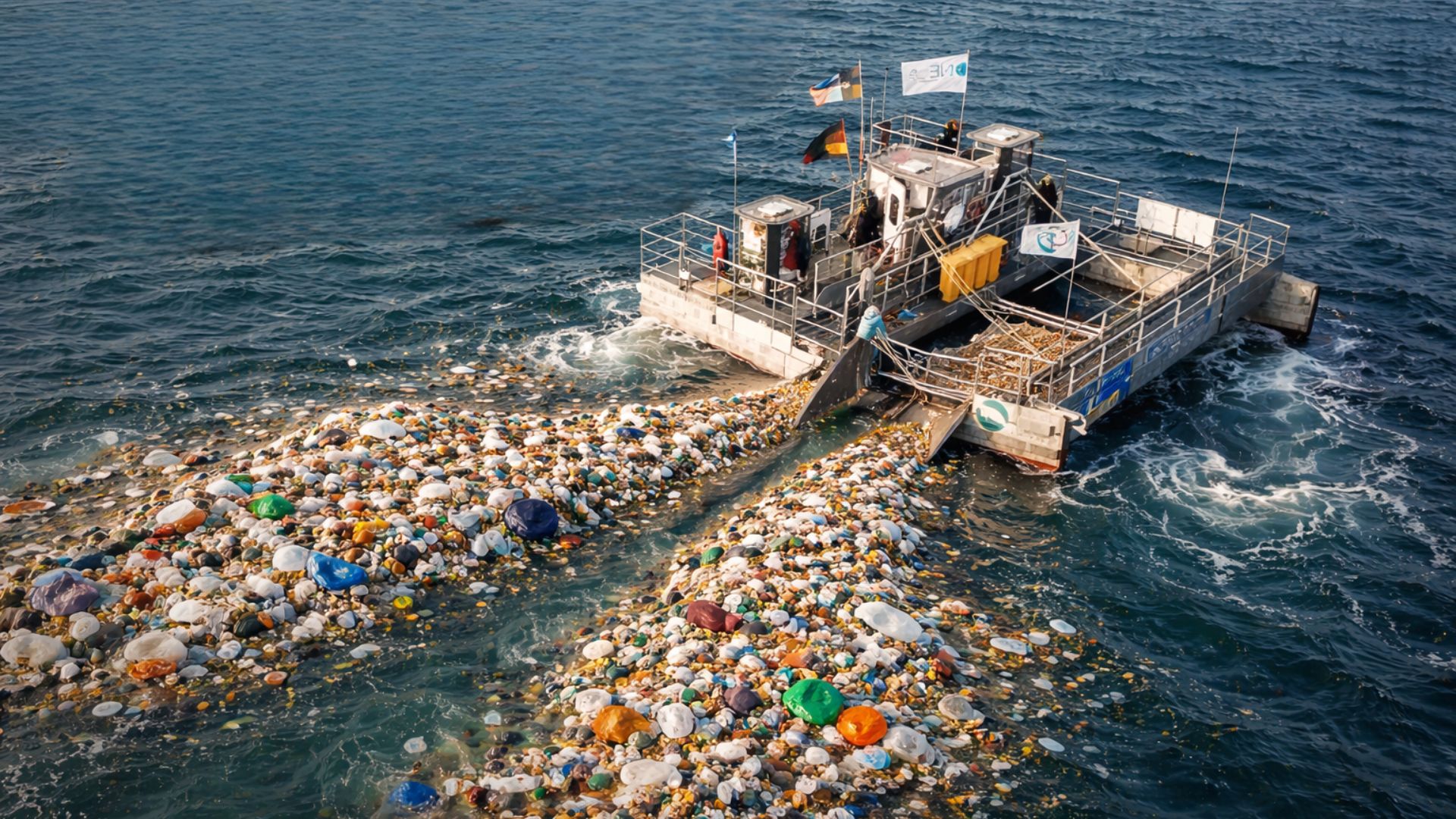


German Initiative Bets on Modular Vessel to Collect Plastic Before Waste Spreads, with Declared Capacity of Up to Two Tons Per Trip and a Proposal to Transform River and Coastal Cleanup into a Continuous, Structured Service Integrated with Land Recycling.
A German initiative led by the organization One Earth – One Ocean bets on vessels designed to collect floating waste before plastic fragments and spreads, with a prototype nicknamed Seekuh that is presented as capable of removing up to two tons per trip.
Instead of relying solely on volunteer efforts, the project advocates transforming the cleaning of rivers, canals, and coastal areas into a continuous operation, with logistics and scale similar to that of a collection “service”, connecting removal from the water to sorting and disposal on land.
Seekuh: How the Sea Cow Plastic Collection Ship Works
The name Seekuh, which in German means “sea cow”, is used to identify a cleaning catamaran designed to operate where trash concentrates on the surface, such as patches in coastal areas, bay entrances, and current stretches that act as accumulation corridors.
-
Motorola launched the Signature with a gold seal from DxOMark, tying with the iPhone 17 Pro in camera performance, Snapdragon 8 Gen 5 that surpassed 3 million in benchmarks, and a zoom that impresses even at night.

-
Satellites reveal beneath the Sahara a giant river buried for thousands of kilometers: study shows that the largest hot desert on the planet was once traversed by a river system comparable to the largest on Earth.

-
Scientists have captured something never seen in space: newly born stars are creating gigantic rings of light a thousand times larger than the distance between the Earth and the Sun, and this changes everything we knew about stellar birth.

-
Geologists find traces of a continent that disappeared 155 million years ago after separating from Australia and reveal that it did not sink, but broke into fragments scattered across Southeast Asia.


The concept gained visibility when described by the Bundespreis Ecodesign, a German design award, which attributes to the equipment the ability to collect up to two tons of plastic per outing and notes that, at the current stage, the material removed is sent for recycling on land.
Although the volume depends on operational conditions and the type of waste found, the repetition of the number in materials and reports indicates the project’s focus: remove a lot in a short time, always aiming for what is in the upper layer, more exposed to wind and transport to the open sea.
Günther Bonin and the Origin of One Earth – One Ocean
At the forefront of the initiative is Günther Bonin, cited by various institutional sources as a former information technology entrepreneur who shifted his work to combat water pollution, following personal experiences during voyages where he observed waste disposal and the presence of debris in the sea.
Bonin founded One Earth – One Ocean in 2011, and since then, the association has presented a strategy for maritime waste collection, with vessels of different sizes for different environments, such as urban rivers, lakes, estuaries, and shallow coastal areas.
A report from Deutschlandfunk Kultur describes the Seekuh as a collection structure mounted on a catamaran, with a net and frame positioned between the hulls to capture the floating trash, functioning as a type of “shovel” that collects the material and facilitates removal.
Towed Funnel System and Capacity of Up to 2 Tons Per Trip

In the technical description released by the organization, the catamaran is about 12 by 10 meters and carries, between the two hulls, deployable nets with a mesh size of 2.5 centimeters, designed to collect waste up to approximately two meters deep, prioritizing plastic on the surface.
The same project page states that, currently, the system can collect up to two tons “per trip or network”, a formulation that reinforces the operational nature of the equipment and suggests adapting the method according to the location, type of trash patch, and capture strategy used.
In addition to the catamaran itself, the initiative describes an operational design that relies on concentrating waste before capture, using floating barriers to form a “funnel” that directs waste to a collection point, reducing dispersion caused by wind and currents.
When collection occurs in larger areas, the logic presented by the project is to work with towed structures and motorized support to guide the mass of waste to the capture region, an attempt to make the process less dependent on spontaneous action and more routine.
Modular Structure and Transport in Containers
One of the points used to justify the expansion of the concept is modularity, as One Earth – One Ocean states that the Seekuh can be disassembled and stored in four 40-foot containers, allowing the vessel to be transported for operations in different regions.

The maritime newspaper THB also notes the requirement for the catamaran to be “zerlegbar”, that is, detachable, and reports that the modules can be packaged for shipping, while reiterating the capacity of around two tons per trip and describing limitations on the depth of the nets.
In practice, the organization has already used this argument in international actions, such as when it reported having sent the Seekuh to Hong Kong after disassembly and transportation in containers, associating the operation with the idea of demonstrating the model to decision-makers and local partners.
Vessel Chain: SeeHamster and SeeElefant
Within its portfolio, the NGO describes smaller vessels, such as the SeeHamster, presented as a compact unit for inland waters, and states that these catamarans were used as an initial practical implementation of the concept in 2012, operating in lakes and rivers.
On the opposite end, the organization presents the SeeElefant as a processing ship to scale up sorting and reprocessing, with institutional material projecting high annual capacity and mentioning the goal of integrating collects, sorting, and processing stages.
This “chain” design tries to address the central logistical challenge: removing trash from the water solves only the first part of the problem, while the next step involves transportation, sorting, and disposal, in a scenario where degraded, contaminated, or mixed waste can lose value and require solutions compatible with local regulations.

Collection Limits and Integration with Waste Management
By presenting land recycling as the current stage, the Bundespreis Ecodesign also describes plans to process plastic aboard larger ships in the future, a topic that often appears alongside the technical and regulatory debate regarding emissions, efficiency, and industrial viability of conversion routes.
On the other hand, even when the collection technology works, the operation needs to deal with navigation safety, maintenance, and monitoring, as well as coordination with authorities, because collecting waste in urban canals, estuaries, and coastal areas involves vessel traffic and current variability.
Nevertheless, the strength of the proposal lies in the attempt to make cleanup measurable and recurring, using figures like “up to two tons per trip” to size the removal capacity and, at the same time, highlight the load of trash available in certain sections.
If the project aims to prove it is possible to remove plastic before it fragments, the public question remains about governance: why is the collection of floating waste still rarely turned into a permanent activity, with goals, budget, and formal integration with land waste management?







Excelente idea, excelente iniciativa, pregunta que debe ser contestada por el estado, por todos los estados en las cumbres mundiales en que se reúnen.
Ainda tem esperanças Para limpar o rio gande
Que maravilha se ele fechar acordo com o presidente dá ÍNDIA para limpar o rio gande vai ficar bilionário.