





 Portuguese
  English
  Spanish
  5 min of reading
  0 comments


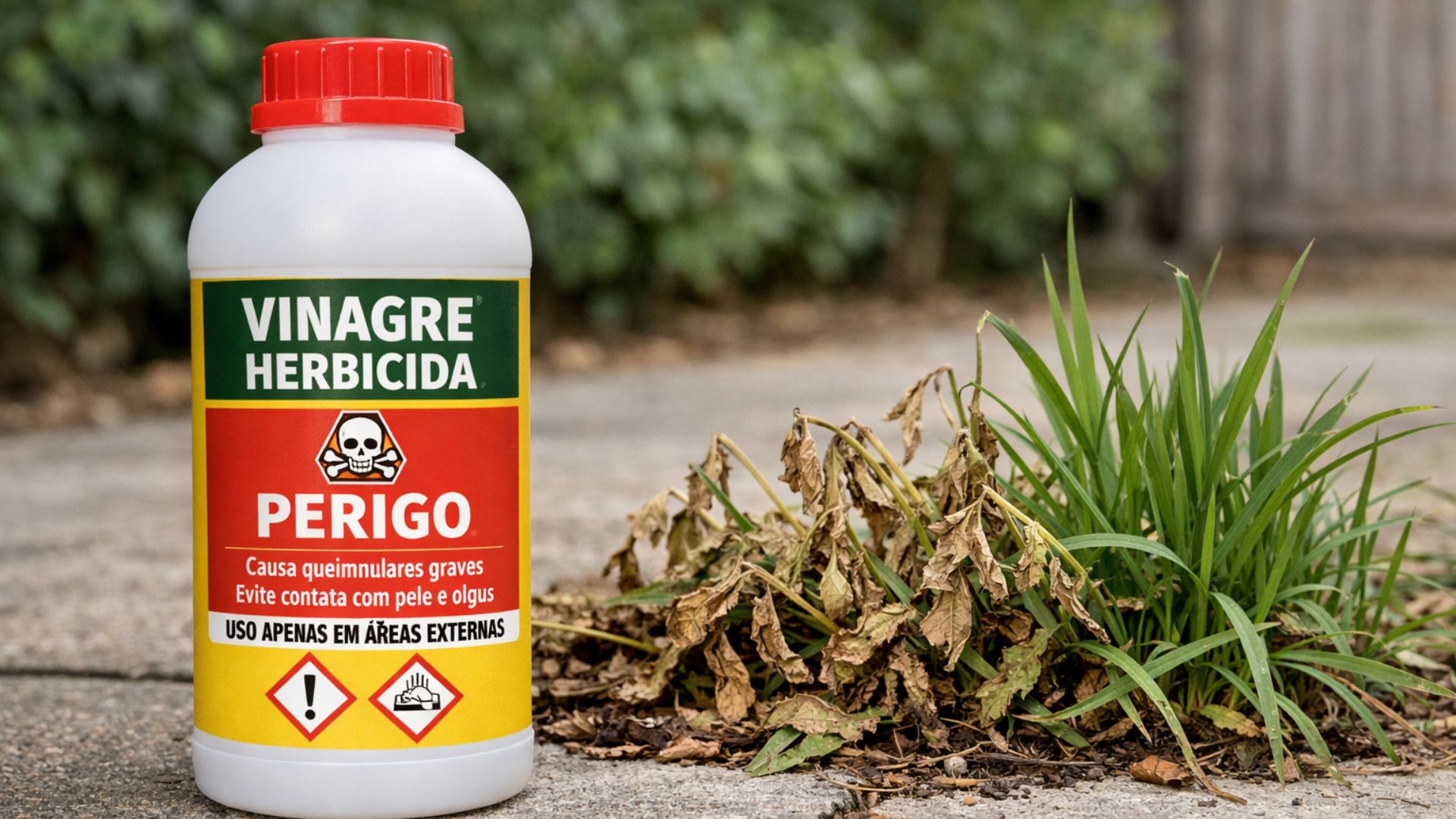
Viral Videos Reinforce Promise of Quick Weed Control, but Ignore Concentration Differences, Health Risks, and Technical Limits of the Product. Immediate Visual Effect Often Masks Failures in Controlling Established Grasses and Weeds, Besides Minimizing Warnings Present on Labels About Burns, Corrosivity, and the Need for Careful Handling.
Videos circulating on social media have once again boosted the idea that “vinegar” could replace herbicides in the backyard, on the sidewalk, and in the garden, always accompanied by images of plants wilting a few hours after application.
What almost never appears in these posts is that the product presented as “herbicidal vinegar” does not correspond, in general, to the culinary vinegar used in the kitchen, but rather to a much more concentrated acetic acid solution, with danger labeling and strict handling guidelines.
Even when application causes a quick visual response, the effect tends to be superficial and often does not eliminate established grasses and weeds, which can sprout again with relative ease.
-
Friends have been building a small “town” for 30 years to grow old together, with compact houses, a common area, nature surrounding it, and a collective life project designed for friendship, coexistence, and simplicity.

-
This small town in Germany created its own currency 24 years ago, today it circulates millions per year, is accepted in over 300 stores, and the German government allowed all of this to happen under one condition.

-
Curitiba is shrinking and is expected to lose 97,000 residents by 2050, while inland cities in Paraná such as Sarandi, Araucária, and Toledo are experiencing accelerated growth that is changing the entire state’s map.

-
Tourists were poisoned on Everest in a million-dollar fraud scheme involving helicopters that diverted over $19 million and shocked international authorities.


University extension materials point out that the effectiveness of this type of product varies according to the stage of plant development, which helps explain why the “before and after” shown in the videos does not always repeat itself weeks later in the real world.
What Is “Herbicidal Vinegar” Sold as a Natural Alternative
Despite the name, “herbicidal vinegar” or “horticultural vinegar” usually designates solutions with acetic acid content far above that of food vinegar, a difference that is central to understanding both the rapid effect on leaves and the increased risk for the user.
While household vinegar is a food formulated for consumption, the so-called “herbicidal version” is marketed specifically for controlling unwanted plants and can reach concentrations of up to 20% acetic acid, according to safety data sheets from manufacturers.

These same documents describe the risk of irritation and burns, as well as recommendations to avoid inhaling the mist formed during spraying and to restrict use to outdoor environments.
The difference in concentration helps explain the contradiction present in many labels, as marketing relies on the idea of a “natural” product, but the labeling includes terms associated with danger, corrosivity, and serious health hazards.
Regulatory agencies also make clear distinctions between food vinegar and more concentrated solutions, establishing reference limits for products of minimal risk and effectively separating the food category from the formulations sold for external use.
Why Plants Wilt Quickly, but Control Doesn’t Always Last
The image that goes viral is real and grabs attention: burnt, wilted, and darkened leaves can appear shortly after application, reinforcing the perception of immediate effectiveness.
This happens because acetic acid, at high concentrations, damages exposed tissues, ruptures cells, and accelerates dehydration of the affected part, especially when there is good coverage from spraying.
Plants with thin leaves and in early stages of growth tend to show even more intense visual responses, which contributes to the impact of video demonstrations.
On the other hand, the same explanation that justifies the rapid effect reveals the main limitation of the method, since technical materials describe acetic acid as a contact herbicide, with action restricted to the point of contact.
Without significant capacity to move internally through the plant, the product can “burn” the aerial part without eliminating roots and reserve structures, which continue to support survival and regrowth.
Grasses and Weeds Expose Limitations of the Immediate Effect

In the case of grasses, the difference between “burning” and “killing” usually becomes evident over time, even when the initial result seems convincing.
The leaf tissue changes quickly, reinforcing the sense of control, but well-established grasses tend to withstand superficial damage better and can recover from protected growth points or the vigor of the root system.
When the application hits very young plants, the chances of control increase, since the energy reserve is smaller and the root system does not yet support growth with the same efficiency.
Extension guides repeatedly describe this scenario, treating effectiveness as more likely in seedlings and less consistent in larger plants, even when higher concentrations and adequate coverage are used.
Thus, the discussion shifts from “whether it works or not” to involving the gap between the expectation created by the immediate effect and the result observed over time, especially in areas requiring continuous maintenance.
Danger Label and Risks in Domestic Use
In domestic environments, the margin for error is smaller, as application often occurs near people, pets, and plants that residents wish to preserve.
Spraying increases the chance of drift, allowing droplets to reach ornamental plants, gardens, and lawns, where sensitive species may suffer burns, as contact products do not distinguish desired plants from unwanted ones.
Risks also involve the applicator, as safety data sheets describe irritation, possibility of burns, and significant danger to the eyes, along with guidelines to avoid inhaling mist and reduce skin contact.
In practice, the fact that the ingredient exists in the kitchen does not make the concentrated version safe for spraying without precautions, especially when the labeling requires protective measures and usage restrictions.
In this context, the label ceases to be mere formality and begins to portray the real risk of the product, even when the presentation relies on the idea of a “natural” alternative.
How the Term “Vinegar” Contributes to Consumer Confusion
Part of the popularity on social media arises from a linguistic shortcut that treats “vinegar” as a single category, creating the impression that all solutions with that name behave the same way.
In practice, the word encompasses products with distinct purposes, concentrations, and risks, which helps explain the discrepancy between expectation and result.
Culinary vinegar is regulated as food and sold for human consumption, while “herbicidal vinegar” is marketed for plant control and may come with safety documentation carrying a danger classification.
Additionally, regulatory agencies differentiate concentrations related to food use and establish reference limits for minimal risk products, reinforcing that the acetic acid content is a decisive boundary.
The visual appeal of burnt leaves drives virality and sustains the “quick solution” narrative, but the record usually limits itself to the first hours, leaving out what happens afterward.
It is precisely in that interval that regrowth reveals the difference between superficial injury and effective control, raising the question of why the promise of immediate effect continues to convince so many people.









Seja o primeiro a reagir!