





 Portuguese
  English
  Spanish
  5 min of reading
  0 comments


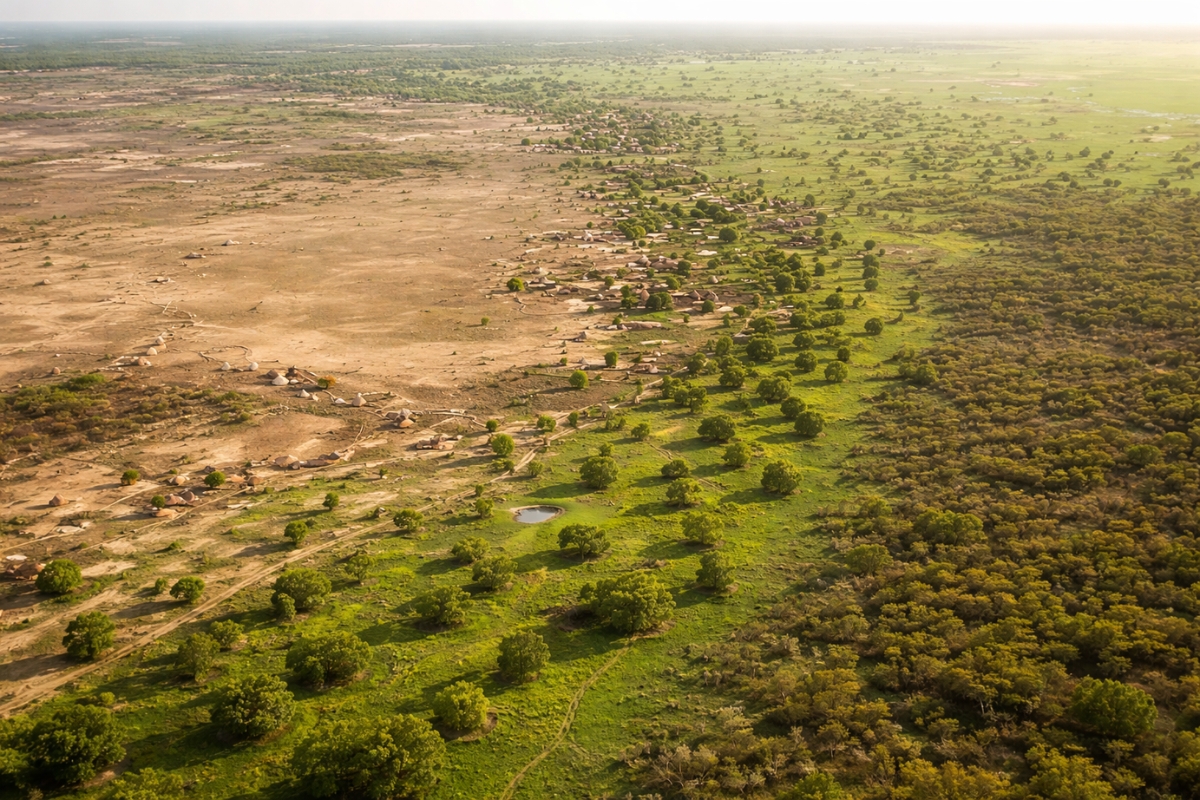
China and Africa Make Combating Desertification a Climate Priority, with Megaprojects for Restoration Promising to Capture Carbon and Restore Degraded Soils Across Two Vulnerable Continents
Desertification has ceased to be a distant problem and has become a concrete threat to food security, water supply, and social stability in various regions of the planet. In response to the advancing degradation of land, China and African countries have invested in large-scale initiatives known as “green walls.” Although the name is similar, the projects follow different paths, combining reforestation, ecological restoration, and rural development strategies.
Recent international reports explain how these efforts have evolved over time and face complex technical and political challenges. An analysis from the Swiss portal blue News details how China and Africa have been trying to “save themselves from the sand,” each with their own methods and unequal results, highlighting both advances and structural obstacles.
The Chinese Strategy: Green Belts and Large-Scale Ecological Engineering
In China, the project known as the “Great Green Wall” is linked to the Three-North Shelter Forest Program, initiated in 1978 and planned to continue until 2050. The central goal is to reduce sandstorms, contain the expansion of deserts, and restore degraded areas in the northern part of the country, especially in vulnerable regions like Xinjiang and Inner Mongolia.
-
Motorola launched the Signature with a gold seal from DxOMark, tying with the iPhone 17 Pro in camera performance, Snapdragon 8 Gen 5 that surpassed 3 million in benchmarks, and a zoom that impresses even at night.

-
Satellites reveal beneath the Sahara a giant river buried for thousands of kilometers: study shows that the largest hot desert on the planet was once traversed by a river system comparable to the largest on Earth.

-
Scientists have captured something never seen in space: newly born stars are creating gigantic rings of light a thousand times larger than the distance between the Earth and the Sun, and this changes everything we knew about stellar birth.

-
Geologists find traces of a continent that disappeared 155 million years ago after separating from Australia and reveal that it did not sink, but broke into fragments scattered across Southeast Asia.

A recent milestone was the completion of a green belt extending over 3,000 kilometers around the Taklamakan Desert, announced in 2024. Chinese authorities claim that this vegetation barrier helps stabilize shifting dunes and protect highways, cities, and strategic infrastructures, consolidating decades of continuous public investment.

Academic research published in international scientific journals indicates that the program has brought measurable benefits such as reduced erosion and increased vegetation cover in certain areas. At the same time, scientific analyses warn of persistent challenges, including water sustainability, long-term maintenance, and the adaptation of planted species to arid conditions.
Studies published in the journal Nature have also highlighted the risk of poorly planned reforestations in dry regions, where excessive water consumption by certain species may exacerbate water scarcity. The Chinese experience shows that while the scale is impressive, ecological balance requires constant adjustments.
The African Great Green Wall: Restoration as Development
In Africa, the Great Green Wall Initiative was launched in 2007 by the African Union with an initially ambitious proposal to create a continuous band of vegetation along the Sahel. Over time, the initiative evolved into a more flexible concept based on the restoration of degraded landscapes, agroforestry systems, and strengthening rural economies.
Official documents from the African Union describe the project as a continental movement for climate resilience and sustainable development, with goals aimed at the recovery of millions of hectares of degraded land by 2030. The institutional platform of the initiative reinforces objectives related to generating green jobs and capturing carbon.
Despite the optimistic rhetoric, reports from the Spanish newspaper El País point out that progress is uneven. The lack of effective funding, logistical difficulties, and security issues in parts of the Sahel continue to be significant obstacles to fully implementing the announced goals.

Unlike the more centralized Chinese model, the African initiative relies on solutions tailored to local realities, including assisted natural regeneration, sustainable water management, and recovery of agricultural soils. In many cases, success directly depends on community participation and institutional strengthening.
Cooperation and Exchange Between China and Africa
The experience accumulated by China has sparked interest among African countries, particularly regarding techniques for stabilizing dunes and large-scale planning. Studies published in international scientific databases discuss the possibility of technical exchange between the two regions, highlighting both opportunities and limitations of this cooperation.
Recent academic analyses indicate that knowledge transfer must consider climatic, social, and economic differences, avoiding automatic replications of models. Diplomatic forums within the China-Africa cooperation framework have also begun to include the fight against desertification as a strategic agenda item, according to official institutional statements.
Although cooperation exists on both technical and political levels, experts emphasize that practical success depends more on stable funding, effective governance, and local engagement than on formal declarations. Environmental restoration in arid regions is a long-term process that requires continuous monitoring and constant adaptation.
Between Hope and Ecological Limits
The two projects show that combating desertification is possible, but far from simple. In the Chinese case, the results are more visible in terms of ecological infrastructure and state mobilization. In Africa, the challenge involves integrating environmental restoration with socioeconomic development in contexts often marked by climate vulnerability and political instability.
Experts in ecology and environmental policy agree that restoring dry landscapes does not simply mean planting trees. It involves recovering ecological functions, protecting water resources, and ensuring that local populations can live sustainably in previously degraded areas.
The trajectory of the “green walls” reveals a complex reality: the advance of sand can be contained, but only with scientific planning, consistent investment, and long-term commitment. More than environmental symbols, these projects have become global experiments on how entire societies face the limits imposed by climate change and land degradation.








-

-

-

-

5 pessoas reagiram a isso.