





 Portuguese
  English
  Spanish
  5 min of reading
  3 comments


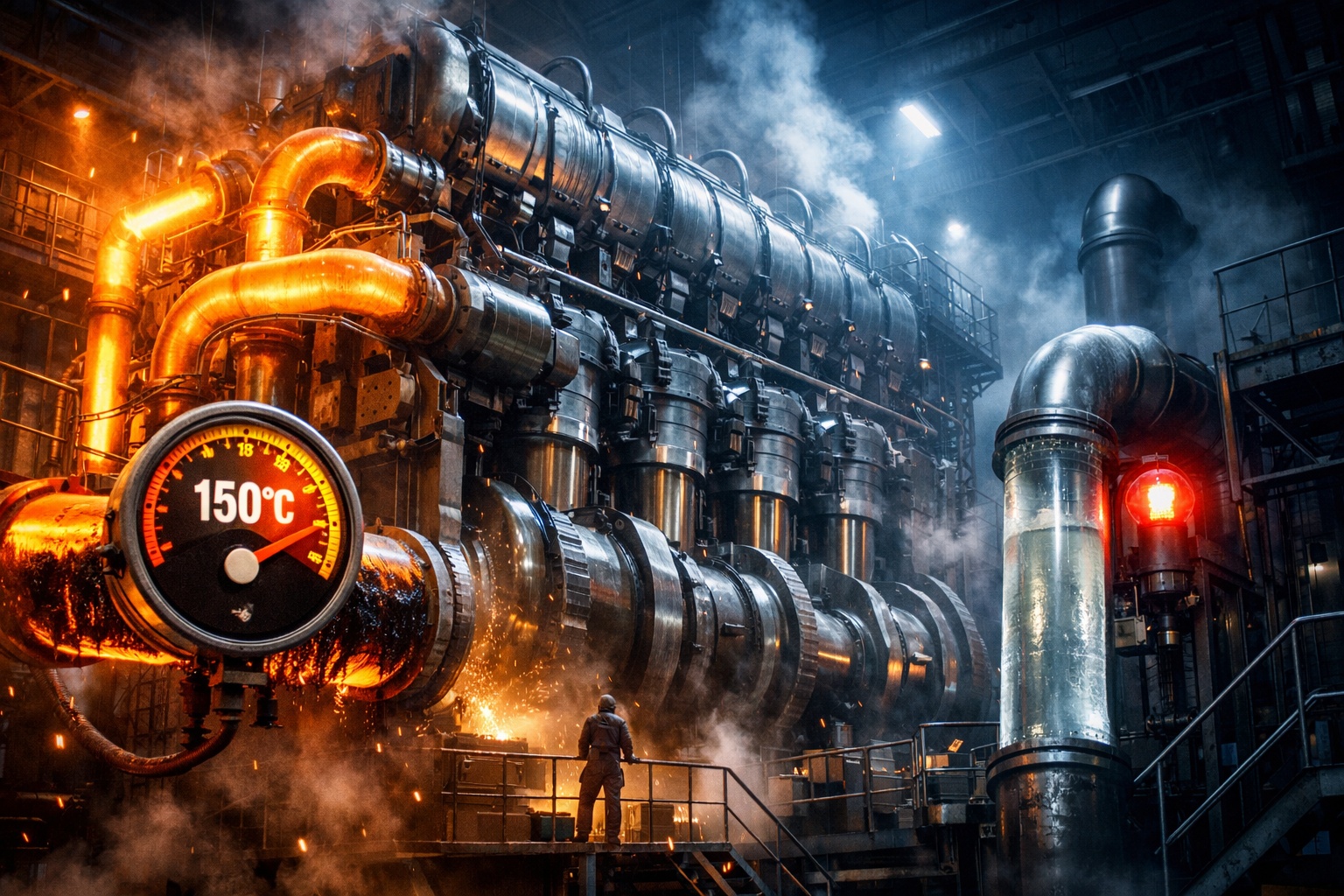


HFO Is The Most Used Fuel in Navigation: It Needs to Be Heated to 150°C to Flow and, Despite Being Pollutant, It Is The Only One That Protects Large Marine Engines.
The HFO (Heavy Fuel Oil), also known as heavy fuel oil or bunker fuel, is not a conventional fuel. At room temperature, it does not flow. It is a black, viscous, and dense mass — a refinery residue composed of heavy fractions of oil that remain after lighter fuels are extracted. To be used in large marine engines, HFO needs to be heated between 130°C and 150°C within an insulated piping system that runs through the ship from the storage tank to the injection pumps. Without heating, it solidifies like tar.
It is the cheapest fuel in commercial navigation, about 30% cheaper than distilled alternatives and also the most complex to operate. Paradoxically, it is the only one that does not compromise the structural integrity of the engines that were designed to burn it.
The contradiction becomes evident when a ship needs to enter an Emission Control Area (ECA), where international regulations require low-sulfur fuels, such as MGO (Marine Gas Oil). The MGO is clean, fluid, easy to handle, and much less polluting. However, the inadequate transition to MGO can cause severe failures in two-stroke marine engines.
-
Luxurious mansion in Rio valued at up to R$ 40 million has already impressed international celebrities and belongs to a well-known Globo presenter.

-
Friends have been building a small “town” for 30 years to grow old together, with compact houses, a common area, nature surrounding it, and a collective life project designed for friendship, coexistence, and simplicity.

-
This small town in Germany created its own currency 24 years ago, today it circulates millions per year, is accepted in over 300 stores, and the German government allowed all of this to happen under one condition.

-
Curitiba is shrinking and is expected to lose 97,000 residents by 2050, while inland cities in Paraná such as Sarandi, Araucária, and Toledo are experiencing accelerated growth that is changing the entire state’s map.


Viscosity and Fuel Injection in Two-Stroke Marine Engines
Viscosity is the critical parameter in this equation. Water has a viscosity of approximately 1 centistoke (cSt). The HFO, before heating, can reach 700 cSt.


At 150°C, its viscosity drops to the ideal range of 10 to 20 cSt — the range recommended by manufacturers like MAN Energy Solutions and Wärtsilä for safe operation of the injection pumps.
This range is not arbitrary. It ensures:
- Proper lubrication of the pumps
- Efficient sealing in internal clearances
- Accurate fuel dosing
- Stable formation of protective film
The MGO, on the other hand, has a viscosity between 2 and 6 cSt at room temperature. It flows too easily. It is exactly this excessive fluidity that creates the problem.
High-Pressure Injection Pumps and Risk of Seizure
Two-stroke marine engines, such as the Wärtsilä RT-flex96C, operate with injection pressures exceeding 1,000 bar. The pumps use a plunger and barrel system with clearances measured in microns.
The fuel itself acts as a lubricant between these metal surfaces. With heated HFO, a viscous film forms that prevents direct metal contact.
With MGO, the fuel trickles through the clearances. The film disappears. Friction increases. The result can be:
- Accelerated wear
- Loss of injection pressure
- Pump seizure
- Partial or total engine shutdown
CIMAC (International Council of Combustion Engines) documented cases of injection pump failures associated with an inadequate transition to low-viscosity distilled fuels.
In one reported incident, a container ship lost propulsion when approaching an ECA after a sudden change from HFO to LSMGO without proper thermal control.
Vapor Lock and Overheating of MGO in Systems Designed for HFO
The second critical failure mechanism involves the phenomenon known as vapor lock. The HFO piping system remains heated even after the transition to MGO begins. Since MGO has a significantly lower boiling point, it can begin to form vapor bubbles inside the pumps and pipes.
When this occurs:
- The pump starts compressing vapor
- Injection pressure drops abruptly
- The engine may stop due to lack of liquid fuel
To avoid this scenario, changeover procedures require:
- Gradual temperature reduction (maximum 2°C per minute)
- Progressive reduction of engine load
- Constant monitoring of viscosity
The process can take between 30 minutes and 2 hours, depending on engine power. MAN and Wärtsilä have published specific Service Letters guiding the use of fuel coolers to maintain a minimum viscosity of 2 cSt at the pump inlets — a value considered the lower safe limit.
Asphaltenes, Chemical Dissolution, and Clogging of Filters
There is also a third, less intuitive problem: the dissolution of internal deposits. HFO contains asphaltenes, heavy compounds that slowly deposit on the inner walls of the pipes. Over years, a stable layer forms.
When MGO enters the system, it acts as a chemical solvent, dissolving these deposits. The result is:
- Formation of suspended sludge
- Rapid clogging of filters
- Blockage of the fuel system
- Loss of power even before reaching the pumps
In real operations, engineers often need to replace filtering elements repeatedly during the first changeover after years of continuous operation with HFO.

This phenomenon is one of the most documented causes of partial loss of propulsion when approaching European and North American ports.
Maritime Economy: Why HFO Still Dominates the Global Fleet
Despite its environmental impacts, HFO remains the predominant fuel in global commercial navigation.
The reason is purely economic. The price differential between HFO and MGO can reach US$ 300 per metric ton. A large ship consumes between 100 and 250 tons per day.
In a 20-day crossing, the cost difference can vary between US$ 600,000 and US$ 1.5 million per trip. Multiply this by a fleet of dozens of vessels and the competitive advantage becomes structural.
Without international regulation, the complete replacement of HFO would be economically unfeasible for many shipping companies.
IMO 2020 and the Emergence of VLSFO
In January 2020, the International Maritime Organization (IMO) implemented the IMO 2020 regulation, reducing the global sulfur limit from 3.5% to 0.5%. This gave rise to VLSFO (Very Low Sulfur Fuel Oil).
VLSFO maintains residual characteristics similar to HFO in terms of viscosity and lubricity but with lower sulfur content. This allows:
- Reduction of SOx emissions
- Maintenance of injection pump protection
- Operational continuity
The MGO, with 0.1% sulfur, remains mandatory only within ECA Zones. Outside these areas, most ships return to HFO or VLSFO as soon as the thermal system stabilizes.
The Structural Paradox of Naval Engineering
The two-stroke marine engine was designed to operate with viscous and residual fuel. It relies on flow resistance to preserve its own mechanical integrity.
Replacing HFO with a cleaner fuel without completely redesigning the injection system creates structural incompatibility.

The paradox is simple: The most polluting fuel is the one that protects the engine. The cleanest fuel can destroy it if used incorrectly.
HFO remains dominant not for environmental efficiency, but for mechanical compatibility and economic viability. The energy transition in maritime transport will require more than just a fuel change. It will require:
- Redesign of injection pumps
- Structural adjustments of clearances
- New materials
- Advanced thermal control systems
Until then, the denser and more difficult-to-handle fuel will continue to move the majority of global cargo. Not by ideological choice.
But because, in the balance between cost, engineering, and mechanical survival, it is still what keeps the engines running.









Muito relevante
Os EUA serão a **** fera terrestre? Pois perseguem todo o planeta, por seus próprios interesses e ainda inventam todo tipo de calúnia ate mesmo aos seus aliados, e o resto do mundo assiste de braços cruzados, uma plateia de covardes.
Eles podem destruir tudo, ja os outros não podem da um **** que ameaça a segurança nacional deles, tudo é base secreta, ate quando o mundo vai assistir isso de braços cruzados?
Puxa…a matéria tem seu valor pra entendermos como o mundo funciona, não apenas se vai chover ou fazer sol
Mas oque tem a ver isso ?!?!