





 Portuguese
  English
  Spanish
  7 min of reading
  0 comments


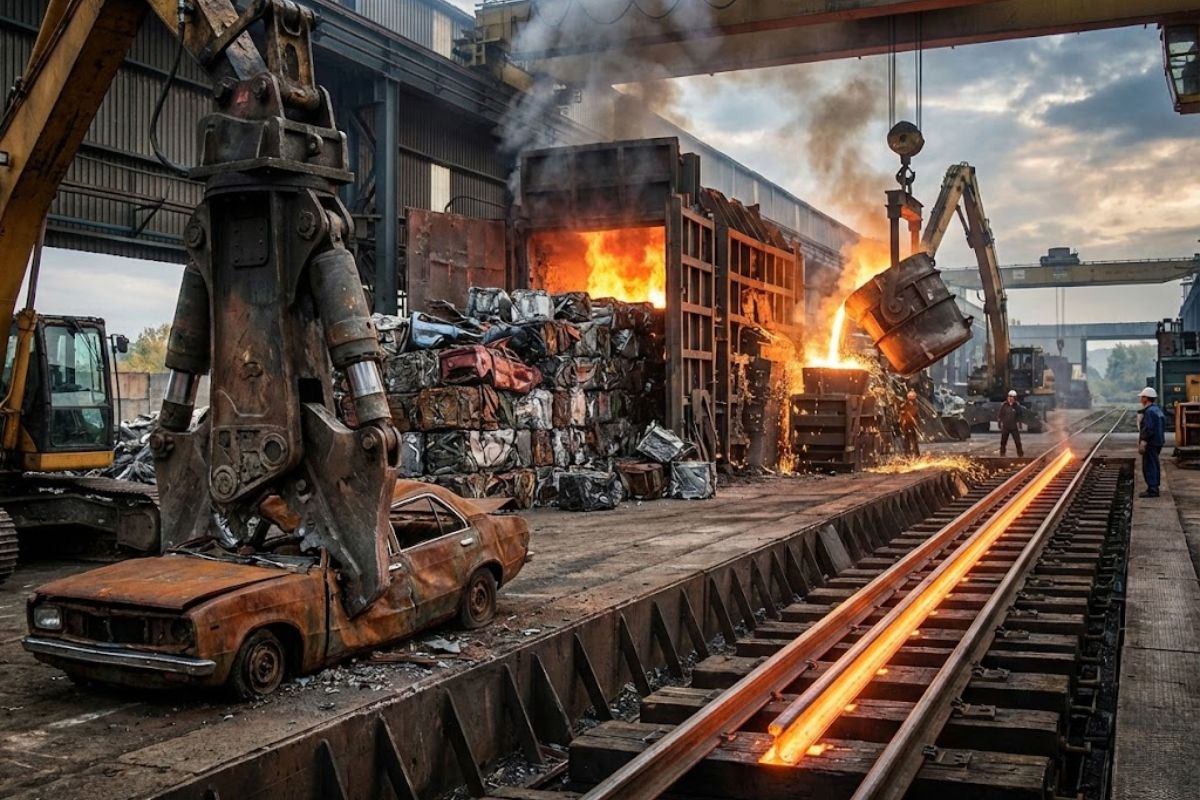
From Junkyard to Infrastructure, Discarded Vehicles Are Compressed, Conveyed to the Crusher, Subjected to Magnetic Sorting, Fluid Drainage, Battery and Airbag Removal, and Turn into Molten Steel in Furnaces Above 3,000°F. Cooled Billets Rolled, Cut, Laser-Scanned, and Tested Become Solid Rail Tracks.
The rail tracks that support modern railroads can start in an unlikely place: a cemetery of old cars, where millions of vehicles reach the end of the road and seem to have ceased their utility. However, there, disposal is not the end; it is the beginning of a complete industrial transformation.
The journey goes through extreme disassembly, heavy crushing, advanced material separation, and furnaces that raise steel to temperatures above 1,500 °C. In the end, what was a pile of scrap turns into the exact, tested, and approved profile of new rail tracks ready for installation.
The Old Car Cemetery and the Beginning of Transformation

Every year, millions of cars reach the end of the line and are stacked as if they are just metallic scraps.
-
Oldest tree on the planet reappears after 130 years of searches: Wattieza, 385 million years old, was 10 meters tall and had no leaves or seeds; Gilboa fossils in New York solved the mystery in 2007.

-
A 48-square-meter house assembled in hours with 4,000 bricks made of recycled plastic that does not absorb moisture, has natural thermal insulation, and costs less than 90,000 reais in a complete kit.

-
Luciano Hang revealed that Havan’s air fleet has already accumulated more than 20,000 landings, 10,000 flight hours, and 6 million kilometers traveled, and he says that without the planes, the company would never have grown so quickly.
-
A historical discovery in the Andes Mountains reveals a gold deposit valued at 770 billion reais hidden over 4,000 meters above sea level on the border between Chile and Argentina, and the whole world is watching.

Many of these vehicles are rusted after years of use, reinforcing the impression that there is no possible return.
It is at this point that the turning begins. What seems like idle scrap turns into raw material for rail tracks, and the process does not depend on luck: it relies on sequence, control, and repeatability at scale.
Crane, Hydraulic Claw, and Crushing into Steel Cubes
The first major movement is mechanical and brute. A large crane comes into action, and the hook, along with the hydraulic claw, grabs discarded vehicles and takes them to the crushing stage.
The cars are compressed until they become more manageable steel cubes. This initial crushing is not a detail; it is the step that allows transporting and feeding the next machines continuously, maintaining the flow towards future rail tracks.
Conveyor Belts and the Direct Path to the Crusher
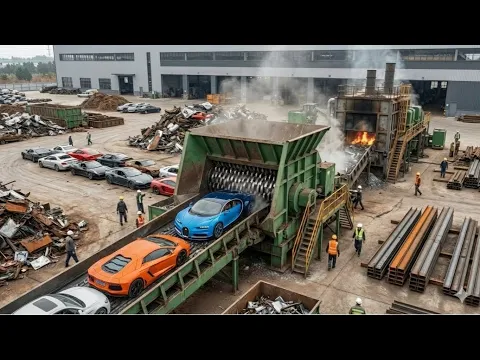
With the cubes formed, the vehicles are loaded onto specialized transport platforms. After the initial crushing, the cars, with tires still attached, move along a massive conveyor belt system towards the crusher.
The logic is simple and relentless: the junkyard needs to turn into crushed material, and the crusher is the funnel where the shape of the car disappears to give way to the input that will be reused in rail tracks.
From Crushing to Founding: Giant Trucks and Crushed Material
After crushing, enormous trucks transport the crushed material to the foundry. At this stage, the focus is no longer on the vehicle as an object but on the metal as a resource.
The operational message is straightforward: the metal will be reused in new rail tracks, and the scale of transport shows the magnitude of the flow.
Millions of destroyed cars leave the junkyard heading for the foundry, keeping the process on track.
Batch Scanning, Manifest, and Magnetic Sorting
Before proceeding, each batch of destroyed vehicles undergoes control and traceability. The material is meticulously scanned, recording the materials before moving on to the next phase.
In a facility of this scale, the debris from countless vehicles is magnetically lifted and placed on sorting lines.
This control prevents the process from losing precision and supports the ultimate goal: to produce rail tracks with industrial standards.
Safety First: Fluid Drainage and Correct Disposal
Recycling begins with the safe extraction of everything that needs to be removed.
The cooling liquid is carefully drained into specialized containers, and workers ensure that chemical waste is properly contained before any material leaves the facility.
Here, the operation makes clear what guides the pace: safety and compliance. Without this, there is no reliable process, and without a reliable process, there are no approved rail tracks.
Battery, Airbags, Rubber, and the Controlled Disassembly of the Car
The battery, described as heavy and dangerous, is meticulously disconnected and removed from the engine compartment. Risky components, such as airbags, enter the routine of identification and removal.
The hydraulic press exerts tremendous force to remove the rubber from steel rims, preparing the materials for the next steps.
Nothing is improvised: each removal clears the way for cleaner and more useful steel to evolve into rail tracks.
Robotic Arms, Glass, and Wire Harnesses: Material Separation in Detail
With the car already directed for fine sorting, precise disassembly begins. Robotic arms identify and remove materials, and in state-of-the-art facilities, doors and other elements are removed to organize the recycling flow.
The process includes safely breaking windshields within a reinforced chamber, separating glass from the rest.
There is also the laborious removal of wire harnesses, carefully detached from the steel chassis. The goal is to isolate the steel and prepare the way for rail tracks with maximum consistency.
Magnets, Electromagnet, and Eddy Separator: How Metal Is Refined
After crushing, magnetic separation comes into play. Powerful magnets separate the valuable aluminum, while an electromagnet separates iron and other ferrous metals from the crushed bodies.
Next, an Eddy separator uses magnetic forces to divert lighter non-ferrous metals, such as aluminum and copper, from the heavier steel.
This stepwise refining defines what will be quality steel, the basis for rail tracks with integrity.
Furnaces Above 1,500 °C, Molten Steel, and the Burning of Impurities
With the steel isolated, the journey enters the thermal heart of transformation. The recycled molten steel from millions of old cars reaches temperatures exceeding 3,000°F, fitting the idea of furnaces above 1,500 °C.
The material, now superheated to thousands of degrees, violently stirs as impurities are burned away.
When the molten steel is poured from the furnace, a rain of sparks arises, marking the transition of raw metal to metal ready to become rail tracks.
Molds, Water Jet Cooling, and the Birth of Billets
In the foundry area, the molten steel enters molds and begins its transformation into something new: railway tracks.
After being cast, the material is slowly cooled with precise water jets, creating enormous columns of steam.
What emerges are bright billets, the result of recycled metal. These billets are cooled and cut rapidly. They were once old cars; now they are glowing billets, already on their way to becoming rail tracks.
Continuous Casting and Rolling: The Profile of the Rail Takes Shape
After being compressed and melted, the metal is cast into ingots and enters the rolling furnace, where it is reheated before the process begins.
The rolling mill initiates the transformation: rollers compress the incandescent material, dramatically elongating the metal and slowly forming the precise shape needed.
The recycled molten steel from millions of old cars is forced through the roller until it takes on the profile of the rail, a step that defines the future rail tracks in dimension and geometry.
Final Cooling, Precision Cutting, and Laser Measurement
With the profile established, high-pressure water cooling jets hit the shiny rail to solidify the steel. Next, precision cutting occurs, where the incandescent metal is cut according to specifications before proceeding down the line.
Precision is evident in operational details: a laser scanner records the reading of 15.2 cm, precisely according to specifications, releasing the material for the next stage. Every centimeter matters when the goal is to deliver rail tracks that withstand real use.
Ultrasound, Friction, and Approval: The Step That Decides Everything
The newly forged rail tracks undergo ultrasonic testing, considered crucial to ensure the integrity of the recycled steel.
Next, the material is subjected to rigorous friction tests to verify if the new parts can withstand extreme conditions.
There is also thermal monitoring and data comparison when observing variation near the rail, reinforcing the role of real-time control.
Industrial rigor is not optional; it is the condition for the rail to receive inspection and approval certification.
From Inspection to Shipping: Rail Tracks Ready for Modern Railroads

The major global steel manufacturers leading the transformation of discarded vehicles into railway infrastructure, operating precisely the cycle of crushing, melting in electric furnaces, and rolling tracks, are Gerdau (leader in recycling in Latin America), Nucor Corporation, and Steel Dynamics (American giants of mini-mills), ArcelorMittal (with its specialty division in high-performance rails), and voestalpine (a global reference in railway technology and safety); all use advanced magnetic sorting and laser quality control systems to ensure that the recycled steel from millions of old cars achieves the extreme strength required for modern railroads.
After quality controls, the forged rails are approved and loaded for the next journey. The process concludes with the idea of a complete cycle: from junkyard to final destination, the rails represent the culmination of advanced recycling.
In the end, the old car is dismantled and remade as steel infrastructure. What was discarded comes back as rail tracks, ready for installation and to power the future of railway transportation.
Would you trust more in rail tracks made of recycled steel from millions of old cars, or would you still prefer tracks produced solely with new steel?







-

-

-

9 pessoas reagiram a isso.