





 Portuguese
  English
  Spanish
  4 min of reading
  0 comments


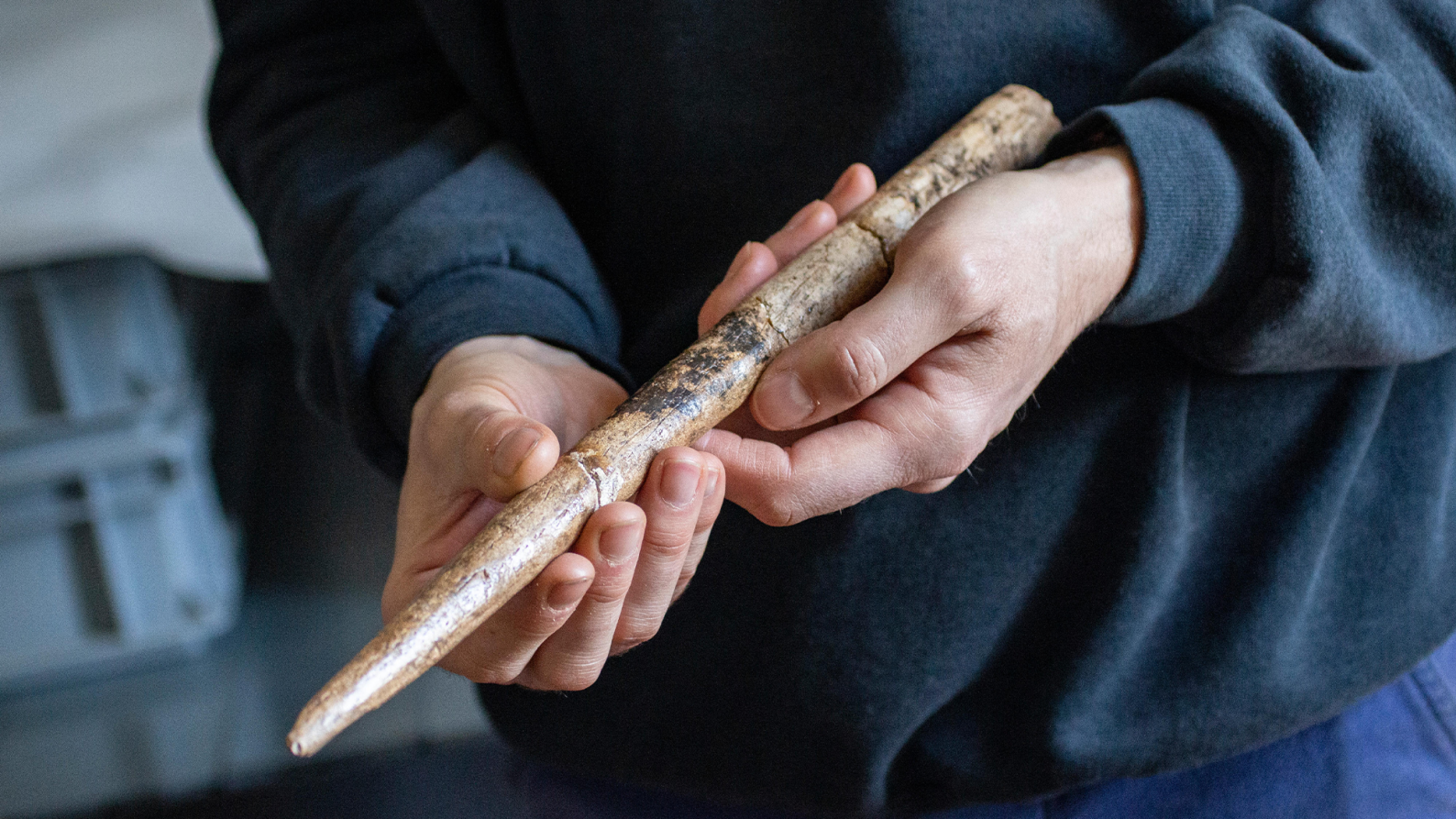
Discovery Reveals That Ice Age Hunters Shaped Stranded Whale Bones into Tools 20,000 Years Ago in the Bay of Biscay
In the frozen landscape of the Upper Paleolithic, hunter-gatherers found an unexpected source of survival along the coast of the Bay of Biscay: the bones of stranded whales.
Today submerged by the sea, this ancient region was the stage for a practice that still surprises archaeologists to this day.
Unprecedented Discovery Reveals Use of Whale Bones
In a study published in the journal Nature Communications, a team of researchers identified the first known evidence of humans shaping whale bones to make tools. The work revealed that, around 20,000 years ago, these human groups were already utilizing remains from at least six different whale species.
-
China has created a mass-produced hypersonic missile that costs the same as a Tesla, and this is changing everything in modern warfare because the United States cannot defend itself without spending millions.

-
100% Brazilian technology transforms agricultural waste into a meat-scented ingredient using fungi from the Amazon rainforest. The process does not use excessive water or chemicals, and it also increases the nutritional value of the final product.

-
Psychology reveals that adults who avoid conflicts at all costs are not balanced individuals, but rather children who learned in the worst way that expressing emotions brought punishment and now live paralyzed by the fear of expressing themselves.

-
Goodbye pet hair on clothes: a washer with an internal filter promises to remove up to 5 times more hair than regular machines and uses an XL trap dryer system to capture what remains.


Among the identified animals are sperm whales, common whales, blue whales, gray whales, right whales, and even dolphins.
The diversity of species shows that what mattered was not the type of whale, but the opportunity to use the material brought by the waters. These remains, which washed up on the beach, were transformed into essential instruments for hunting and survival.
How the Tools Were Identified
In total, scientists analyzed 83 molded objects and 90 unworked bone fragments. All were found in 26 caves and rock shelters along the Bay of Biscay, a region that encompasses the north of Spain and the southwest of France.
To determine the origins of the bones, researchers applied the technique of Zooarchaeology by Mass Spectrometry, known as ZooMS.
This methodology allows the identification of collagen proteins unique to each species, even in highly worked or deteriorated fragments. Thus, it was possible to associate each piece with its species of origin, even after thousands of years.
Tools Older Than Previously Thought
The oldest pieces date from 20,000 to 19,000 years ago, during the Magdalene period of the Upper Paleolithic.
This finding pushes back the date of known whale bone artifacts by more than three times, significantly expanding knowledge about the use of this material by early humans.
At that time, the climate was considerably colder, and the sea level was lower than today. This created a coastal environment teeming with marine life, providing hunter-gatherers with a constant source of resources. The sea, by bringing in carcasses, supplied abundant and durable raw materials.
Why Whale Bones Were So Highly Valued
According to researchers, it is unlikely that hunter-gatherers had the capability to hunt whales directly. Without suitable boats or specialized harpoons, people of that time likely collected carcasses already stranded on the beach. Under these conditions, the bones became a gift from the sea.
Compared to other available materials, whale bone had clear advantages. It was stronger than wood, which rotted, and less brittle than stone, which could chip. Additionally, its availability increased whenever the ocean brought in new carcasses. Thus, these people began to work the material with fire and stone tools, shaping weapons and instruments.
Predominance of Sperm Whale Bones
A significant portion of the identified tools, especially weapons like projectile tips and shafts, was made from sperm whale bones. While the exact reason is not fully understood, a possible explanation lies in the animal’s anatomy. Sperm whales have long, dense jaws, providing a material particularly suitable for shaping and strength.
These weapons served to hunt other terrestrial animals of the time, such as reindeer and bison. Thus, the whale bone, transformed into a hunting instrument, completed a cycle of resource utilization from the coastal environment.
Study Also Provides Information About Whales Themselves
In addition to identifying the species, researchers went further. Using stable isotope analysis — variant forms of atoms — they were able to obtain data about the diet and marine ecosystem thousands of years ago.
The results showed some similarities with the diets of modern whales. For example, common whales displayed low nitrogen levels, indicating a diet rich in krill. Meanwhile, sperm whales showed elevated values, consistent with a diet based on squid.
However, some differences were notable. In several samples, the levels of carbon and nitrogen were higher than those found in current populations, suggesting colder waters or changes in the food chains of that period. Another curious data point was the presence of gray whales in the Atlantic, a species now restricted to the Pacific.
Why the Use of Whale Bones Disappeared
Despite extensive use for thousands of years, the record of whale bone tools virtually disappears after 16,000 years ago. From that time onward, only one artifact was recovered in Germany.
The reasons for this disappearance remain uncertain. It could have been a cultural shift leading to the abandonment of the practice, or simply that the archaeological record was not preserved.
As part of the ancient coastal areas is now submerged due to rising sea levels after the end of the Ice Age, many traces may be lost beneath the waters.
Researchers suggest that future submerged finds may help clarify this puzzle and reveal whether the use of whale bones continued beyond what we can confirm today.
Scientific Reference: Krista McGrath et al (2025). Upper Paleolithic Whale Bone Tools Reveal Human and Whale Ecology in the Bay of Biscay. Nature Communications. https://www.nature.com/articles/s41467-025-59486-8








Seja o primeiro a reagir!