





 Portuguese
  English
  Spanish
  5 min of reading
  30 comments


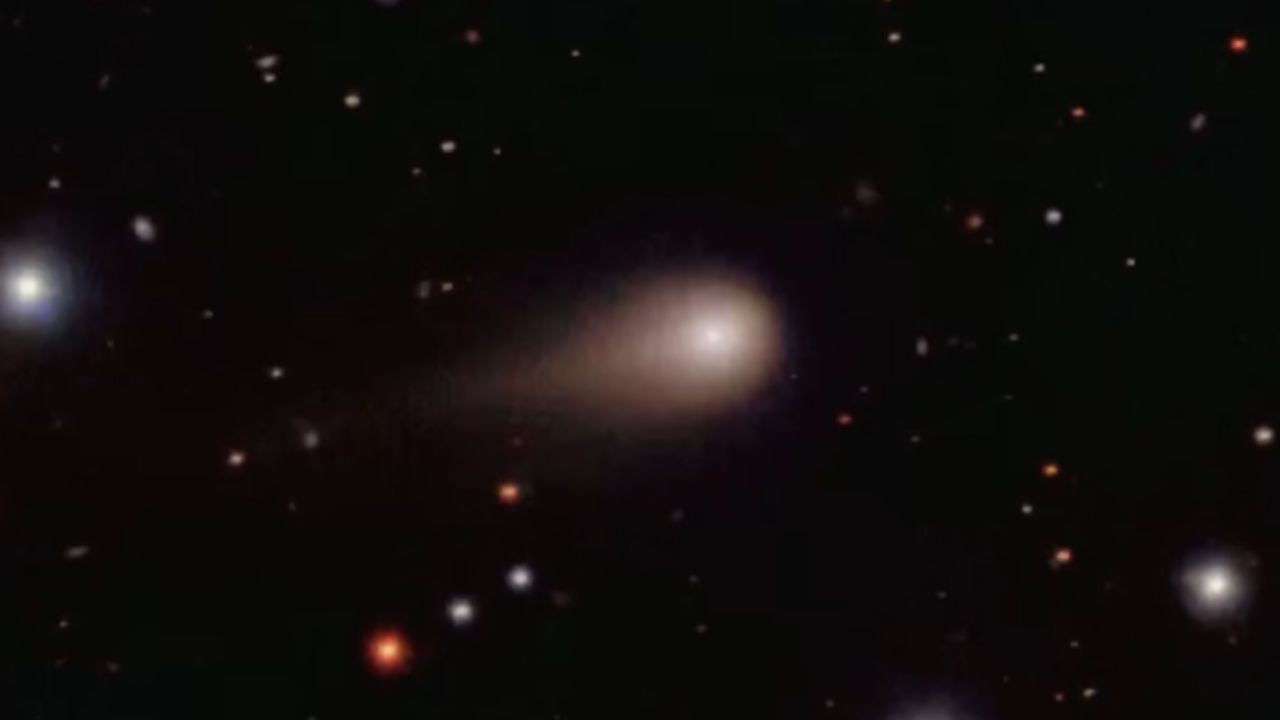


Recent Reports Indicate A Deliberate Deceleration Of The Interstellar Visitor, Raising Debates About Artificial Origin And Challenging Traditional Physics Models.
The saga of 3I/ATLAS continues to rewrite the history of modern astronomy, becoming one of the most complex enigmas ever faced by the scientific community. After emerging from behind the Sun, the expectation of seeing a gigantic tail was frustrated; instead, astronomers found a visual absence that revived old theories about the artificiality of the object. The turning point, however, occurred in early November 2025, when it was detected that the celestial body seems to have decreased its speed once again, stirring the excitement of global space agencies.
This anomalous behavior of 3I/ATLAS immediately caught the attention of scientists as they realized that its speed did not correspond to the expected standard hyperbolic trajectory for an object on an interstellar journey. According to data from NASA’s Jet Propulsion Laboratory (JPL), the object exhibited a measurable deceleration relative to the Sun’s gravitational pull. More than just a simple physical effect, it presented components of non-gravitational acceleration that suggest something beyond a passive natural body, configuring a unique event in the history of space observation.
The Anomalous Behavior That Challenges Gravity
Since its discovery on July 1 of this year by the Atlas telescope in Chile, 3I/ATLAS has already shown clear signs of being a visitor from outside our solar system. However, the recent anomalies are much more subtle and intriguing. The object seemed to decelerate as if “something invisible was braking its motion“, deviating from a path that gravity alone should impose. Measurements indicated radial acceleration concerning the Sun with impressive numbers, including a transverse variation of about 60 km per day.
-
From sertanejo star to international investor: Ana Castela invests millions in a mansion in the USA, creates a themed accommodation in Orlando, and shows that the “boiadeira” also wants to grow away from the stage.

-
The 10 most stunning motorhomes in the world: a $3 million trailer with a rooftop nightclub and garage for a Ferrari, “palaces on wheels” with Italian marble, private cinema, and five-star hotel luxury for billionaires.

-
Trump wanted to spend $400 million on the White House, but the courts prohibited the million-dollar construction.

-
How the Egyptians erected giant structures like pyramids, temples, and obelisks without modern technology, cranes, or engines still amazes the world and reveals the power of engineering based on ramps, levers, ropes, and colossal organization.


For NASA, the term “non-gravitational acceleration” generally implies natural factors like solar winds or outgassing. However, in the case of 3I/ATLAS, the deceleration appears too precise to be mere chance. The direction of the observed force deviates from the expected pattern, and its intensity is strong enough to rule out a simple gas jet. At certain moments, the object’s tail even inverted, pointing toward the Sun, a behavior contrary to common comets, which usually emit gas and dust in the opposite direction of solar radiation.
This “braking maneuver” occurred about 203 million kilometers from the Sun, slightly within Mars’ orbit. Executing an active velocity change at that distance would require power, precision, and refined timing control. According to experts, this location suggests that 3I/ATLAS was not just being carried by gravitational forces or solar wind, but was following an intentional route, something that challenges traditional explanations applied to interstellar comets.
Artificial Hypothesis: Probe Or Ancient Visitor?
The possibility that we are observing an artificial maneuver significantly expands the range of hypotheses. If we admit that the deceleration was a controlled action, we could be facing a interstellar probe or a remnant artifact from an advanced civilization. The deceleration could have specific objectives: altering the course, prolonging the stay in the solar system, or redefining its exit vector. Even if future natural explanations arise, the behavior of 3I/ATLAS already forces science to rethink observation methods and break free from old paradigms.
A significant group of scientists, led by Avi Loeb, suggests that the observed anomalies are compatible with a technological artifact. Among the arguments is the trajectory curiously close to planets like Mars (which it passed on October 3, 2025), Venus, and Jupiter, a statistically improbable coincidence for a wandering body. Additionally, subtle photometric fluctuations revealed a periodicity that suggests deliberate orientation adjustments, as if 3I/ATLAS were actively realigning, possessing a kind of “assisted direction“.
The chemical composition of the object also reinforces its uniqueness. Spectroscopic analyses indicate a core rich in ice, surrounded by a coma dominated by carbon dioxide (CO2), with a surprisingly low water vapor ratio. This unusual relationship suggests that 3I/ATLAS formed in extremely cold and distant regions, and age estimates indicate that it may be older than the solar system itself, wandering through space for billions of years before crossing our path.
The Political Reaction And The Future Of Observation

The tension surrounding the object has spilled over into the political arena. According to a report by The New York Post in early November 2025, U.S. Representative Anna Paulina Luna formally requested that NASA share undisclosed photos of 3I/ATLAS. The request is based on the fact that the object changed color for the third time, a detail that adds yet another layer of mystery to its physical nature. The object’s core is estimated by the Hubble Space Telescope to be between 3.5 and 5.6 km, but its “camouflage” of behavior continues to confuse sensors.
Regardless of whether its origin is confirmed as natural or artificial, 3I/ATLAS has already become a symbol of transition in astronomy. It represents a turning point between traditional comet research and modern pursuits for “techno-signatures” in the cosmos. The mere fact that an interstellar body alters its speed and exhibits patterns never before observed indicates that the space around us is an active crossroads of cosmic routes, rather than just a static backdrop.
To decode this enigma, scientists are now aligning telescopes and computational models to analyze the light curve, tail morphology, and acceleration vectors. The nature of this visitor’s departure, after reaching its perihelion around October 29, seems to be anything but passive. Our understanding models need to adapt, as the possibility of propulsion in interstellar objects redefines the boundaries of astrobiology.
Do You Believe We Are Facing An Advanced Technology Or Just A Natural Phenomenon That We Still Don’t Fully Understand? Does The Precision Of This “Braking” Convince You? Leave Your Theory In The Comments Below; We Want To Debate With Those Closely Following This Mystery.







Será que esta nave está trazendo uma rainha igual a de indendence day????????
Quando os cientistas vão admitir que o 3I/Atlas não é um cometa e sim uma nave?
Essa nasa nunca tem certeza de nada para q serve