





 Portuguese
  English
  Spanish
  3 min of reading
  0 comments


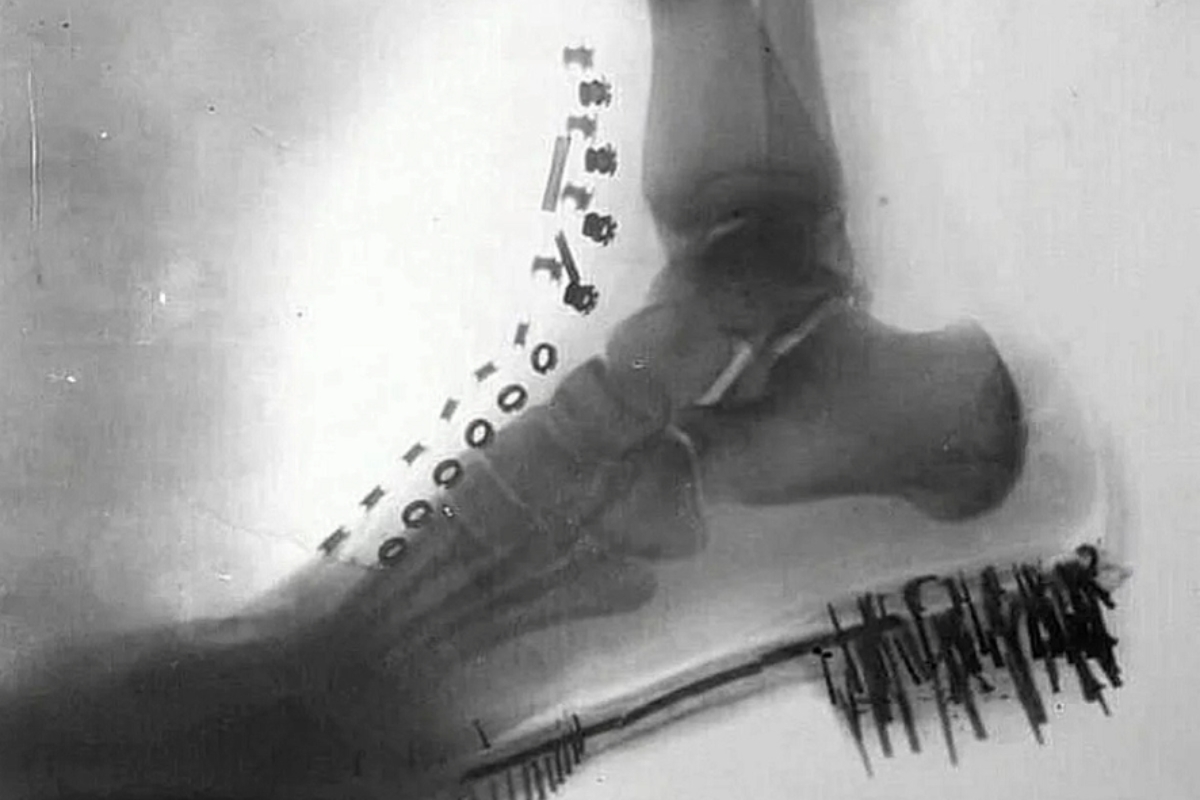
In New York, Nikola Tesla Conducted High-Frequency Radiation Experiments With Voltages Above 100 Thousand Volts to Generate Images of His Own Body, Sparkling Debate About Biological Effects and Calling Attention to the Scientific Community.
Nikola Tesla did something that still impresses when the subject is technology and science. In 1896, he was already producing radiographic images of his own foot and hand, just a few months after the official announcement of the discovery of X-rays by Wilhelm Conrad Röntgen in November 1895.
The setting was a private laboratory, with high-cost equipment and technical capabilities far above the standard of the late 19th century. And the detail that stands out the most is the level of energy involved in the tests.
Few Months After the Discovery of X-Rays, Tesla Was Already Testing High-Frequency Radiation in the United States
Shortly after Röntgen’s announcement in November 1895, Tesla began experiments with high-frequency radiation in 1896.
-
Friends have been building a small “town” for 30 years to grow old together, with compact houses, a common area, nature surrounding it, and a collective life project designed for friendship, coexistence, and simplicity.

-
This small town in Germany created its own currency 24 years ago, today it circulates millions per year, is accepted in over 300 stores, and the German government allowed all of this to happen under one condition.

-
Curitiba is shrinking and is expected to lose 97,000 residents by 2050, while inland cities in Paraná such as Sarandi, Araucária, and Toledo are experiencing accelerated growth that is changing the entire state’s map.

-
Tourists were poisoned on Everest in a million-dollar fraud scheme involving helicopters that diverted over $19 million and shocked international authorities.


These tests took place in his laboratory in New York, a typical private research environment of the time, where inventions and advanced electrical demonstrations were conducted outside universities.

High-Voltage Coils and Vacuum Tubes Made by Him Enabled the First Images of His Own Body
Tesla used high-voltage coils and vacuum discharge tubes developed by him to generate the images. The result was the production of radiographs of his own foot and hand still in 1896.
While the term X-ray was quickly becoming popular in the international press between 1896 and 1897, Tesla preferred to call these images shadowgraphs, reinforcing a vocabulary of his own for a phenomenon that was still being understood.
Thousands of Dollars Costs and Voltage Above 100 Thousand Volts Show the Scale of What Was at Stake
At that time, private electrical laboratories like Tesla’s operated with equipment that could cost thousands of dollars. There is no official number disclosed for a single value, but the text indicates that, adjusted for current economy, this would amount to tens of thousands.
Besides the cost, the technical level was extreme: the experiments involved voltages exceeding 100 thousand volts, something considered very advanced for the late 19th century.
This type of scale helps to understand why the rapid reproduction of radiographic technology was so difficult outside a few centers with robust electrical infrastructure.
Tesla Warned in 1896 About Biological Effects After Skin Irritations During Repeated Tests
Still in 1896, Tesla drew attention to possible biological effects of prolonged exposure to radiation. He reported skin irritations after repeated tests, a warning that comes very early in the history of X-rays.
The point becomes even more relevant when compared to the pace of scientific publications of the period. Röntgen’s initial publication was dated December 28, 1895, at the University of Würzburg in Germany, and within a few months the topic was already being replicated and expanded in other countries.
The Race for X-Rays in the 19th Century Placed the United States Among the First to Expand the Technology
Tesla’s experiments helped place the United States among the first countries to reproduce and expand the new radiographic technology still in the 19th century, at a time when the discovery was recent and the understanding of risks was still in its infancy.
What seemed impossible for the time, radiographing one’s own body with technology built within one’s own laboratory, became reality in 1896 and helped accelerate scientific curiosity around radiation.
If this type of story surprises you, let us know in the comments what caught your attention the most: the speed of the evolution of X-rays, the 100 thousand volts involved, or the early warning about biological risks.










-

-

-

-

-

21 pessoas reagiram a isso.