





 Portuguese
  English
  Spanish
  4 min of reading
  1 comment


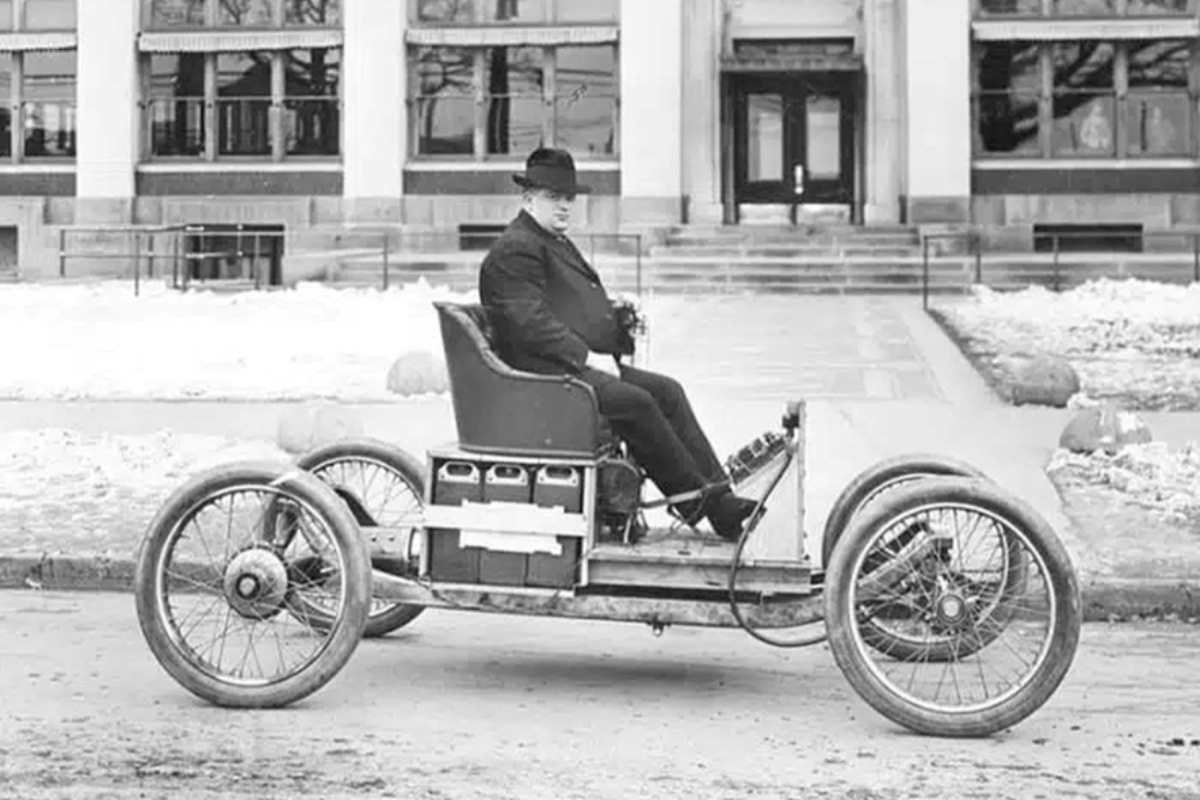


In The United States, Henry Ford and Thomas Edison Developed in 1913 a Prototype of an Electric Car with Over 100 Years of History to Create an Affordable Model for the Public, Investing $1.5 Million, but the Project Was Interrupted and Only Decades Later the Brand Resumed Electrification
When it comes to electric cars, many people think of recent technology. But the truth is that Ford had been working on an electric-powered model for over 100 years.
In 1913, when the automobile was still taking its first steps, Henry Ford and Thomas Edison joined forces to develop a fully electric vehicle. What seemed impossible at the time took shape in a functional prototype.
The project became known as Edison Ford, even though it never received an official name. And it almost changed the course of the automotive industry.
-
Friends have been building a small “town” for 30 years to grow old together, with compact houses, a common area, nature surrounding it, and a collective life project designed for friendship, coexistence, and simplicity.

-
This small town in Germany created its own currency 24 years ago, today it circulates millions per year, is accepted in over 300 stores, and the German government allowed all of this to happen under one condition.

-
Curitiba is shrinking and is expected to lose 97,000 residents by 2050, while inland cities in Paraná such as Sarandi, Araucária, and Toledo are experiencing accelerated growth that is changing the entire state’s map.

-
Tourists were poisoned on Everest in a million-dollar fraud scheme involving helicopters that diverted over $19 million and shocked international authorities.


The Friendship Between Henry Ford and Thomas Edison That Gave Rise to the Electric Project
Before becoming one of the biggest names in the industry, Henry Ford was just another employee at Thomas Edison’s companies. In 1896, during an event of the Detroit Edison Illuminating Company, Edison met the Quadricycle, Ford’s first automobile.
Impressed, he encouraged the young engineer to start his own company. Their friendship grew, and the two became neighbors and idea partners.
Edison had already shown interest in electric vehicles. In 1901, he founded the Edison Storage Battery Company to market nickel-iron batteries aimed at the automotive sector.
The seed was planted.
The First Electric Prototype from Ford in 1913 and Its Technical Features

With the success of the Model T launched in 1908, which sold 15 million units by 1927, Ford returned to thinking about electric vehicles.
In 1913, the first electric prototype from the brand emerged. It was basically a rolling chassis, without a body and without a traditional steering wheel. Instead, there was a kind of rudder, similar to that of a boat.
The Edison batteries were located under the seat, and the electric motor was positioned in front of the rear axle.
In 1914, a second, more advanced prototype came out, designed for production. It used parts from the Model T as a chassis, suspension, and front axle, a strategy that could reduce costs.
The motor moved to the front, and an additional row of batteries was added to increase the range.
Estimated Price Between $500 and $750 and Range of Up to 160 km Caught Attention
Thomas Edison claimed that the new electric car would cost between $500 and $750. By comparison, the Model T varied between $390 and $440.
In current values, this would represent something between €13,700 and €20,500, according to estimates.
The reported range varied according to the media outlet of the time, being either 80 km or even 160 km.
It may seem small today, but in the context of 1915 and 1916, when there were no highways and trips were predominantly urban, these numbers were considered adequate.
The launch was expected for 1915. Then there was talk of 1916. Expectations kept rising.

The Problem of Nickel-Iron Batteries and the Investment of $1.5 Million
The main obstacle was technical.
The nickel-iron batteries developed by Edison had high internal resistance. This meant low current discharge capacity over short periods, in addition to insufficient energy density to move the car efficiently.
They also charged slowly, although they were lighter than lead batteries and could withstand many charge cycles.
According to the book The Ford Century, Ford had even acquired 100,000 batteries from Edison for the project.
A demonstration prototype ended up using lead batteries to work around the issue. When Henry Ford discovered the replacement, he was furious.
The project had already consumed $1.5 million, a value that today would exceed €40 million. Even so, it was canceled.
Theories pointed to pressure from oil magnate John Rockefeller, but there is no proof that this was the real reason.
The Cancellation Did Not Prevent Advances and Ford Returned to Electric Vehicles Decades Later
Although the Edison Ford never made it to market, the project left important marks.
Engineers involved in the development later contributed to the introduction of electric starting and electric lighting systems in the brand’s vehicles.
Decades later, Ford resumed investing in electric vehicles for production. In 1998, it launched the electric Ranger.
More recently, the electric offensive gained momentum with the Mustang Mach E, the F-150 Lightning, and the E Transit and E Transit Custom vans.
In Europe, the automaker promises a total paradigm shift by 2035, with the production of new electric models in Cologne, Germany.
The first electric vehicle may have remained in the past, but it helped shape the future.
The story of Edison Ford shows that the race for electrification began long before many imagine, and that technical decisions can completely change the direction of the industry.
Did you know that Ford had been trying to launch an electric car over 100 years ago? Leave your opinion in the comments.










Hoje é muito fácil ser um gênio! Basta copiar os verdadeiros gênios do passado que usava todo seu intelecto e habilidades para inventar o futuro!!!