





 Portuguese
  English
  Spanish
  7 min of reading
  1 comment


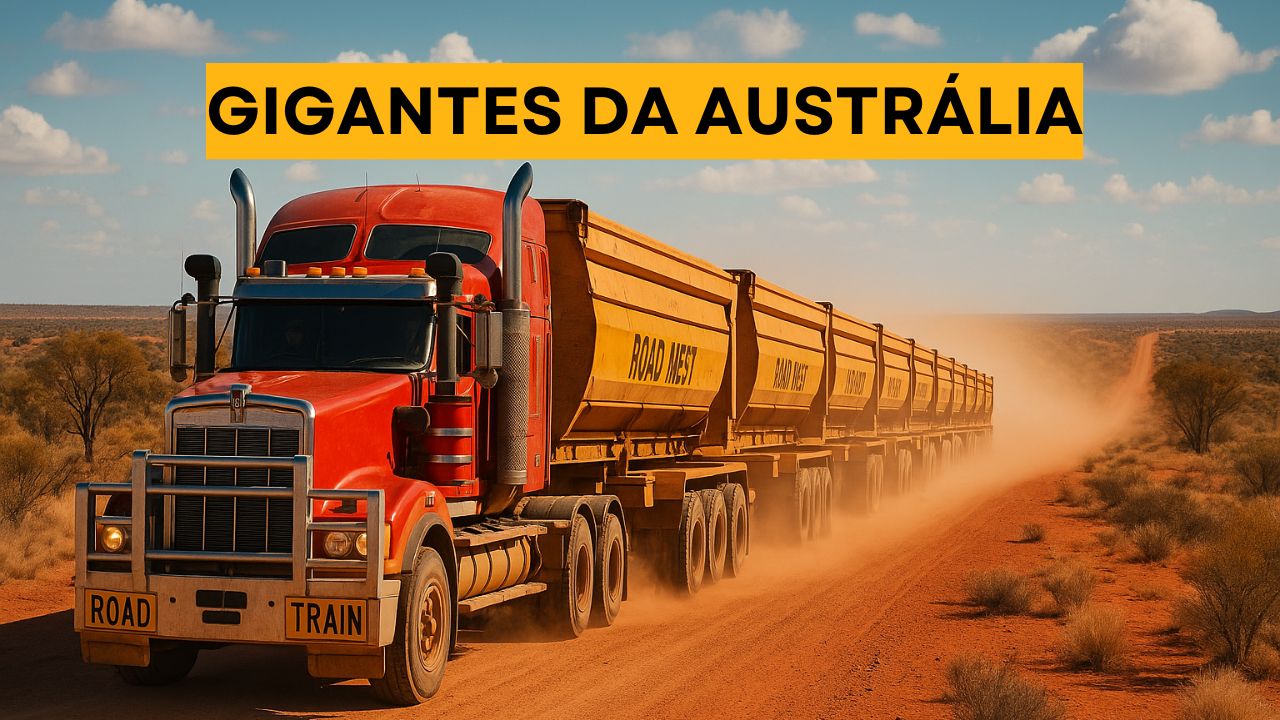


In The Australian Outback, Trucks Up To 53 M Operate As Road Trains, Crossing Over 1000 Km Without Support And Ensuring Logistics In The Desert. They Are The Backbone Of Mines, Farms, And Isolated Communities Where Almost Nothing Else Arrives.
In the heart of the so-called Australian outback, where the heat easily exceeds 40 degrees, rain is rare, and the nearest town may be many hours away, transportation is not just an economic operation; it is literally a matter of survival. It is in this extreme scenario that trucks up to 53 m emerge as the radical solution to a problem that almost no other country faces.
A Giant, Nearly Empty Country Dependent On The Road
Australia occupies a continental territory, but most of the population is concentrated in the coastal strip. More than 80 percent of the country is a void of deserts, sunburned savannas, and long stretches without any sign of human life. In these remote areas are mines, farms, and small communities that depend entirely on the road to receive fuel, food, machinery, medicine, and to transport everything they produce.
The railway network does not reach much of this interior. Planes make long-distance transport too expensive, and rivers are scarce or intermittent. The result is straightforward: unpaved roads, often uneven and vulnerable to the weather, end up being the only possible link between nothing and the world. It was this extreme isolation that paved the way for trucks up to 53 m as the main logistical solution, and not as an extravagance.
-
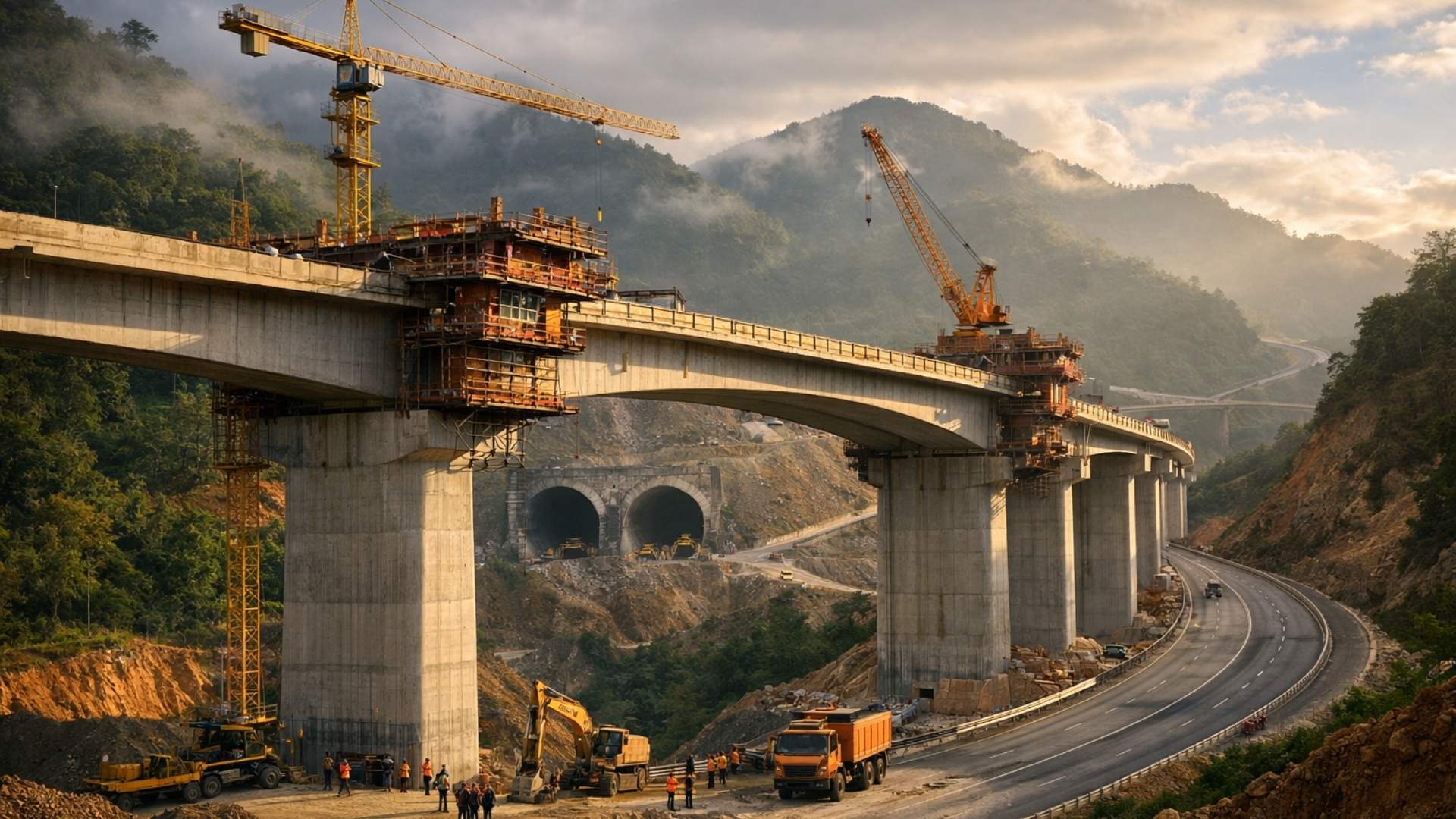
The government puts R$ 8.6 billion on the table to change the highway (BR) with 50 overpasses, 28 bridges, 4 tunnels, and 40 km of bike lanes in 180 km of historic duplication.
-
BRL 20.1 Million Bridge Project Kicks Off: 200-Meter Construction to Improve Access in Three Cities in Minas Gerais

-
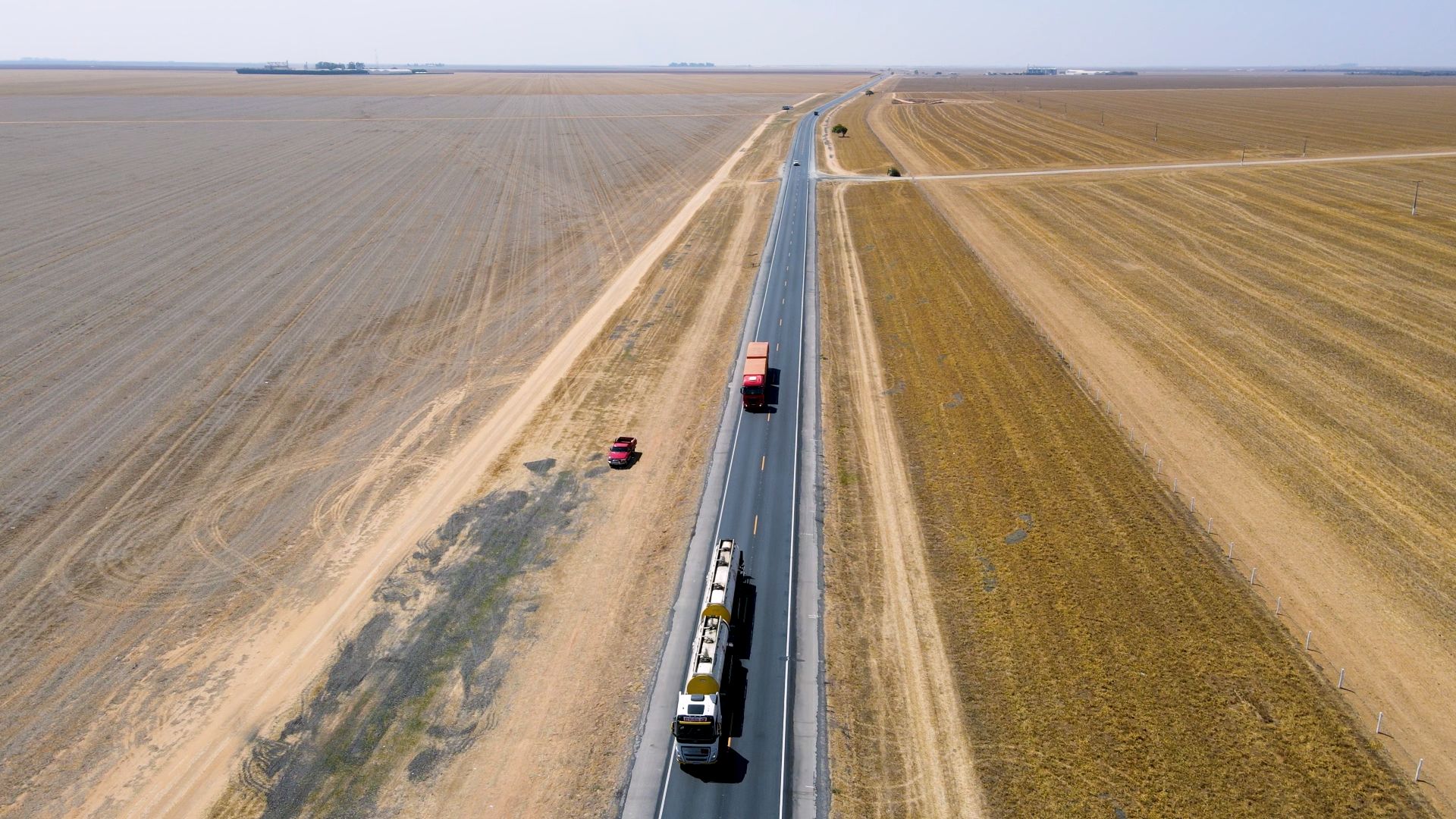
‘Endless Road’ In Brazil Is One of The Largest In The World: 145 Km Stretch On An Important Highway (BR) Crosses The West Of Bahia And Had 135.9 Km Revitalized With R$ 35.3 Million
-
Engineer From ITA Who Worked at Embraer Leads Free Flow Expansion With National Artificial Intelligence and Technology for Toll Without Barriers in Brazil


From Camel To Giant Articulated Truck Of The Desert
Before the roar of engines, what dominated these routes was the slow, yet constant, pace of camel caravans guided by Afghan and Indian camel drivers. For decades, they were the only bridge between isolated communities and civilization. In the 19th century, crossing the Australian interior was a survival mission, not just freight transport.
The turning point began in the 1930s when the government decided to gradually replace these caravans with motorized vehicles, trying to modernize transport in the middle of the desert. The decisive transformation came from a mechanic in Alice Springs, in the center of the country.
Kurt Johanson adapted an abandoned military transporter and created an articulated trailer system capable of carrying up to five times more cattle than conventional trucks. His prototype, which transported about 100 heads of cattle per trip, is regarded as the official birth of the first Australian road trains.
From then on, the concept only grew. The compositions began to gain more axles, more trailers, more robustness, and specialization for different types of cargo. Today, on public roads in the outback, it is common to see trucks up to 53 m pulling up to 200 tons.
In private areas, such as inside mines, there is practically no limit, and the historic record from 2006 is impressive: a single truck towing 113 trailers in a total length of almost 500 m.
How Trucks Up To 53 M Work In Practice

Australian road trains are not just big; they are engineering projects designed for one of the most hostile environments on the planet.
An articulated set of trucks up to 53 m can weigh the equivalent of two fully loaded Boeing 737 commercial airplanes, crossing unpaved and heat-expanded asphalt roads.
This power is used to transport cattle, fuel, grains, industrial equipment, and ore along stretches where no alternative road exists.
There are several different configurations, designed for specific needs. The B double arrangement, with two semi-trailers supported on an integrated fifth wheel, reduces oscillation and improves stability.
The B triple adds a third semi-trailer following the same concept. Meanwhile, the A triple set uses movable dollies, small trailers with axles and an intermediate fifth wheel, making the set more flexible but also more demanding in terms of driving.
There are also hybrid compositions, like the AB triple, which combine characteristics according to the type of cargo and terrain.
These formats are not arbitrary. Every detail of trucks up to 53 m responds to three constant challenges: maximizing load, withstanding the terrain, and maintaining control over an articulated monster on unpredictable roads.
Behind the scenes, engineering is guided less by aesthetic pursuit and much more by the survival of those behind the wheel.
Engines, Cabins, And Systems Designed To Survive, Not Just To Operate
Models like the Mack Titan have become icons of road trains. They feature engines that reach up to 780 horsepower, but, interestingly, it is not just the power that differentiates these trucks from those used in other countries.
The secret lies in mechanical resistance and the ability to withstand years of dust, extreme heat, and constant vibration without collapsing.
Larger radiators, reinforced filters, cooling systems designed for temperatures above 40 degrees, and chassis prepared for torsions on dirt stretches are all part of the package.
The cabins are true mini houses on wheels, with beds, air conditioning, pneumatic suspension, storage space, and digital monitoring systems. In routes that can exceed 1000 km without any support, comfort is synonymous with safety.
The daily operation of trucks up to 53 m requires nearly military discipline. Before departing, drivers check tires that can number up to 86 per vehicle, inspect brakes, couplings, electrical systems, and set off with dozens of liters of potable water, food, and emergency tools.
If something goes wrong in the middle of the desert, help can take hours or even days, and the driver needs to be prepared to fend for themselves.
A Risky Routine On Roads That Change With Every Rain
Driving trucks up to 53 m in the outback means living with risks that do not appear on densely populated highways in other countries. Gravel and dirt sections turn into mud after heavy rains.
Small rivers need to be crossed without structured bridges. Wildfires can surround the truck in minutes, forcing the driver to quickly decide whether to back off, advance, or stop.
Even so, these vehicles are essential for the Australian economy. A single road train does the work of three or four conventional trucks, reducing fuel, crew, and fleet maintenance costs in a region where everything is distant and expensive.
It is estimated that there are about 20,000 registered road trains in the country, crossing daily low population density regions but with a high demand for logistics.
In many small towns, seeing trucks up to 53 m delivering fuel, food, and agricultural supplies is almost a daily ritual, more important than any train or plane.
Not surprisingly, they have also become a tourist attraction, with companies offering rides for visitors who want to experience the true Australian outback.
Why The Rest Of The World Doesn’t Copy This Model
Given such efficiency over long distances, it is natural to ask why trucks up to 53 m do not spread around the world.
The answer lies in the combination of factors that only Australia gathers on such a large scale: vast territorial expanse, sparsely populated interior, and limited infrastructure. In many developed countries, the logic is the opposite.
In the United States, legislation significantly limits the maximum size of compositions. In most states, it is only permitted to use a maximum of two smaller trailers, totaling about 19 m in length, a fraction of what is allowed on outback highways.
In Europe, the restrictions are even stricter, with a general limit of around 25.25 m and a maximum weight of 60 tons. Ancient cities, narrow streets, tight roundabouts, short bridges, and heavy traffic make the circulation of articulated giants unfeasible.
That is why road trains have become a very particular symbol of Australia. They are a technology born to adapt to the desert, not the international market. Instead of following the global path of increasingly compact vehicles, the country accepted that for its remote interior, the future of logistics meant becoming larger, longer, and heavier.
Giants Of The Present, Challenges Of The Future
Even established as the logistical backbone of mines, farms, and isolated communities, road trains continue to evolve. More comfortable cabins, advanced electronic systems, more efficient brakes, and reinforced engines are emerging to cope not only with the terrain but also with an increasingly unpredictable climate.
Extreme temperatures, prolonged droughts, recurring fires, and roads destroyed by heavy rains require trucks up to 53 m to be even more robust and intelligent.
In the end, these articulated giants are the portrait of an unusual equation: long distances, almost no access, and an economy spread across the desert.
They were born from the improvisation of a mechanic in Alice Springs, grew propelled by mining and cattle ranching, and today literally sustain modern life in one of the world’s most extreme environments.
And you, would you dare to travel through the outback on trucks up to 53 m, or do you prefer to keep that experience only on the video screen?








Sou motorista e adoraria passar por está experiência!