





 Portuguese
  English
  Spanish
  5 min of reading
  13 comments


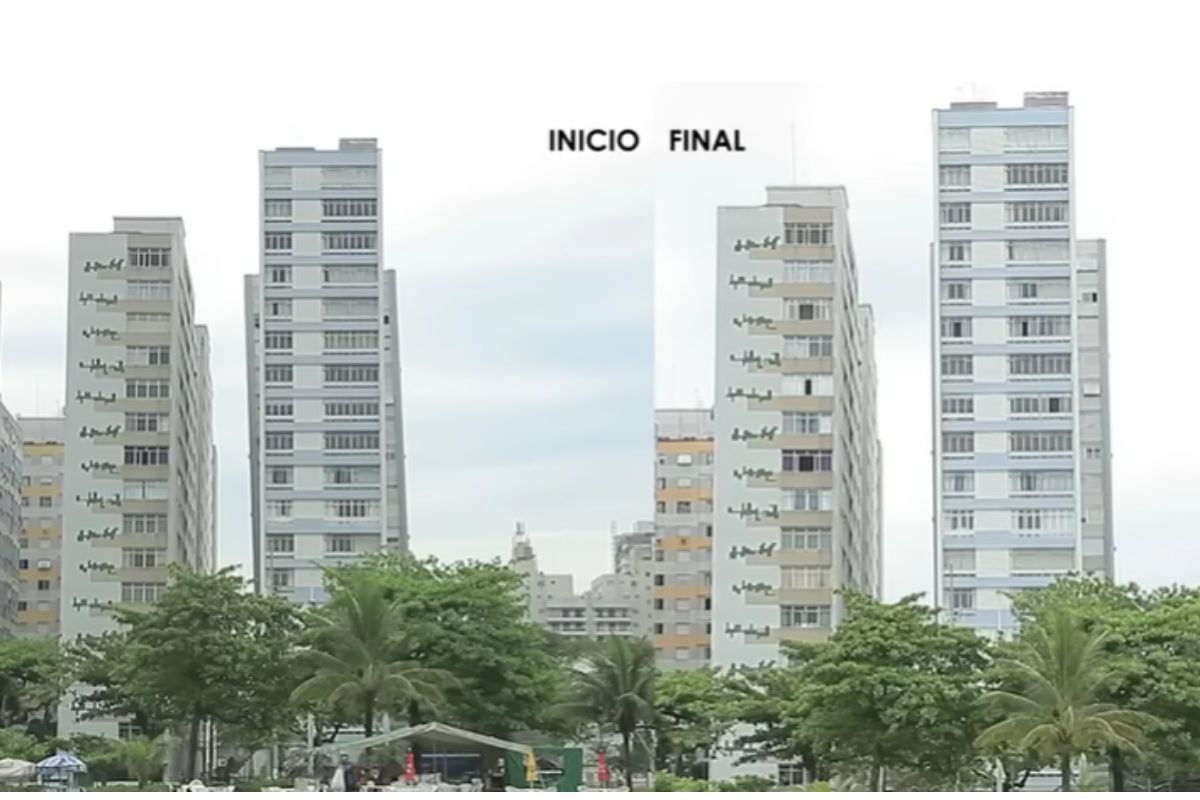


With Precision Engineering, Leaning Building That Sunk for Decades in Santos Is Lifted on Deep Pilings with Hydraulic Jacks, Keeping Residents in Their Apartments and Opening the Chance to Recover Up to 50% of Property Values.
In Santos, a leaning building that spent years suffering from settlement is being slowly brought back to plumb by engineers working beneath the structure, not inside the apartments. Supported by deep pilings and hydraulic jacks distributed along the columns, the building is raised millimeter by millimeter while water, sewage, electricity, and phone services continue to function.
For those who live there, it’s not just an engineering project. It’s the possibility of seeing the discomfort of the tilt become a thing of the past and recovering their assets. Residents report that just the announcement of the leaning building being corrected has already started to push apartment prices up, with the expectation of recovering up to 50% of market value.
Santos, The City of Leaning Buildings
The city of Santos has about 100 buildings constructed between 1950 and 1975 that now show tilts exceeding two degrees.
-
The lack of welders, electricians, and operators becomes a structural threat in 2025, with the construction industry and manufacturing already suffering from delays, cost pressures, and labor shortages in Brazil.
-
Brazil and Paraguay are just 46 meters away from a historic union on the bioceanic bridge that promises to revolutionize trade between the Atlantic and the Pacific.

-
With 55 km over the sea, a cost of US$ 20 billion, and enough steel to build 60 Eiffel Towers, China’s largest project has connected Hong Kong, Zhuhai, and Macau in a colossal bridge that defies the logic of engineering.

-
A trick with joint compound transforms a Styrofoam ceiling into a plaster-like ceiling: leveled panels, wires and mesh at the joints, sand, paint, and change the environment while spending little today.

In some cases, like this leaning building, the difference is visible to the naked eye. There are reports of displacements of about 1.70 meters in the transverse direction and 34 centimeters in the longitudinal direction, which changes how residents live, walk through corridors, and even arrange furniture at home.
This tilt did not appear overnight. It is linked to how these buildings were constructed. Many leaning buildings in Santos rest on footings interconnected by beams over a shallow layer of compacted sand approximately 10 meters thick.
Below this layer, there is a thick layer of very deformable marine sediments that continue to settle over the years.
An academic study showed that these buildings are still undergoing secondary settlement, with values ranging from 0.5 to 1.5 centimeters per year.
In other words, if nothing is done, the leaning building will not only remain crooked but may continue to slowly worsen, compromising comfort, perceived safety, and, most importantly, market value.
How to Correct a Leaning Building Without Emptying the Structure

The first step to correct a leaning building is to ensure that the problem does not happen again. Therefore, years before the lifting operation, new foundations with root piles about 55 meters long were installed, capable of reaching firmer layers underground and reducing differential settlements.
With the building’s behavior monitored over nearly ten years, the readings indicated stabilization of the settlements.
From there, engineers were able to plan the “return” of the leaning building, meaning the process of bringing the structure back to a condition closer to the original level, now safely supported on the deep pilings.
To actually start adjusting the building’s position, it is necessary to expose the structure. Therefore, walls in specific areas are demolished to expose columns and beams that will receive supports and hydraulic jacks.
At the same time, all utilities passing through the site, such as water, sewage, electricity, and phone services, are adapted with flexible sections so that they can accommodate the small movements without breaking.
Deep Pilings and Hydraulic Jacks Lifting Tons
With the new foundations already completed, the next step is to prepare the columns. For each column, concrete supports are executed, which will receive auxiliary jacks and main jacks.
These hydraulic jacks temporarily take on the role of supporting the load of the column while the leaning building is repositioned.
The engineers calculate the load that each jack must bear and distribute these forces to maintain global balance. The aim is to reduce the tilt of the leaning building as a rigid body, avoiding local deformations that could crack slabs, walls, and structural elements as much as possible.
In practical operation, the lifting is done in stages. The jacks are activated gradually, increasing the stroke to the limit.
When this happens, part of the load returns to the auxiliary jacks, the piston of the main jack is retracted, metal support plates are placed, and the process repeats.
Thus, the leaning building is repositioned, centimeter by centimeter, until it reaches the desired leveling within the limits defined by the project.
Residents Inside the Leaning Building During the Work
One of the most impressive aspects of this intervention is that residents do not need to leave their apartments. While the leaning building is being lifted from below, life continues above.
The adaptation of the plumbing with flexible sections and careful effort sequencing allows water, sewage, electricity, and phone services to continue functioning.
The engineers plan each stage to minimize discomfort. The goal is for the resident to perceive the work more as noise and movement on the ground floor than as a sudden change inside the apartment.
However, those living in a leaning building feel the anticipation with each construction update, as the result directly impacts perceived safety and property value.
At the end of the lifting process, another delicate phase begins. The main jacks that supported the columns are replaced with reinforced concrete blocks and collars.
Steel cages are assembled, concrete placements are executed in stages, and gradually, the building begins to rest definitively on the new deep foundations, without the need for jacks.
Value Recovery and Effect on the Real Estate Market
The pronounced tilt over decades has devalued the leaning building and its apartments. Living in a crooked building means dealing with discomfort, a sense of insecurity, and difficulty in resale.
Thus, the decision to invest in deep pilings and hydraulic jacks is not just technical. It is also an economic choice.
Residents report that, in some cases, just the announcement that the leaning building would be corrected has already made prices react, with the expectation of recovering up to 50% of apartment values.
The work comes to be seen as a form of asset protection since the building stops deteriorating further and gains a more secure base for the coming decades.
This type of intervention in a leaning building does not only resolve an isolated case. It serves as a showcase for a potential solution for other buildings of the same era in Santos, built on the same type of soil and showing similar settlement problems.
Each leaning building has its limits and particularities, but the combination of new deep foundations and hydraulic jacks shows that not every crooked structure is doomed.
And you, would you have the courage to continue living in a leaning building while it is being lifted by hydraulic jacks beneath your head?








APRECIARIA muito saber o nome dos engenheiros envolvidos.
Parabéns à engenharia e engenheiros envolvidos! Segurança acima de tudo!
Quais empresas brasileiras que fazem este serviço?