





 Portuguese
  English
  Spanish
  5 min of reading
  4 comments


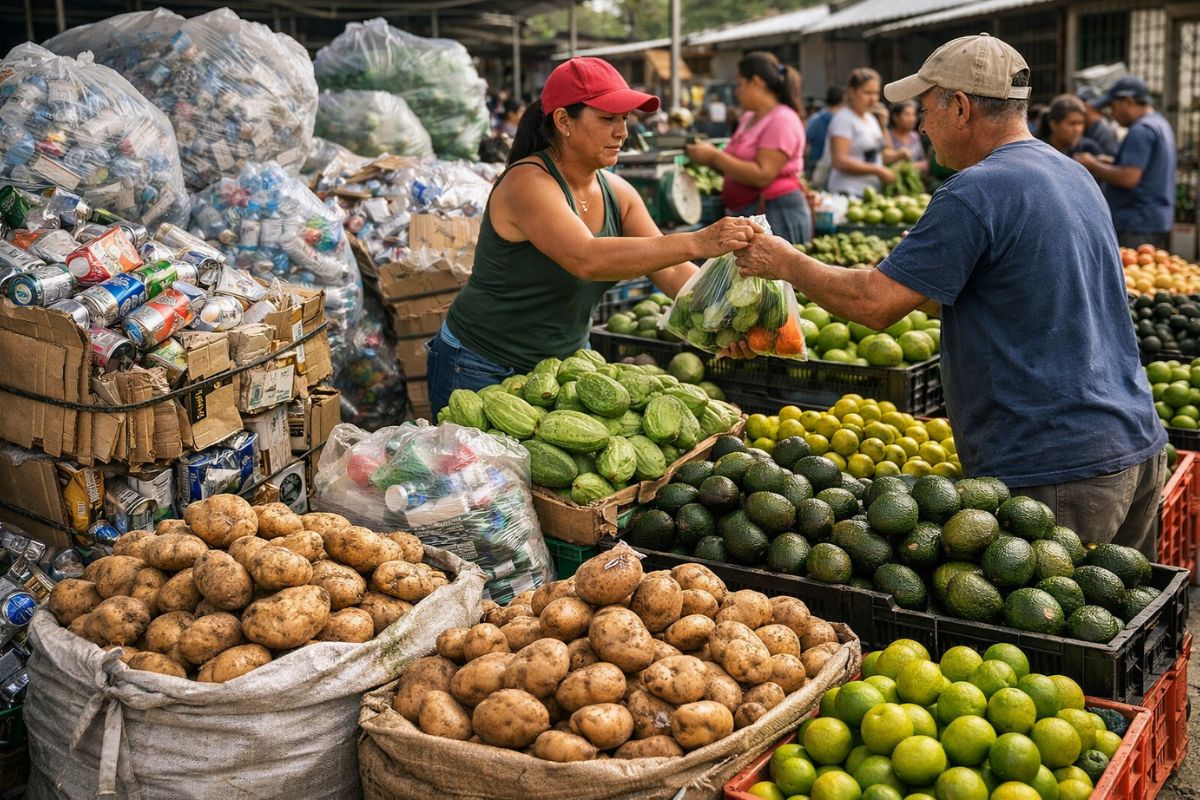


In The Coto Bruce Canton, Eight Hours From San Francisco, Recycling Has Ceased To Be Merely Disposal: Residents Store Waste For A Month, Weigh It At The Green Market, And Choose Vegetables And Fruits. The Project, Launched In 2020, Reduces Common Waste, Creates Jobs, And Reinforces A Real Local Community Circular Economy.
The recycling in Coto Bruce happens under a blazing sun on the mountains and, still, it does not rely on grandiose speeches: it depends on ordinary people who diligently save cans, cardboard, plastic, and Tetra Pak as part of their routine. Eli Flores is one of these residents, walking down a rural road with bags full of what he has collected over the month, turning accumulation into choice.
At the Green Market, the material is weighed and converted into an equivalent that opens up the space to decide what to take home. Potatoes, chayote, lemons, avocados, lettuce, tomatoes, cilantro, and seasonal items appear as a direct result of a system that attempts to prove, in practice, that there is value behind waste when it is separated and treated as a resource.
A Month Of Separation, A Morning Of Exchange

The cycle begins at home and lasts for weeks: cans, cardboard, plastic, and Tetra Pak packaging cease to be “trash” and become items saved with intention.
-
Friends have been building a small “town” for 30 years to grow old together, with compact houses, a common area, nature surrounding it, and a collective life project designed for friendship, coexistence, and simplicity.

-
This small town in Germany created its own currency 24 years ago, today it circulates millions per year, is accepted in over 300 stores, and the German government allowed all of this to happen under one condition.

-
Curitiba is shrinking and is expected to lose 97,000 residents by 2050, while inland cities in Paraná such as Sarandi, Araucária, and Toledo are experiencing accelerated growth that is changing the entire state’s map.

-
Tourists were poisoned on Everest in a million-dollar fraud scheme involving helicopters that diverted over $19 million and shocked international authorities.


When the time for delivery comes, bags and boxes carry not just materials, but also the expectation that the separation has been done correctly to enter the recycling route.
At the exchange point, there are no guesses: the weight of what arrives defines the equivalent for each participant, guiding the selection of vegetables, greens, and fruits.
The scene is simple but strategic, because it puts face to face two things that normally do not meet in everyday life: waste measured as an asset and food understood as an immediate return for those participating.
A Municipal Project That Treats Waste As An Asset

What sustains the Green Market is an environmental management decision by the municipality: to reduce the volume of non-recyclable common waste while simultaneously increasing what can be used and valued.
The central idea is straightforward: instead of leaving everything “by the side of a landfill”, assign value to what was once thrown away without generating anything.
This logic fits into the local context, where the community heavily relies on natural resources and tourism, seeking to strengthen a circular economy.
By placing recycling as a piece of public policy, the municipality attempts to create a cycle in which the reused material becomes raw material, improves quality of life, and helps generate environmental and social impacts that remain within the canton.
The Collection Center And The Jobs Behind The Green Market

After the material is received, it proceeds to a collection center where more than six operators work, under the coordination of Marianela Jiménez, environmental manager.
There, a new sorting takes place, categorized by type to ensure proper treatment: cardboard, paper, aluminum, plastic, tetra, glass, and tinplate appear as categories that require careful separation to keep recycling functioning.
There is also an effect that often goes unnoticed when talking only about “awareness”: door-to-door collection generates jobs, and the project reinvests profits both in operations and in the community.
Moreover, what is no longer transported to a landfill represents savings on transport and greater local autonomy, reinforcing the idea that being in charge of one’s own waste is not just a slogan but a way of organizing work and responsibility in the territory.
From Bottle Caps To The Park Ramp

The recycling in Coto Bruce is not limited to “separating and sending”: it also manifests as transformation into products and infrastructure.
Among the cited examples, bottle caps have already become material for manufacturing wheelchairs, increasing access and mobility, and repurposed waste contributed to construct a large ramp in Friendship Park.
The impact of this is not just material, but cultural: when the community sees a completed ramp or a wheelchair linked to something that was once discarded, waste changes status.
What was “trash” becomes concrete proof that a domestic choice can turn into a collective result, fostering a kind of pride that does not stem from advertising but from visible work and real utility.
Organic, Composting, And Fertilizer As A Second Line Of Recycling

The project also receives organic vegetables from supermarkets and greengrocers that would be discarded due to being in poor condition and uses this volume to produce a supply aimed at both sale and cultivation of vegetables, fruits, and greens in municipal gardens.

Thus, the circular economy is not confined only to dry recyclables: it includes what is organic and opens a second route for utilization.

The mentioned technique is composting, a process in which microorganisms decompose organic matter until it yields a product similar to fertilizer, used as a soil enhancer.
The high temperature of the process helps eliminate harmful pathogens, and the final compost is described as rich in minerals and nutrients, allowing cultivation without pesticides, as in planting cilantro seeds with the compost already prepared.
In this framework, recycling and composting merge to form a more complete cycle, where what rots does not have to become a problem.
When Recycling Becomes “Life” And Everyday Public Policy
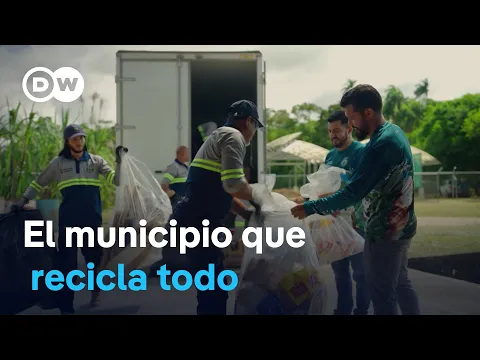

A resident summarizes the change in a personal way: after the project, he understood that recycling means life because it reduced common waste by nearly 80% to 85%, and furthermore, part of the reusable waste gained practical function in new products.
This statement is not merely emotional; it points to an important detail: when recycling begins to yield measurable results, adherence no longer depends solely on goodwill.
Nevertheless, the model requires consistency and trust: separating for a month, storing, bringing, weighing, classifying, reinvesting, and keeping collection and sorting working.
It is a chain that depends on schools, public institutions, private companies, and, primarily, the everyday discipline of residents.
When all this falls into place, environmental policy ceases to be distant and becomes routine, with economic benefits for families and a clear message that caring for the environment is also management.
At the end of the cycle, the result comes back home in the form of salad, market produce, and supplies, linking the act of home separation to the meal that arrives at the table.
If your city created something similar, with recycling exchanged for food, what would you find easier to separate in your daily life: cans, cardboard, plastic, or Tetra Pak? And what would be the biggest challenge for you to truly participate: storing for a month, keeping everything clean and separated, or trusting that the system will weigh and return fairly?










Costa rica onde? Ms?
Ou pais ?
Santo André já tem este programa há muitos anos. chama Moeda Verde, que atender bairros periféricos , trocando produtos recicláveis por legumes e verduras. Vale pesquisar e divulgar
Muito interessante. Gostaria, se possível for, de receber informações mais detalhadas para discutir em grupo e analizar a possibilidade de experimentar em ninha cidade.