





 Portuguese
  English
  Spanish
 5 min of reading
  0 comments


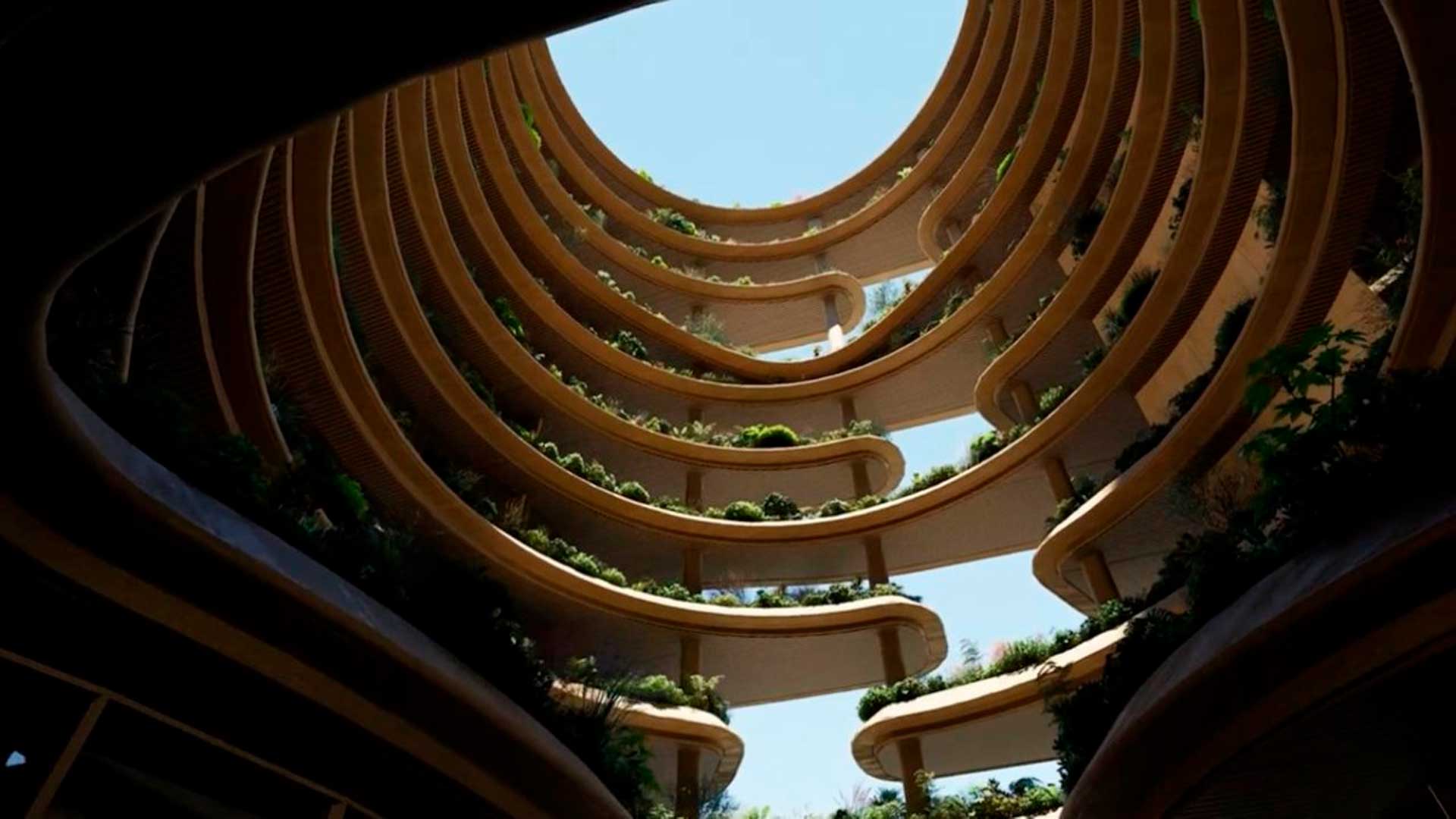
Solum Hub, Corporate Hub in Cuiabá Inspired by the Structure of Termite Mounds, Bets on Natural Ventilation, Abundant Vegetation, and Biomimetic Architecture to Reduce the Use of Air Conditioning in Large Corporate Slabs of Up to 2,000 m², Creating a New Model of Sustainable Building in the Country.
Cuiabá has been known for years as one of the hottest cities in Brazil, with the heat index that can exceed 50 ºC on extreme summer days. In such a scenario, the rule in offices is simple: air conditioning on all day and skyrocketing energy bills. It is precisely this model that the Solum Hub, the new corporate hub of the capital of Mato Grosso, aims to challenge with a project that learns directly from nature.
The building was conceived based on how termite mounds regulate internal temperature and humidity, using tunnels and chambers that favor air circulation. In the building, the logic is similar, but expressed in high-standard architecture, with large openings and internal voids that create a constant flow of natural ventilation.
According to recent reports about the project, the proposal is to allow rooms up to 2,000 m² to operate with thermal comfort without continuously relying on mechanical air conditioning systems.
-
The Argentine government celebrates the lowest poverty rate in 7 years, but experts warn that the methodology has changed, real wages have fallen, unemployment has risen, and the number of people on the streets of Buenos Aires has increased by 57% since Milei took office.

-
7.8 magnitude earthquake in Indonesia frightens the population, triggers tsunami alert, and hits an island with over 200,000 inhabitants this Thursday.

-
Google will finally let you change that embarrassing Gmail address you created in your teenage years without losing any accounts, logins, or old emails: the feature is already available in the United States.

-
Heading to Brazil in a Bonanza F33 single-engine aircraft: a couple departs from Florida on a visual flight, makes technical stops in the Caribbean to refuel and organize paperwork, and begins the staged crossing until they reach the country.


Developed by the Scheffer group, a giant in the agribusiness sector in Mato Grosso, the Solum Hub was designed by the international office Leinemann | Ortiz, in partnership with the Colombian studio Obreval Arquitectura. The declared intention is to create an urban landmark of biomimetic architecture in the cerrado, uniting business, well-being, and nature in a single corporate address.
Located on Helder Cândia Highway, next to the Brasil Beach Home condominium and near the Florais condominiums, the venture positions itself as a new business hub in Cuiabá. With easy access to areas such as Estação Shopping and Parque das Águas, the building attempts to balance strategic location with a more green urban design integrated with its surroundings.
Architecture Inspired by Termite Mounds in One of the Hottest Cities in the World
The conceptual foundation of Solum Hub lies in biomimetic architecture, a field that seeks solutions from biology for human engineering problems, comfort, and energy efficiency. In the case of termite mounds, nature has already developed a structure capable of keeping the interior stable even under extreme heat. The building takes this model as a direct reference to create a building that also breathes.
According to specialized reports on technology and architecture, termite mounds work with a system of internal tunnels where hot air rises, loses heat as it passes through the walls, and descends cooled through narrower channels. This continuous cycle maintains adequate temperature and humidity for the colony. In the Solum Hub, structural openings and internal voids aim to reproduce this logic, guiding hot air out and pulling cooler air in.
According to Travel and other outlets covering urbanism and tourism, the building is described as an organism that adapts to the cerrado. Gardens, open terraces, and water mirrors help stabilize the internal microclimate, reinforcing the feeling of a corporate oasis amid the intense heat of the capital of Mato Grosso.
How Natural Ventilation Reduces the Use of Air Conditioning
In promotional materials for the project and in recent reports, Solum Hub is presented as a building that operates with predominant natural ventilation, drastically reducing the need for traditional air conditioning. The idea is that the hot air produced by occupancy and equipment rises through internal voids and exits through upper openings, while cooler air enters through renewal points in the facades and balconies.
The building was designed to maintain thermal comfort even on days when the heat index in Cuiabá approaches 50 ºC, something that typically requires a heavy load of air conditioning in conventional buildings.
Experts remind us, however, that the main strategy is to reduce dependence on air conditioning and make it complementary, not necessarily eliminating it in all situations, which already represents a significant gain in energy consumption.
Giant Structure, Flexible Rooms, and Comprehensive Services for Companies
The Solum Hub was conceived as a high-standard corporate hub, with slabs ranging from 100 to 2,000 m² that allow flexible configurations for companies of different sizes. According to the official website of the venture, the building offers adaptable layouts for coworking spaces, corporate headquarters, and hybrid workspaces, bringing the project closer to the major business centers seen in capitals like São Paulo.
There is a slight discrepancy between some reports and the official material regarding the number of floors. While media outlets mention the building as having eight floors, the Solum Hub website indicates 11 floors in the current configuration, suggesting the project’s evolution during the development process. Common to all sources is the emphasis on the presence of spacious floors, balconies with vegetation, and vertically distributed common-use spaces.
In addition to corporate offices, the complex includes an audiovisual room, gym, restaurant, event hall, panoramic rooftop, and parking lot. The idea is that workers can resolve almost everything at their own workplace, reducing commuting and making the routine more integrated. This corporate hub model is gaining traction in Brazilian cities that seek to concentrate services and quality of life in a single location.
Another important front lies in landscaping. Balconies with dense vegetation, internal gardens, and treed terraces serve as natural barriers to heat, filter the air, and create shade on the facades. This way, greenery becomes part of the building’s technical infrastructure, rather than just a decorative element.
Locally, the Solum Hub also reinforces the urbanization strategy of the Helder Cândia Highway region, which already features high-end residential condominiums and leisure ventures. By attracting companies and services, the hub tends to further enhance the surrounding area, opening up a debate on who benefits first from this type of urban innovation in a city with significant inequalities.
Energy, Sustainability, and Biomimetic Architecture in the Cerrado
According to analyses published in architecture outlets, the Solum Hub is part of a global trend of buildings that consume less energy in extreme climates, combining natural ventilation, shading, high-performance materials, and a strong presence of vegetation. In very hot cities, every percentage point reduction in air conditioning use directly impacts electricity bills and greenhouse gas emissions.
In the case of Cuiabá, where the demand for air conditioning is high for a large part of the year, the investment in bio-inspired solutions also serves as a demonstration of technology and commitment to corporate sustainability agendas. Companies that occupy the Solum Hub will be able to use the building as a showcase of ESG applied to architecture, something increasingly valued by investors and business partners.
In your opinion, projects like Solum Hub are an advance that should be applauded or just another symbol of innovation restricted to a few square meters of high standards? Do you think that nature-inspired buildings should receive public incentives, even when primarily serving companies and investors? Leave your comment.









-

-

-

5 pessoas reagiram a isso.