





 Portuguese
  English
  Spanish
  3 min of reading
  7 comments


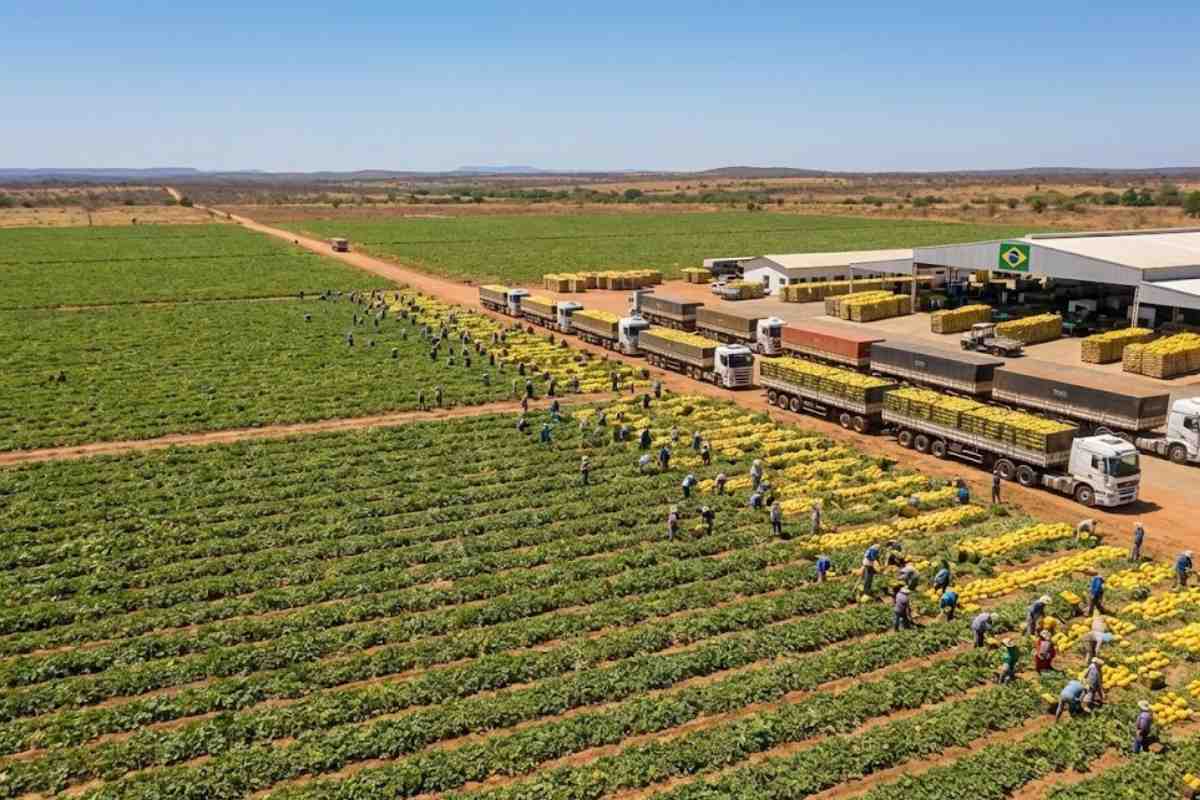


The Largest Melon Farm in Brazil Operates Between Ceará and Rio Grande do Norte, Cultivates 12 Thousand Hectares, Manages 25 Thousand Hectares in 14 Farms, Harvests 1 Million Melons a Day and Delivers About 300 Thousand Tons of Fresh Fruit That Support Exports from the Northeastern Sertão to the World.
Since 1995, when it began operations between Ceará and Rio Grande do Norte, the Largest Melon Farm in Brazil has transformed the sertão into a highly productive area, with daily harvests that now total 1 million fruits and support regular exports of tropical fruits.
With 30 years of existence, Agrícola Famosa encompasses 25 thousand hectares of land, dedicating 12 thousand hectares to the direct cultivation of melons and watermelons, and, distributed across 14 farms, it reaches around 300 thousand tons of fresh fruit moving from the northeastern semi-arid region to different continents.
Scale That Impresses in the Semi-Arid Region

In the heart of the northeastern sertão, Agrícola Famosa’s routine resembles a large open-air industry. Every day, about 1 million melons leave the fields cultivated over 12 thousand hectares, the result of planning that combines dry climate, careful water use, and planting windows designed to maintain continuous harvests.
-
The water that almost everyone throws away after cooking potatoes carries nutrients released during the preparation and can be reused to help in the development of plants when used correctly at the base of gardens and pots, at no additional cost and without changing the routine.

-
The sea water temperature rose from 28 to 34 degrees in Santa Catarina and killed up to 90% of the oysters: producers who planted over 1 million seeds lost practically everything and say that if it happens again, production is doomed to end.

-
An Indian tree that grows in the Brazilian Northeast produces an oil capable of acting against more than 200 species of pests and interrupting the insect cycle, gaining ground as a natural alternative in soybean, cotton, and vegetable crops.
-
The rise in oil prices in the Middle East is already affecting Brazilian sugar: mills in the Central-South are seeing their margins shrink just as ethanol gains strength.


The company manages 25 thousand hectares of land and organizes production across 14 farms, spread between Ceará and Rio Grande do Norte.
The combination of large planted area with constant harvests makes the operation an essential cog for internal supply and for export contracts.
Technology, Irrigation, and Precision Management

At the core of the Largest Melon Farm in Brazil, the difference lies not just in size but in the way of production.
Between Rio Grande do Norte and Ceará, the climate with little rain favors sweeter and more uniform fruits, as long as it is accompanied by calibrated irrigation and strict soil management.
Controlled irrigation systems, constant moisture monitoring, and careful soil management allow each hectare to be maximally utilized, maintaining high productivity even in areas traditionally marked by water scarcity.
The result is standardized melons, with the quality demanded by international buyers.
Own Logistics to Take the Melon Further
For the melons harvested in the sertão to arrive intact and fresh at distant markets, Agrícola Famosa invests in its own infrastructure.
A fleet of trucks, packaging centers, and sorting lines work in sequence right after harvesting, reducing losses and preserving quality until the final destination.
From the farm, the fruits quickly move to units where they are selected, standardized, and packaged.
This flow shortens the time between the field and shipping, which is crucial for the Largest Melon Farm in Brazil to serve supermarkets and distributors across different continents without compromising freshness.
Impact on Exports and the Prominence of the Northeast
With around 300 thousand tons of fresh fruit, Agrícola Famosa has established the Northeast as a reference in melon exports.
Large-scale production strengthens Brazil’s image in the global tropical fruit market and ensures a constant presence of northeastern melons in international shipments.
The operation helps stimulate local economies in Ceará and Rio Grande do Norte, with ongoing work in the fields, irrigation, harvesting, and packaging.
And you, did you imagine that the northeastern sertão houses such an extensive structure for melon production or are you still surprised to see the reach of the Largest Melon Farm in Brazil?










Muito bom saber que temos esse potencial de produção. Mas preciso comentar que a reportagem ficou muito repetitiva, e informações importantes como nome das cidades onde se encontra a “maior fazenda de melões do Brasil” está localiza, um pouco que seja da história dos proprietários, a marca do melão, países e estados que ele é encontrado… Isso é importante numa reportagem. A sua parece ter sido escrita por um aluno do ensino fundamental II.
Era bom mencionar os municípios onde são produzidos esses frutos (melões). Dar crédito aos trabalhadores locais que produzem toda essa riqueza. Icapuí no Ceará é uma dessas cidades, onde os melões são cultivados.
Parabéns ao Nordeste mostrando que temos sim produtividade basta investimento de ponta.