





 Portuguese
  English
  Spanish
  5 min of reading
  1 comment


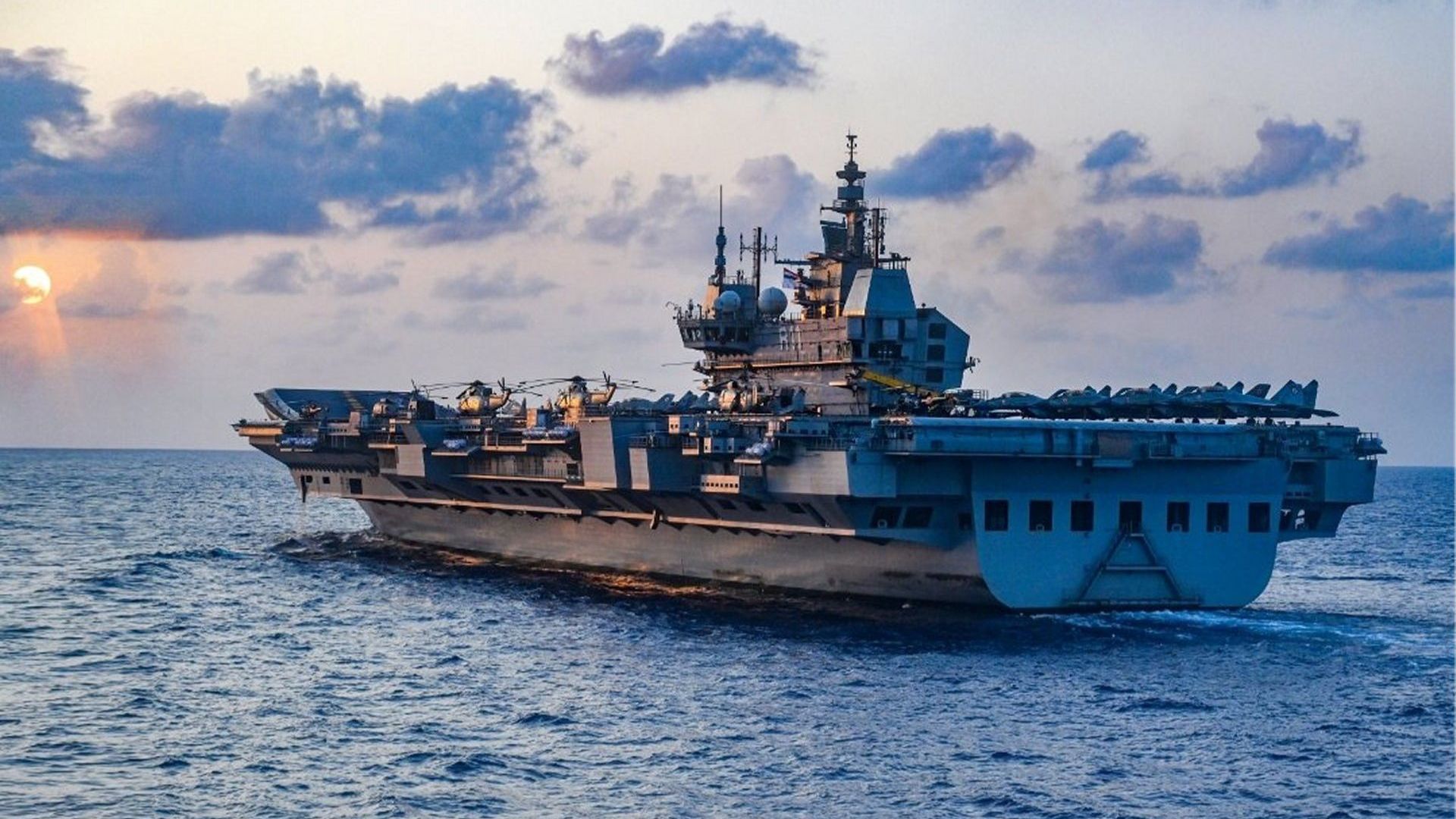


Indian Naval Mobilization Gathers Dozens Of Countries In Visakhapatnam And Places The Aircraft Carrier INS Vikrant At The Center Of A Strategy That Combines Military Power, Diplomacy, And Long-Term Economic Goals Linked To The India 2047 Plan.
India has placed its Navy at the center of the news by holding, this week, the International Fleet Review (IFR) off the coast of Visakhapatnam, on the eastern shore, bringing together foreign delegations and showcasing naval assets in a coordinated demonstration of military capability and diplomatic reach.
On the water, the event combined a review and maneuvers with ships of different classes, while on land, officials and guests attended official ceremonies, in a format designed to transform naval power into a political message to allies and interlocutors.
The most visible highlight was the aircraft carrier INS Vikrant, whose presence served as a technological and industrial showcase, as well as a symbol of strategic ambition, being presented as a key element of a Navy that seeks to expand its operations in the Indian Ocean and beyond.
-
Friends have been building a small “town” for 30 years to grow old together, with compact houses, a common area, nature surrounding it, and a collective life project designed for friendship, coexistence, and simplicity.

-
This small town in Germany created its own currency 24 years ago, today it circulates millions per year, is accepted in over 300 stores, and the German government allowed all of this to happen under one condition.

-
Curitiba is shrinking and is expected to lose 97,000 residents by 2050, while inland cities in Paraná such as Sarandi, Araucária, and Toledo are experiencing accelerated growth that is changing the entire state’s map.

-
Tourists were poisoned on Everest in a million-dollar fraud scheme involving helicopters that diverted over $19 million and shocked international authorities.


International Fleet Review In Visakhapatnam Gathers 74 Countries
Home to the Eastern Naval Command, Visakhapatnam hosted the IFR with broad international participation, in a formal cooperation environment between navies, even though the regional backdrop is marked by persistent rivalries and competition for influence in the Indo-Pacific.

The official numbers of the meeting indicated participation from 74 countries, with dozens of vessels involved, including Indian assets and foreign ships, as well as air support and submarines, making up a picture intended to highlight interoperability and coordinated presence at sea.
The central ceremony included a fleet review by President Droupadi Murmu, who inspected the group embarked on the INS Sumedha, while aligned units advanced offshore in formation, reinforcing the character of a state event, and not just a technical exercise.
Although India gathered representatives from various nations, participation varied by country, with some sending ships and others opting for delegations, allowing New Delhi to demonstrate diplomatic reach without relying on a single power.
INS Vikrant Symbolizes Industrial Autonomy And Naval Power
Named with a term associated with “victorious” in Sanskrit, the Vikrant was presented as the result of national construction, aligned with a policy that seeks to reduce external dependencies, strengthen the defense industry, and at the same time, project India as a maritime power.
At 262.5 meters long, the aircraft carrier operates in a STOBAR configuration, with a launch ramp, and was described as capable of deploying up to 34 aircraft, including Russian-origin MiG-29K fighters and helicopters, as per the composition of the air group.

The autonomy was reported to be around 7,500 nautical miles, and the maximum speed was indicated to be near 30 knots, parameters that reinforce the operational reach of the vessel, especially in presence missions, escorting, and protecting maritime routes.
In addition to visual impact, the presence of the Vikrant at the forefront of the maneuvers served to underline India’s investment in high-value strategic assets, in a region where aircraft carriers hold both symbolic and practical weight in the competition for projection and deterrence.
India 2047 Plan Connects Defense, Economy, And Sovereignty
The Indian government links military modernization to long-term economic and social goals, and the IFR was used as a showcase for this strategy by associating the construction of the Vikrant with the India 2047 plan, aimed at the centenary of the country’s independence.
In the material supporting this agenda, the idea appears that “The initiative places strong emphasis on building a self-sufficient nation with a prosperous and robust economy,” an argument used to justify investments in industrial capacity, science, technology, and infrastructure.
Thus, the aircraft carrier was presented not only as a weapon but as a product of the domestic supply chain, bringing together suppliers, shipyards, and systems, in a narrative that connects sovereignty with defense and economic growth, without diverting focus to unbacked promises.
Maritime Diplomacy Expands Reach In The Indo-Pacific
The list of foreign participants included navies with distinct interests and alliances, allowing India to reinforce its tradition of maintaining dialogue with different poles, avoiding automatic alignment, even in a global scenario of tensions and disputes.
Amid the presence of partners and interlocutors, the IFR also highlighted notable absences, such as China and Pakistan, countries with which New Delhi maintains relations marked by territorial disputes, episodes of confrontations, and persistent strategic distrust.
The Indian reading is that maritime stability depends on cooperation, but also on response capability, and the IFR combined these two messages by presenting a meeting with dozens of countries without neglecting to highlight combat assets and readiness.
Modi’s Speech Reinforces Global Stability Narrative

The naval demonstration took place while the Indian government maintained a parallel agenda of diplomacy and technology in New Delhi, in a context that included official meetings with foreign leaders and discussions about artificial intelligence, a topic that India is trying to insert into the global debate.
In a speech to maritime industry leaders in 2025, Prime Minister Narendra Modi stated: “When the global seas are rough, the world looks for a steady lighthouse. India is well poised to play that role with strength and stability,” connecting economy, trade, and presence at sea.
By showcasing ships, aircraft, and systems in a context of formal cooperation, the country sought to sustain its own narrative of strategic autonomy, emphasizing that it can engage with different actors while expanding its capacity to operate in the regional environment and global routes.
With the INS Vikrant as a central piece and the IFR as a stage, to what extent will India be able to transform this combination of industry, diplomacy, and naval power into lasting influence without escalating tensions with neighbors who already see the Indo-Pacific as a contested area?









A giant emerging Technology in Asia after China