





 Portuguese
  English
  Spanish
  10 min of reading
  0 comments


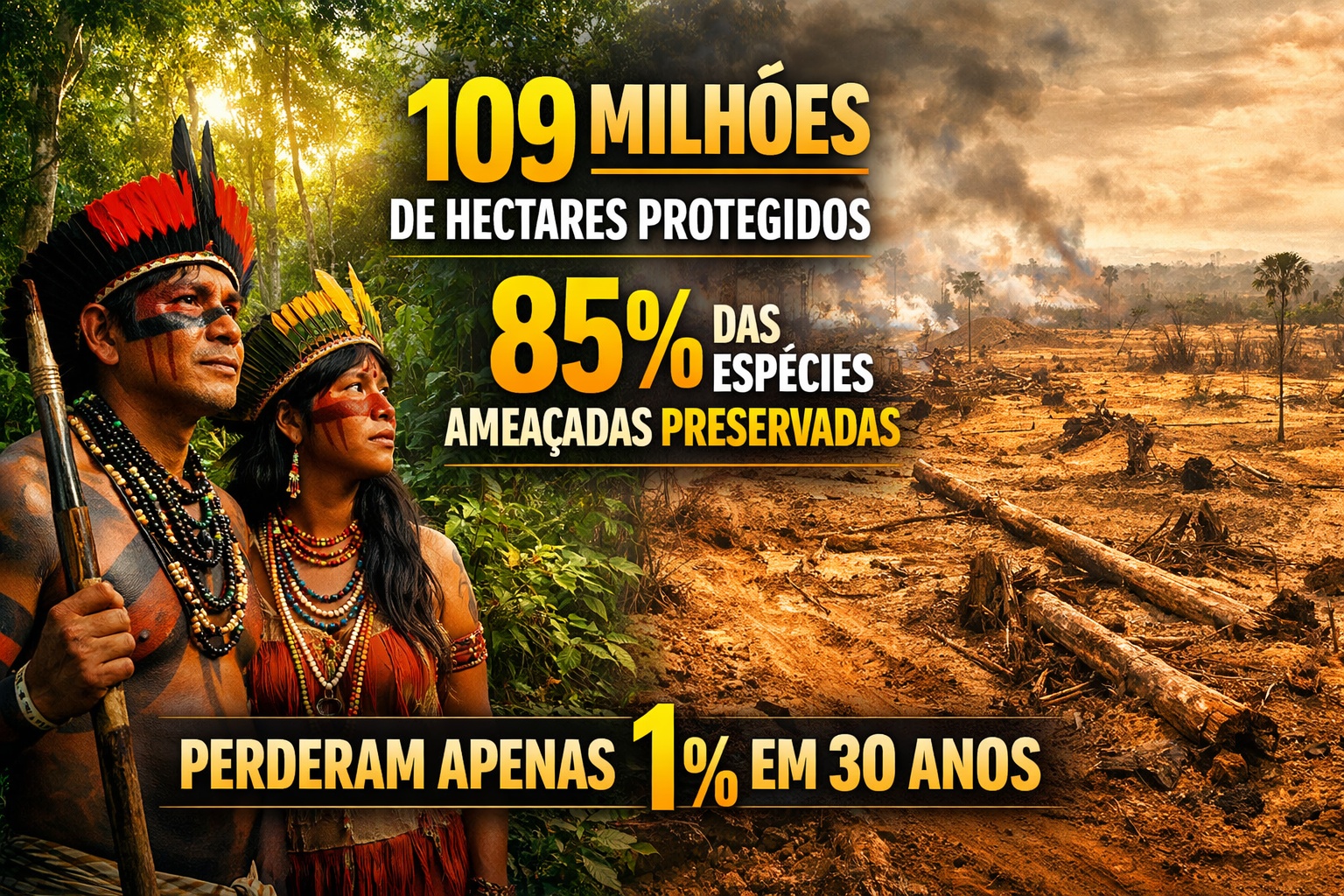
While Brazil lost 69 million hectares of native forest between 1990 and 2020, indigenous territories remained almost intact — with only 1% loss. Now, these same peoples who protected the forest are leading the recovery of degraded areas, planting thousands of seedlings and proving that ancestral knowledge is the key to saving the planet.
Indigenous lands occupy 13.9% of Brazilian territory and contain 109.7 million hectares of native vegetation, corresponding to 19.5% of all native vegetation in Brazil. But the most impressive data is not the size, but the protection capacity. In 30 years, between 1990 and 2020, indigenous lands lost only 1% of their native vegetation area, while private areas lost 20.6%. Of the total 69 million hectares deforested in Brazil during this period, only 1.1 million occurred in indigenous lands. Another 47.2 million hectares were deforested in private areas.
And there’s more: 85.7% of endangered species in Brazil are preserved in indigenous lands.
“Satellite data leave no doubt that it is the indigenous peoples who are halting the destruction of the Amazon rainforest. Without their territories, the forest would certainly be much closer to its tipping point, at which it can no longer provide the environmental services on which our agriculture, industries, and cities depend,” explains Tasso Azevedo, general coordinator of MapBiomas.
-
Friends have been building a small “town” for 30 years to grow old together, with compact houses, a common area, nature surrounding it, and a collective life project designed for friendship, coexistence, and simplicity.

-
This small town in Germany created its own currency 24 years ago, today it circulates millions per year, is accepted in over 300 stores, and the German government allowed all of this to happen under one condition.

-
Curitiba is shrinking and is expected to lose 97,000 residents by 2050, while inland cities in Paraná such as Sarandi, Araucária, and Toledo are experiencing accelerated growth that is changing the entire state’s map.

-
Tourists were poisoned on Everest in a million-dollar fraud scheme involving helicopters that diverted over $19 million and shocked international authorities.


From Xingu to the World: The Story of Raoni
The story of this protection has faces and names. The most emblematic is that of chief Raoni Metuktire, who at 93 continues to be the living symbol of the fight for the Amazon.
Raoni was born in 1932 in the Mebêngôkre village, in Mato Grosso. In 1954, when he was about 24 years old, the Mebêngôkre people established definitive contact with white men. That was when he met the Villas Boas brothers, learned Portuguese, and became aware of the non-indigenous world.
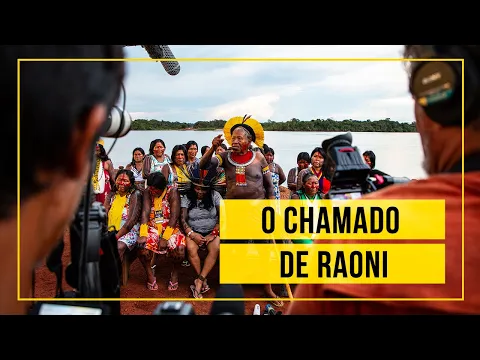

His struggle began early. In March 1984, Raoni led a group of Mẽbêngôkres warriors who blocked the BR-080 highway, took over the ferry crossing the Xingu, and kidnapped FUNAI employees.
The Partnership That Changed Everything
In 1987, British singer Sting visited Xingu and met Raoni. The rocker said: “Alright, Raoni, I understand. But I’m not going to help you with my own money. I will help you run a campaign, and thus we will raise the necessary resources for demarcation.”
The great tour through 17 countries in 1989 resulted in the unlocking of international funds for the demarcation of Brazilian indigenous lands, as well as raising public awareness about the need to protect the Amazon rainforest and its native populations.
As a result, 12 offices of the Rainforest Foundation were created worldwide to raise funds to help create a national park in the Xingu River region, in the Amazon, with an area of about 180,000 square kilometers.
In 1993, an area traditionally occupied by indigenous peoples, located between the states of Mato Grosso and Pará, was demarcated, constituting one of the largest protected tropical forest reserves on the planet.
The Kayapó Territory: A Barrier Against Destruction
Today, the Kayapó people protect 10.6 million hectares across five indigenous territories (Kayapó, Menkragnoti, Baú, Bandjakôre, and Capoto-Jarina), one of the largest stretches of protected tropical forest in the world. About 8,000 indigenous people of the Kayapó ethnicity are responsible for this vast territory.
The conquest was not easy. In 1967, epidemics of flu and measles killed 30% of the Kayapó Mekrãgnotí population. From 1971, the BR-163 highway began to be constructed, cutting through the forest. The Kayapó were in the way.
When the BR-163 was inaugurated in 1976, only 20% of the original population of the Baú Indigenous Land had survived.
But the Kayapó resisted. In 1989, more than 700 indigenous people participated in the great meeting in Altamira to protest against the construction project of a hydroelectric complex on the Xingu River. The project was abandoned at that moment.
The Knowledge of Women in Demarcation
The demarcation of the Menkragnoti Indigenous Land happened because of a woman. Megaron Txucarramãe recalls: “My uncle Raoni went to the Mekrãgnoti Velho village and a woman who had never left there asked him to help demarcate the land.”
Raoni was surprised and wanted to know how that woman, who did not travel and had little or no contact with the outside world, knew what demarcation was, understood the importance of demarcating the land, and made this request.
The answer lies in the deep connection that indigenous peoples have with their territories — especially women, who have historically been the guardians of seeds, planting, and the transmission of knowledge.
From Kayapó to Puyanawa: Restoration Begins
If protection would already be enough to guarantee indigenous leadership in conservation, now these peoples are going further: they are recovering areas that were devastated before the demarcations. In Acre, the Puyanawa people lead the Aliança Reflorestar da Amazônia project.
The Puyanawa Indigenous Land, located in the municipality of Mâncio Lima, in the Juruá Valley, has a total area of 24,500 hectares, home to a population of about 750 people distributed across two villages.
Invaded by rubber tapper colonizers in the early 1900s, this region was actively exploited during the rubber cycle, and the indigenous peoples had their lands expropriated and were forced to work as laborers for latex extraction for decades. The demarcation of the territory only occurred in 2001.
The Pain of Slavery and the Stolen Name
Chief Joel Puyanawa recounts: “We were a people detected here in 1905, and in 1910 was the capture of our ancestors. We were enslaved by Colonel Mâncio Lima until 1950, when he passed away.”
Young Caroline Puyanawa, 24, a student of agroecology, wrote on social media: “It’s obvious that Colonel Mâncio Lima, the same one who, through his miserable cruelty, nearly wiped out my entire people, wouldn’t let our people continue to perpetuate our identity, appearance, and language.”
“My name on my birth certificate is Caroline Lima da Costa, but this ‘Lima’ never belonged to anyone in my family; we have this mark on our name because every Puyanawa born was like an object of ownership of this Colonel.”
Only starting in 2012 did the Puyanawa gain the right to use this name on their birth certificates, and the vast majority of the approximately 750 indigenous people of the ethnicity still haven’t been able to effect the change.
Reforesting What Was Destroyed
Today, the Puyanawa are recovering what was taken from them.
About 5.8% of the TI — 1,500 hectares — lost its original vegetation cover, a portion of land that was already deforested by farmers who exploited the region in the past, before the territory’s demarcation.
In Puyanawa Land, work is being done in an initial area of 9 hectares. Puwe Puyanawa explained that the project’s goal is to produce 30,000 seedlings in this first phase.
The indigenous leader Puwe Puyanawa received digital influencers in July 2023 to showcase the work:
“The idea is to demonstrate to the community what we can do in degraded areas and to make this place a paradise, so that there can be many fruits, medicinal plants, and hardwood, emphasizing our ancestral care for the forest.”
Since the demarcation in 2001, the average deforestation rate in the Puyanawa Indigenous Land has been in the process of reduction. In recent years, the project claims that there have been no new deforestations, “indicating the community’s effort to value the existence of primary forest.”
Yawanawá: 5 Thousand Seedlings in Months
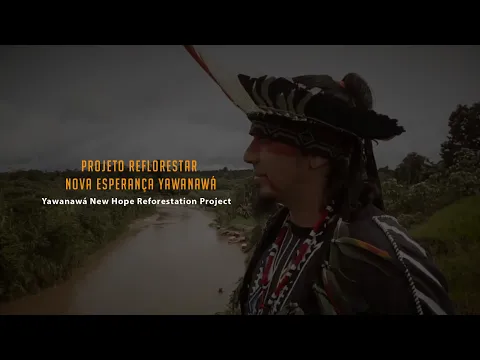
The project has also reached the Yawanawá people in Tarauacá. After months of work, the main stage of the reforestation project in the Nova Esperança Village was completed with the planting of five thousand fruit tree seedlings, in addition to pioneer species and hardwood.
A nursery with a capacity for over 7,000 seedlings and a seedbed were also built on site.
The Yawanawá community also received training in arboriculture for collecting seeds from the tops of trees.
The chief of Nova Esperança Village, Isku Kua, expresses gratitude: “This reforestation project is very valuable. We are very happy to repurpose areas to plant trees that will bear fruit for the children and animals. We are a humble people living here in this forest, but with much respect and love.”
The Recognition of the UN
The model developed by the Puyanawa has drawn international attention. Titled ‘In the Heart of the Amazon, a Development Model that Respects the Forest Takes Root,’ the UN article tells the story of the Puyanawa Indigenous People, who, even after the deforestation affecting the Amazon, have managed to reorganize, resuming traditional cultural practices, as well as agricultural production, while respecting the forest and the environment.
The Puyanawa territory has 93% of its area covered by forests, which represents an important model to be replicated by other communities that can sustainably align the conscious use of the land with economic factors, generating income and forest protection.
Chief José Puyanawa emphasizes: “There is an extra effort, yes, but it is precisely to preserve what is most sacred. If we cut down a forest, it will never recover.”
The Transformation That the World Did Not See
Social entrepreneur Kamila Camilo, creator of the Creators Academy project, observes: “One thing that becomes evident to us is that the forest peoples are not asking for assistentialism. The solutions are there; they are reforesting. Fourteen years ago, the Puyanawa territory was a devastated place, and today we see a rich forest, an abundant ground. We need to strengthen the work they are doing.”
Numbers of Indigenous Restoration
Project Restore Amazon (national): 19 selected projects will recover more than 3,300 hectares in indigenous territories, with 5.7 million trees planted and the generation of 1,420 jobs. R$ 150 million from the Amazon Fund allocated for restoration in up to 137 indigenous lands.
Puyanawa Indigenous Land (Acre):
- Goal to produce 30,000 seedlings in the project’s first phase to recover 1,500 hectares of deforested area
- 35,000 seedlings distributed through the State Fruit Program, including fruit and forest species
Yawanawá Indigenous Land (Acre):
- 5,000 seedlings planted, in addition to a nursery with a capacity for 7,000 seedlings
The Knowledge That Academia Ignored
The Puyanawa indigenous people have technical knowledge about seed collection, seedling nursery structuring, and implementation of agroforestry systems. This ancestral knowledge is not academic recognition but a millenary practice tested by generations.
Recent research has shown that indigenous peoples played a crucial role in the formation of the biodiversity found in South America. Many plants emerged as a result of indigenous techniques for managing the forest, such as Brazil nuts, pupunha, cocoa, babaçu, cassava, and araucaria.
In the case of the Brazil nut and araucaria, these trees were widely distributed by indigenous peoples before the European occupation of the continent.
Agrobiodiversity: The True Farmers
The Upper Rio Negro is a major center of cultivated plant diversity, and the agricultural system of the indigenous peoples in this region was recognized by the National Institute of Historical and Artistic Heritage (Iphan) as a Cultural Heritage of Brazil.
The list of products from this agrobiodiversity is quite extensive: açaí, peanuts, various species of potatoes and peppers, as well as a large quantity of corn and bean seeds, to name a few.
What Scientific Data Prove
A 2021 study released by the Food and Agriculture Organization (FAO) and the Fund for the Development of Indigenous Peoples of Latin America and the Caribbean (Filac) indicates that deforestation rates are lower in regularized indigenous lands.
According to the survey, titled collective territories avoided between 42.8 million and 59.7 million metric tons of carbon dioxide (CO2) emissions each year in Brazil, Bolivia, and Colombia, an amount equivalent to removing between 9 million and 12.6 million vehicles from circulation for a year.
The Difference is Striking
While Brazil as a whole faces severe environmental crisis, indigenous territories prove that another path is possible:
GENERAL BRAZIL:
- Between 1985 and 2022, there was a loss of 96 million hectares of native vegetation, an area equivalent to 2.5 times Germany
- The proportion of native vegetation fell from 75% to 64%
INDIGENOUS LANDS:
- Between 1985 and 2023, TIs lost only 1% of their native vegetation, while private lands lost 28%
- From 1985 to 2022, indigenous lands lost less than 1% of their vegetation area, while in private territories this rate was 17%
Raoni’s Warning at 90
In July 2023, at 90 years old, Raoni summoned 700 people for a meeting in Alto Xingu: “If we do not take care of our land and our forests, if we allow everything to be deforested, everyone will suffer from climate change, intense heat, and air pollution.”
“I’ve been alerting the world for a long time, but we need to keep alerting all of you. And that’s why I call upon all of you, leaders and authorities, to together commit to defending the Earth.”
The Speech That Sums It All Up
The Minister of Indigenous Peoples, Sonia Guajajara, highlighted in a recent speech to international leaders: “If 82% of the planet’s biodiversity is under the guardianship of indigenous peoples worldwide, it is urgent to protect the rights of these peoples. If the rights of indigenous peoples in the world, their ways of life, are threatened, all this biodiversity is threatened. If this biodiversity is threatened, then all of humanity is at risk.”
Why This Matters to You
Indigenous peoples are not only protecting their lands; they are protecting the future of humanity.
Every hectare of standing forest regulates the climate, stores carbon, produces rain, protects springs, and harbors species that may contain cures for still-unknown diseases.
When the Kayapó protect 10.6 million hectares, when the Puyanawa replant 30,000 seedlings, when Raoni travels the world at 93 asking for help, they are saving not just the Amazon.
They are saving the entire planet. And they do this without depending on governments, without waiting for public policies, without needing authorization. They do it because this is their ancestral mission. Because the forest is not a resource; it is home, it is sacred, it is life.
INDIGENOUS LANDS IN NUMBERS
- 109.7 million hectares protected (13.9% of the national territory)
- 19.5% of all native vegetation in Brazil is in TIs
- 1% loss of vegetation in 30 years (vs. 20.6% in private areas)
- 85.7% of endangered species are preserved in TIs
- 42.8 to 59.7 million tons of CO2 avoided annually
- Equivalent to removing 9 to 12.6 million vehicles from circulation per year
RESTORATION PROJECTS
- 137 indigenous lands will receive resources from the Amazon Fund
- R$ 150 million allocated for restoration
- 5.7 million trees will be planted
- 1,420 jobs generated by the projects
- 30,000 seedlings target for the Puyanawa in the first phase
- 5,000 seedlings already planted by the Yawanawá










Seja o primeiro a reagir!